

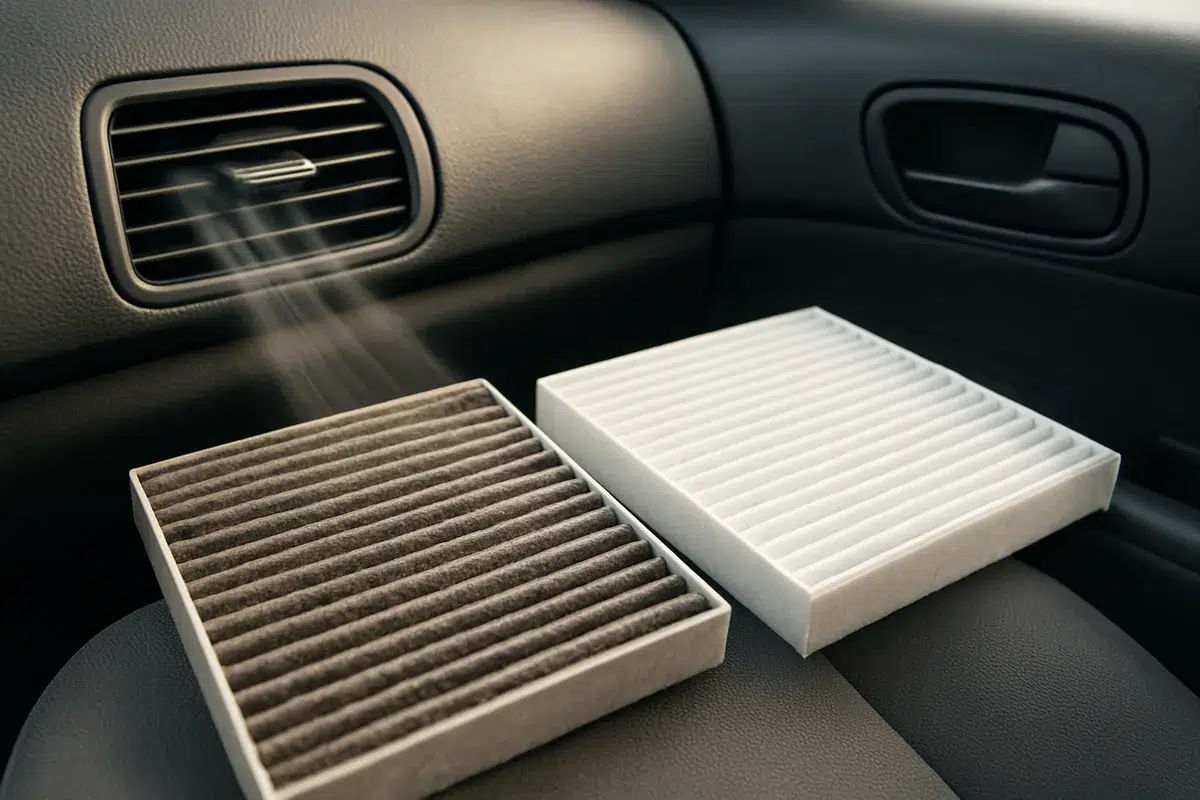
At a Glance
| What it is | Mold and bacteria on the damp evaporator behind the dash |
| #1 cause | An evaporator that never dries out between drives |
| Fast confirm | Smell is strongest in the first seconds after switching the AC on |
| The fix | New cabin filter, clean the evaporator, dry it, clear the drain |
| The prevention | AC off, fan on, for the last few minutes before you park |
| Safe to drive? | Yes. Musty is a comfort problem, not a mechanical one. |
The smell that hits you in the first few seconds of switching on the AC and then fades is not coming from the vents themselves. It is coming from something living a few inches behind them, in the one part of your car that is permanently cold and wet whenever the air conditioning runs.
This page explains that mechanism, ranks the causes, gives the full cleaning sequence, and then covers the habit that stops the smell returning, which most articles mention in passing if at all. For the rest of the system, see the complete car AC and climate guide.
Cabin filter replacement intervals and filter locations differ by vehicle, so check your owner’s manual for yours. Use any evaporator cleaner strictly according to its own directions. This page names product categories generically and recommends no brand.
Table of Contents
Why does my car AC smell musty or moldy?
A musty AC smell means mold and bacteria are growing on your evaporator. The evaporator is a small radiator-like panel inside the dashboard that gets very cold when the AC runs, and cold surfaces pull moisture out of the air passing over them. That is how air conditioning dehumidifies a car, and it is also why the evaporator sits wet in a dark enclosed space.
Mold needs exactly two things, and a wet evaporator supplies both. The EPA puts the rule simply: mold begins growing when spores land on surfaces that are wet, and none of it will grow without water or moisture. Spores are already in the air your car breathes in. The dampness is what turns them into a colony.
The smell is strongest at start-up because the growth has been sitting undisturbed while the car was parked. Switch the fan on and the first rush of air carries the accumulated odour into the cabin, then dilutes as it clears. That timing pattern is the single best confirmation that the evaporator, not the interior, is the source.
Most common causes, ranked
Four things produce or worsen a musty AC smell, and they compound rather than compete. Most cars with this problem have at least two of them, which is why a single fix often disappoints and the full sequence works. The list below runs most likely to least, with the confirm for each.
| Cause | How to confirm it | The fix |
|---|---|---|
| Mold on the evaporator (most common) | Smell peaks in the first seconds of AC use, then fades | Clean and, more importantly, dry the evaporator |
| A dirty or damp cabin air filter | Pull the filter and look. Grey, matted or leaf-filled means overdue | Replace it, do not attempt to clean it |
| A clogged AC condensate drain | No puddle under the car after running the AC, or damp passenger carpet | Clear the drain tube so water leaves instead of pooling |
| Always running on recirculate | The recirculate button has been on for months | Use fresh air regularly so the system exchanges cabin humidity |
The drain deserves more attention than it usually gets. Your AC produces a steady trickle of condensate that is supposed to leave through a tube under the car, which is why a normal air-conditioned car drips water on a hot day. Block that tube with leaves or debris and the water backs up around the evaporator instead. The EPA’s household mold guidance makes the same point about air conditioning generally, advising that drip pans be kept clean and drain lines unobstructed and flowing.
Recirculate mode has a similar effect through a different route. Recirculating the same cabin air over and over keeps humidity inside the system rather than exchanging it, so the evaporator stays wetter for longer. Recirculate is genuinely useful for cooling quickly or driving through traffic fumes. It is a bad permanent setting.
How to get rid of the musty AC smell
Clearing the smell takes four steps, and skipping the drying step is why the problem so often returns within weeks. Work through them in order, with the windows open, and expect the whole job to take under an hour on most cars.
- Replace the cabin air filter. Most cabin filters sit behind the glove box or near the base of the windshield, and AAA notes that most can be replaced in under 15 minutes without tools, with factory intervals typically between 15,000 and 30,000 miles. Replace it rather than cleaning it, because a damp filter is itself growing the thing you are trying to remove.
- Run an evaporator cleaner through the fresh air intake. Set the fan running on fresh air, not recirculate, and apply an aerosol evaporator cleaner or HVAC disinfectant into the intake at the base of the windshield, following the directions on the can. The airflow carries it back across the evaporator, which you cannot reach directly.
- Dry the evaporator. Switch the AC compressor off, leave the fan on high, and run it for five to ten minutes with the windows down. This is the step that actually removes the moisture, and the cleaner alone will not do it.
- Check the AC drain is flowing. Run the AC for ten minutes on a warm day, then look under the front of the car for a small puddle of clear water. No puddle suggests a blocked drain tube, which you can usually find by feel behind a front wheel arch and clear gently from beside the car.
Caution: ventilate the car throughout. The EPA advises always ventilating and exhausting to the outdoors when using disinfectants or biocides, and warns never to mix chlorine bleach with cleaners containing ammonia, because the combination produces toxic fumes. Keep the doors or windows open, and do not sit in the car while the cleaner circulates.
One expectation worth setting: killing the mold is not the same as removing it. The EPA notes that dead mold can still cause allergic reactions in sensitive people, which is the reason the filter gets replaced rather than sprayed, and the reason a smell that improves but lingers usually means there is still growth on the evaporator itself. Hand it to a shop if the smell survives two full rounds of this, since a technician can access and treat the evaporator directly.
How to stop the smell coming back
Dry the evaporator before you park, every time, and mold cannot re-establish. Switch the AC compressor off but leave the fan running for the last two to five minutes of your drive. The fan keeps pushing air across the evaporator while it warms back up, which dries it instead of leaving it wet in a dark box for the next twelve hours.
This works because it attacks the only variable that matters. Spores are unavoidable, warmth is unavoidable, darkness is unavoidable. Moisture is the one input you control, and the EPA’s guidance on drying damp surfaces within 24 to 48 hours to prevent growth is exactly the principle applied to a car.
Two habits support it. Use fresh air rather than permanent recirculate so cabin humidity leaves the system, and replace the cabin filter on your manual’s schedule rather than waiting for a smell. Run the AC occasionally in winter too, since systems that sit unused for months tend to come back smelling worse than ones in regular use.
Is a musty AC smell harmful?
A musty AC smell is not a driving hazard and does not mean your car is unsafe, but it is worth clearing rather than tolerating. The honest health picture is that mold affects people differently. The CDC states that for some people mold can cause a stuffy nose, sore throat, coughing or wheezing, burning eyes, or skin rash, and that people with asthma or a mold allergy may have severe reactions.
A new cabin filter helps but does not solve this on its own. AAA notes that standard cabin filters are around 98 percent efficient in the 5 to 100 micron range, while smaller particles including mold and spores can still pass through. That is another argument for removing the source rather than filtering downstream of it.
Caution: a musty smell is the harmless one. Change your plans if what you smell is sweet and syrupy, like gasoline, or like exhaust. A sweet smell with a fogged windscreen or damp footwell points at coolant leaking from the heater core, covered in a car that smells sweet like coolant. A fuel smell in the cabin is covered in why you smell gas in your car, and either deserves attention today rather than this weekend.
Two neighbouring smells are worth separating too, since both are often the same evaporator with a different description attached. A sharp ammonia smell is dealt with in why a car AC smells like pee, and a sour, acidic version in why a car smells like vinegar. The full range is indexed in the car smells guide.
Frequently asked questions
How do I get the mold smell out of my car AC?
Replace the cabin air filter, spray an evaporator cleaner into the fresh air intake at the base of the windshield with the fan running, then dry the evaporator by running the fan with the AC switched off. Clearing the condensate drain and airing the car out speeds up the result.
Why does my AC smell only when I first turn it on?
The smell peaks at start-up because mold and moisture built up on the evaporator while the car sat parked, and the first rush of air pushes that accumulated odour into the cabin before it dilutes. Drying the evaporator before parking reduces it substantially.
Can a dirty cabin air filter cause a musty smell?
A dirty cabin air filter absolutely contributes, because a clogged, damp filter traps debris and moisture that grow mold of their own. Replacing it is cheap, usually takes under 15 minutes, and is the sensible first step even when the evaporator is the main source.
How do I stop my car AC from smelling again?
Switch the AC off but leave the fan running for the last few minutes before parking, so the evaporator dries instead of sitting wet. Use fresh air rather than permanent recirculate, and replace the cabin filter on schedule. A dry evaporator cannot grow mold.
What to do now
Replace the cabin air filter first, since it is cheap and takes minutes, then run an evaporator cleaner through the intake at the base of the windshield with the windows open. Dry the evaporator afterwards by running the fan with the AC off, because cleaning without drying just resets the clock. Check for the puddle of clear water under the car that tells you the condensate drain is flowing. Then make the habit permanent: AC off, fan on, for the last few minutes of every drive. Safe to drive: yes, a musty smell is a comfort problem rather than a mechanical one. A sweet, fuel or exhaust smell is a different problem that needs attention now.
For cooling problems, heater faults and the rest of the climate system, see the complete car AC and climate guide, or browse the wider automotive care and repair section.
