

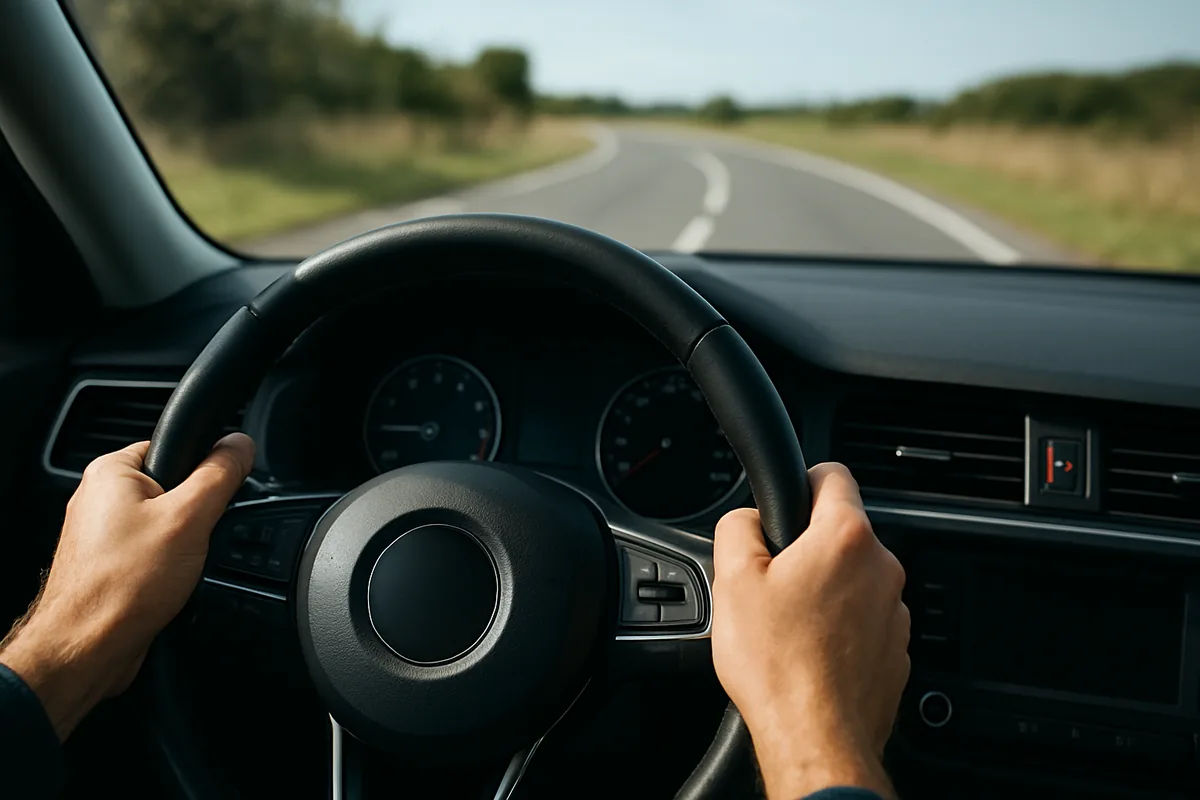
| What it is | The car drifts or tugs toward one side while you hold the steering wheel straight |
| #1 cause | Uneven tire pressure, which is also the cheapest fix |
| Safe to drive? | Mild, steady pull: drive carefully to a shop. Sudden strong pull, loose steering, or a hot wheel: pull over now |
| The key clue | Pulls all the time points to tires or alignment; pulls only when braking points to a brake |
| Fast test | Set all four tires to the door-placard pressure, then drive the same road again |
| Typical cost | Free for air, about $100 to $275 for an alignment, more for brake or steering parts (varies by vehicle) |
A pull to one side makes you hold steady pressure on the wheel just to go straight, and the cause is usually cheaper than drivers fear. Most pulls start at the tires, so this guide ranks the causes cheapest first, shows how to confirm each one, and gives repair costs and the point where a shop takes over. For other driving symptoms, start with our car troubleshooting guide.
Repair costs below are broad national ranges that vary by vehicle, region, and shop, so get a local quote. Tire pressures and alignment specs are vehicle-specific: use your door placard and owner’s manual.
Table of Contents
Is it safe to drive when your car pulls to one side?
A car that pulls gently and steadily to one side is usually safe to drive carefully to a tire or alignment shop. A car that pulls suddenly or hard, feels loose in the steering, or has one wheel smoking or giving off a hot burning smell is not. Pull over somewhere safe and have it inspected before driving further, because those signs point to a brake or steering fault.
Even a mild pull deserves attention within days, not months. Holding the wheel against a pull is tiring on a long drive, and a pull that comes from a dragging brake or a worn steering part tends to get worse. A pull that appears only when you press the brake pedal is a brake problem, so book a brake inspection soon rather than waiting for your next service.
Caution: never touch a wheel or brake to check it for heat after driving. Brake parts can be hot enough to burn skin. Hold the back of your hand a few inches from the center of each wheel instead and compare the two sides.
When does your car pull, and what does that tell you?
The timing of a pull is the fastest way to narrow down the cause. A car that pulls all the time at a steady speed usually has a tire pressure, tire, or alignment problem. A car that pulls only when braking has one brake grabbing harder than the other. A tug only under hard acceleration on a front-wheel-drive car is torque steer, and a gentle drift to the right can be the road itself.
| When it pulls | Most likely cause | What to do next |
|---|---|---|
| All the time, at a steady speed | Uneven tire pressure, a mismatched or faulty tire, or alignment out of spec | Check pressure first, then swap the front tires, then get an alignment check |
| Only when braking | A sticking caliper, a collapsed brake hose, or contaminated or uneven pads | Brake inspection within days |
| All the time, and one wheel runs hot | A brake dragging even with your foot off the pedal | Pull over and have it inspected before driving on |
| Only on hard acceleration (front-wheel drive) | Torque steer, worn engine mounts, or a worn CV axle | Shop check if the tug is new or getting stronger |
| Changes over bumps, or comes with a clunk or loose steering | Worn tie rod ends, ball joints, or control arm bushings | Steering and suspension inspection now |
| A gentle drift to the right only | Road crown, the drainage slope built into the road | Test on a flat surface; often normal |
Note two things on your next drive: whether the pull is there with your feet off both pedals, and whether pressing the brake makes it stronger. Those two answers decide whether you start with a tire gauge or at a brake shop.
What are the most common causes of a car pulling to one side?
There are 6 common causes of a car pulling to one side. They are uneven tire pressure, a mismatched or faulty tire, wheel alignment out of spec, a dragging or grabbing brake, worn steering or suspension parts, and torque steer. The list runs from the cheapest and most common cause to the least common, so work through it in order and rule out the free checks first.
| Cause | The tell | How to confirm | Typical cost (verify locally) |
|---|---|---|---|
| 1. Uneven tire pressure | Pulls toward the low tire | Tire gauge, tires cold, compared with the door placard | Free, or the cost of air |
| 2. Mismatched or faulty tire | Pull started with new tires, or changes side after a tire swap | Swap the front tires left to right | Low labor for the swap; a new tire varies widely |
| 3. Alignment out of spec | Constant pull, off-center steering wheel, edge wear | Alignment check with a before-and-after printout | About $100 to $275 |
| 4. Dragging or grabbing brake | Pull when braking, a hot wheel, a burning smell | Compare wheel heat; brake inspection | About $204 for a hose up to about $970 for a caliper |
| 5. Worn steering or suspension parts | Clunk, loose steering, wandering | Shop checks for play with the wheel raised | $150 to over $1,000 |
| 6. Torque steer or a worn axle | Tug only under hard acceleration | Compare gentle and firm acceleration | Nothing if normal; varies if mounts or an axle are worn |
Uneven tire pressure
Uneven tire pressure is the most common and cheapest cause of a pull. A tire running lower than its partner on the same axle has more rolling resistance, so the car drifts toward the low side. One tire that is noticeably low can be enough, and it is easy to miss by eye.
Check all four tires with a tire gauge before you drive. NHTSA’s tire guidance says the correct pressure is the one on the Tire and Loading Information label on the driver’s door edge or in the owner’s manual, not the figure printed on the tire. NHTSA defines cold tires as tires on a car that has not been driven for at least three hours, and recommends checking all tires at least once a month.
Inflate each tire to the placard figure, drive the same stretch of road again, and see whether the pull is gone. If one tire keeps losing air, the pull will come back, and the slow leak is the real problem to fix. Our guide to the correct tire pressure for your car explains how to read the placard.
A mismatched, worn, or faulty tire
A tire can pull a car even at the correct pressure. Mismatched tires on the same axle, a big difference in tread depth from side to side, or a defect inside a new tire can steer the car gently toward one side. A tire with that built-in pull is often described as having radial pull, and it usually shows up right after new tires go on.
The classic test is to swap the two front tires left to right. If the pull switches direction, a tire is the cause. If the pull stays the same, the tires are cleared, and alignment or brakes move up the list. Check the tread across each front tire too, since our guide on how to check tire tread depth shows how to spot one side wearing faster.
Caution: swapping wheels means lifting the car. Use the jack on firm, level ground with the parking brake set, never put any part of your body under a car held up only by a jack, and tighten the lug nuts to the torque in your owner’s manual. Directional tires cannot be swapped side to side without remounting them on the wheels, so leave the test to a tire shop on those, or on any car you are not comfortable lifting.
If the pull started with a new set, take the car back to the seller and ask them to check it. A car running two different tire models on one axle can pull as well, which our guide on whether you can have different tires on your car covers.
Wheel alignment out of spec
Wheel alignment is the likely cause when the tires check out and the car still pulls at a steady speed. Hitting a pothole or a curb can shift or bend steering and suspension parts enough to knock the wheel angles, mainly camber and toe, out of the manufacturer’s range. Once one wheel points slightly off straight, the car drifts that way.
AAA’s alignment guidance lists three main signs: the car pulling heavily to one side, a steering wheel that is not centered when you drive straight, and uneven or fast wear on the inner or outer edges of the tires. AAA recommends checking alignment at least once a year, and after new tires or a hard hit. Edge wear is also one reason new tires wear out fast.
Alignment is a shop job. The specs are vehicle-specific and need an alignment machine to measure and set. Expect about $100 to $275 for a four-wheel alignment, depending on the vehicle and shop. Ask for the before-and-after printout, which should show every angle back inside the manufacturer’s range. Have a shop replace any bent or worn part first if the alignment cannot be brought into spec, because an alignment will not hold on a loose part.
A dragging or grabbing brake
A brake problem is the cause when the pull appears or gets stronger as you press the brake pedal. One front brake is gripping harder, or releasing more slowly, than the other. The usual culprits are a sticking caliper or seized slide pins, a brake hose that has collapsed inside so fluid cannot flow back, and pads contaminated with grease or brake fluid.
A brake that drags all the time, even with your foot off the pedal, also makes the car pull and overheats that wheel. The signs are one wheel much hotter than the other after a short drive, heavy brake dust on one wheel, and a hot, sharp smell. Overheated brakes are a common source of a burning rubber smell from a car. A pedal that also feels spongy needs the checks in our soft brake pedal guide, and a pull that comes with a vibrating pedal points to the causes in why a car shakes when braking.
Leave brake repair to a mechanic. Typical national averages run about $335 to $394 for brake pads, $204 to $266 for a brake hose, and about $898 to $968 for caliper replacement, all varying by vehicle and shop. Pull over and let the car cool if a wheel is smoking or the smell is strong, because overheated brakes lose stopping power. Have the car towed if the pull or the heat comes straight back once you drive on.
Worn steering or suspension parts
Worn steering and suspension parts let a wheel change its angle as you drive, which shows up as a pull, a wander, or a pull that shifts over bumps. Most of these faults come with a second clue, such as a clunk, play in the steering wheel, or a hum that rises with speed. The common parts are listed below.
- Tie rod ends: loose or vague steering, wandering, and wear on the tire edges.
- Ball joints: a clunk over bumps and play when the wheel is rocked.
- Control arm bushings: a drift that changes under braking or over bumps, with a dull clunk.
- Wheel bearings: a hum or growl that rises with road speed, sometimes with play in the wheel.
This is a job for a pro. Tie rods and ball joints connect the wheels to the steering and suspension, so a worn one is a genuine safety problem, and loose steering means stop driving and get the car inspected. AAA puts suspension repairs at anywhere from $150 to well over $1,000, and wheel bearing replacement averages about $346 to $504. Most of these repairs need an alignment afterward. A clunk alongside the pull points straight at these parts, and our guide to a clunking noise over bumps goes deeper, as does our overview of common steering problems and their warning signs.
Torque steer or a worn axle
Torque steer is a tug toward one side under hard acceleration, and it mainly affects front-wheel-drive cars. Drive axles of unequal length and the engine’s twisting force pull the steering slightly as power goes down, which is a normal design trait on many cars. A tug that is new, getting stronger, or comes with a clunk can mean worn engine mounts or a worn CV axle.
Confirm it on a safe, empty road by accelerating gently and then firmly. If the car tracks straight when coasting and tugs only under firm throttle, the pull is torque related, and normal torque steer needs no repair. Have a shop inspect the mounts and axles if the tug has changed, because a broken engine mount or a failing CV joint gets worse over time.
Is it just the road crown?
A gentle, steady drift to the right on an ordinary road can be completely normal. Roads are built with a crown, a slope from the center toward the edge that sheds rainwater, and a car left alone rolls slightly downhill toward the shoulder. If the drift is mild, only ever to the right, and disappears on a flat surface, the road is the cause, not the car.
Road design standards treat this slope as routine. The Texas DOT roadway design manual recommends a pavement cross slope of 2 percent for usual conditions, and no less than 1 percent, to keep water from ponding. On a right-sloping lane that reads as a faint rightward drift.
Test it in a flat, empty parking lot at low speed. If the car rolls straight there, you are feeling the road. A drift that is stronger than it used to be, or a pull to the left, still deserves a tire pressure check and an alignment check.
How do I figure out which cause it is?
You can narrow a pull to one cause in 6 steps, starting with the free checks and leaving the paid diagnosis for last. Do the tire checks with the car parked on level ground, the engine off, and the parking brake set. Do the driving checks only on a quiet, straight road where you can hold the wheel safely.
- Set the tire pressures. Check all four tires cold and set them to the door-placard figure.
- Drive the same road and note the timing. Keep both hands on the wheel, lighten your grip at a steady speed, and notice whether the car drifts with your feet off both pedals.
- Test the brakes gently. Brake smoothly from a moderate speed and notice whether the pull starts or gets stronger.
- Check the wheels for heat. After a short drive, hold your hand a few inches from each front wheel, without touching, and compare the sides.
- Look at the tread. Check each front tire for wear on the inner or outer edge.
- Swap the front tires. If the pull is still there, have the front tires swapped side to side and drive again.
Hand the car to a shop once the free checks come up empty or point to brakes, alignment, or steering. A shop can raise the car, check each wheel for play, measure the alignment, and inspect the brakes in one visit. When choosing one, look for a technician with ASE certification, which requires at least 2 years of work experience and a retest every 5 years.
Why does my car still pull after new tires or an alignment?
A car that pulls right after new tires or an alignment usually has one of 3 problems. They are a new tire with radial pull, an alignment set while a worn part was still loose, or a brake fault that an alignment cannot fix. Go back to the shop that did the work first and ask them to recheck it, since they have the records of what was done.
Ask the shop to confirm the tire pressures, then swap the front tires side to side. A pull that changes direction after the swap points to the tire, not the alignment. Ask to see the alignment printout as well. All the angles should sit inside the manufacturer’s range, and a shop that could not bring an angle into range should tell you which part is worn or bent. If the pull only happens when you brake, the alignment was never the problem, and the brakes need inspecting.
How much does it cost to fix a car that pulls to one side?
Fixing a car that pulls to one side costs anywhere from nothing to over $1,000, depending on the cause. Setting tire pressure is free or costs a little for air, a four-wheel alignment typically runs about $100 to $275, and brake or steering repairs cost more. Every figure below is a broad national range that varies by vehicle, region, and shop, so get a local quote.
| Repair | Typical range (verify locally) | What drives the price |
|---|---|---|
| Setting tire pressure | Free, or the cost of air | Nothing |
| Front tire swap or rotation | Low labor charge; ask your tire shop | Shop labor rates, directional tires that need remounting |
| Four-wheel alignment | About $100 to $275 | Vehicle, shop, and any adjustment parts needed |
| Brake pad replacement | About $335 to $394 | Pads only or pads and rotors |
| Brake hose replacement | About $204 to $266 | Number of hoses, plus bleeding the brakes |
| Brake caliper replacement | About $898 to $968 | One side or both, and the vehicle |
| Wheel bearing replacement | About $346 to $504 | Pressed-in bearing or a bolt-on hub assembly |
| Tie rod ends, ball joints, or bushings | $150 to over $1,000 | Which parts, plus an alignment afterward |
| Replacement tire | Varies widely | Size, type, and whether a matching pair is needed |
Steering and suspension repairs usually need an alignment afterward, so add that to any tie rod or ball joint quote. Fixing the cheap causes first matters for the same reason: an alignment done on underinflated tires, or on a car with a dragging brake, does not cure the pull.
Frequently asked questions
Is it safe to drive if my car pulls to one side?
A mild, steady pull is usually safe to drive carefully to a shop, but it should be checked within days. A sudden or strong pull, loose steering, or a hot or smoking wheel can mean a brake or steering fault, so pull over safely and have the car inspected before driving any further.
Why does my car pull to one side when braking?
A car that pulls only when braking has one front brake gripping harder than the other. The usual causes are a sticking caliper, seized slide pins, a collapsed brake hose, or contaminated pads. Brake faults get worse rather than better, so have the brakes inspected within days, and sooner if a wheel runs hot.
Can low tire pressure make a car pull?
Yes, low tire pressure on one side makes a car pull toward the low tire because that tire drags more. Check all four tires cold against the pressure on the driver’s door placard and equalize them. Uneven pressure is the cheapest and most common cause of a pull, so check it before anything else.
Why does my car pull to the right?
A gentle pull to the right is often road crown, the slight slope built into roads so rain drains to the edge. A car that pulls right on a flat surface, pulls hard, or also pulls left has a real fault, usually tire pressure, a tire, the alignment, or a dragging brake.
Why does my car pull after getting new tires?
A car that pulls after new tires usually has a tire with a built-in pull, called radial pull, or tires set to the wrong pressure. Ask the shop to check the pressures and swap the front tires side to side. If the pull switches direction, a tire is the cause, and the shop should deal with it.
What to do now
Start with the free check: set all four tires to the door-placard pressure while they are cold, then drive the same road and note when the car pulls. A pull all the time points to tires or alignment, a pull when braking points to a brake, and a gentle rightward drift may just be the road. Book an alignment or a brake and steering inspection based on what you find.
A mild, steady pull is usually safe to drive carefully to a shop, but a sudden strong pull, loose steering, or a hot or smoking wheel means pull over and get it checked now. For more brake and steering problems, browse our brakes and steering guides, and for every other symptom see the complete car troubleshooting guide and our complete automotive care hub.
