

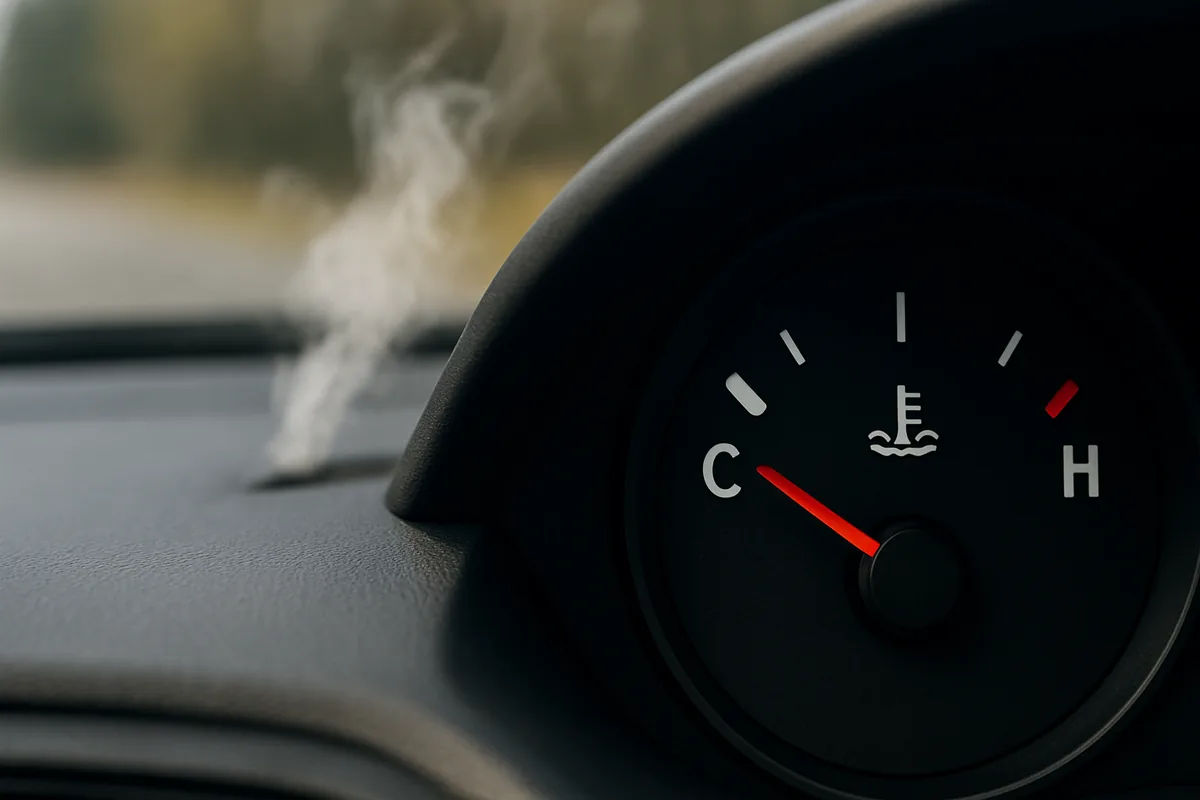
At a Glance
| Safe to drive? | No. Pull over and switch off as soon as it is safe. |
| Do this first | Turn the AC off, the heater on full, then pull over |
| Never | Open a hot radiator or coolant cap; it can scald you |
| Most common cause | Low coolant or a coolant leak |
| Overheats only in traffic? | Usually a failed radiator fan |
An overheating engine is a genuine emergency, not a wait-and-see problem. Once the gauge climbs into the red or steam appears, continued driving can warp the cylinder head, blow the head gasket, or crack the engine block in a matter of minutes, turning a cheap fix into a repair that can cost more than the car. This guide gives you the do-this-now steps first, then the ranked causes, how to confirm each, and what repairs cost.
The temperatures and pressures in a cooling system are make-specific, so this page works from your gauge and owner’s manual rather than quoting a “safe” number. Costs are broad ranges to confirm locally.
Table of Contents
What to do right now, in order
When the car is overheating, act in this order. The goal is to get heat out of the engine and get stopped before damage sets in.
- Turn off the AC and turn the heater on full. This sounds backwards, but per AAA, turning off the air conditioning and running the heater on maximum pulls heat off the engine and into the cabin, which can buy you time. It will be uncomfortable for a few minutes, and that is a fair trade for the engine.
- Pull over safely and switch the engine off. As soon as you can stop safely, get off the road and turn the engine off to stop making heat.
- Do not open the hood if there is steam. Let the steam clear and the engine cool before you raise the hood, so you are not standing over escaping steam.
- Never open a hot radiator or coolant cap. The cooling system is pressurized, and a hot cap can spray scalding coolant and steam. Wait for everything to cool first.
- Let it cool at least 15 to 20 minutes. Give the engine and coolant time to come down before you touch anything under the hood, and longer is safer.
- Check the coolant once cool, then decide. If the coolant is low, that points to a leak. If the car overheats again or the coolant is empty, do not drive it. Call for a tow.
Caution: do not try to nurse an overheating car home. Even a short distance can be enough to cause major damage once the engine is truly overheating. If steam is pouring out or you see any sign of fire, get yourself and your passengers well away from the car and call for help. Steam from the hood is covered further in our guide to why your car is smoking from the hood.
Is it safe to keep driving if my car is overheating?
No, it is not safe to keep driving an overheating car. Driving on an engine that is truly overheating risks warping the cylinder head, blowing the head gasket, or cracking the block, and those repairs can cost more than the vehicle is worth. Even a short distance can do the damage once the temperature gauge is in the red. The engine going into limp mode or losing power is a sign it is already protecting itself, and a related shutdown is covered in whether low oil can cause a car to shut off.
The rule is simple: a red gauge or steam means stop, not slow down. Pulling over and waiting for a tow is always cheaper than the engine repair you risk by pressing on.
What causes a car to overheat?
A car overheats when the cooling system cannot move heat away from the engine fast enough, and the causes run from a cheap coolant leak to a failed head gasket. Ranked from most to least common, the usual culprits are low coolant, a stuck thermostat, a failed water pump, a bad radiator fan, a clogged radiator, and a blown head gasket. The table below gives the confirming sign for each.
| Cause | How to confirm | Fix | Typical cost (varies) |
|---|---|---|---|
| Low coolant or a leak (most common) | Low reservoir once cool; puddles or residue underneath | Refill and repair the leak | $20 hose to several hundred |
| Stuck thermostat (closed) | Overheats fast even with full coolant | Replace the thermostat | $150 to $400 |
| Failed water pump | Coolant not circulating; whine or leak at the pump | Replace the pump | $400 to $900 |
| Bad radiator fan | Overheats in traffic or at idle, fine on the highway | Replace the fan or relay | $300 to $700 |
| Clogged radiator | Runs hot under load; old, dirty coolant | Flush or replace the radiator | $300 to $1,200 |
| Blown head gasket | White sweet exhaust smoke, milky oil, bubbling reservoir | Major repair | $1,000 to $3,000+ |
Low coolant or a coolant leak (most common)
The most common reason a car overheats is simply not enough coolant, usually from a leak at a hose, the radiator, the water pump, or a failing head gasket. Confirm it only once the engine is cool: check the level in the coolant reservoir and look under the car for puddles or dried residue. Top up with the coolant type specified in your owner’s manual, usually a 50-50 coolant-and-water mix, and watch whether it drops again.
According to AAA, you should wait until everything has cooled before removing a cap to check, or you risk spraying boiling coolant. A leak that keeps emptying the system is a shop job, because it will overheat again fast no matter how many times you refill it. If the coolant is disappearing with no puddle to show for it, our guide to why your car is going through coolant so fast covers where it goes.
Thermostat, water pump, radiator fan, or radiator
When the coolant is full but the car still overheats, the problem is circulation or airflow rather than level. Four mechanical faults account for most of these, and when the overheating happens tells you a lot about which one it is.
A stuck-closed thermostat blocks coolant from reaching the radiator, so the engine overheats quickly and consistently, even with a full system. A failed water pump stops circulating the coolant at all, sometimes with a whine or a leak at the pump. A dead radiator fan is the classic “overheats in traffic but not on the highway” fault, because at highway speed air flows through the radiator on its own, while stop-and-go driving depends on the fan. A clogged radiator, often from old coolant, cannot shed heat under load. The idle-versus-highway pattern is the fastest way to narrow it down, and overheating specifically at a standstill is covered in why your car overheats when idle.
All four are shop repairs, and most involve hot, pressurized components or a spinning belt and fan, so this is where a normal owner hands off to a mechanic.
Blown head gasket (the serious one)
A blown head gasket is the cause you least want, because it both results from overheating and causes more of it. Its tells are distinctive: white, sweet-smelling smoke from the exhaust, coolant disappearing with no external leak, bubbles in the coolant reservoir, or a milky, mayonnaise-like film on the underside of the oil cap. Any of these alongside overheating points to combustion gases and coolant mixing where they should not.
A head gasket is a major professional repair, and driving on a blown one makes it worse quickly, so stop and get it diagnosed rather than pressing on. The white-smoke tell is covered in our guide to white smoke from the exhaust, and the sweet coolant smell in why your car smells like coolant or maple syrup.
Is the gauge real, or a false alarm?
A temperature gauge reading high with no steam, no smell, and normal power can occasionally be a faulty coolant temperature sensor or gauge rather than true overheating. That said, treat every red gauge as real until you have proven otherwise, because the cost of being wrong is an engine. Pull over, let it cool, and check the coolant before you decide it is “just the sensor.”
Do not talk yourself into driving on a red gauge. If the gauge climbs but the other signs of overheating are absent, have the sensor and gauge checked rather than assuming. Our guide to what the temperature warning light means covers the dashboard side, and the puzzling case of visible smoke without a hot gauge is in why your car is smoking but not overheating.
How much does it cost to fix an overheating car?
The cost of fixing an overheating car ranges from almost nothing to the price of a new engine, and the whole point of stopping immediately is to keep it at the cheap end. A hose and coolant is a minor bill; a head gasket or a new engine is not. The figures below are broad ranges that change with your make, model, and local labor, so get a quote for your vehicle.
| Repair | Typical range (varies by vehicle) |
|---|---|
| Coolant top-up or hose | $20 to $150 |
| Thermostat | $150 to $400 |
| Radiator fan or relay | $300 to $700 |
| Water pump | $400 to $900 |
| Radiator | $300 to $1,200 |
| Head gasket | $1,000 to $3,000+ |
| Engine replacement (if you keep driving) | $4,000 to $10,000+ |
That escalation, from a $20 hose to a five-figure engine, is the concrete reason to pull over the moment the gauge goes red rather than trying to reach home.
Frequently asked questions
How long can I drive an overheating car?
You should not drive an overheating car at all once the gauge is truly in the red. Even a minute or two of continued driving can warp the cylinder head or blow the head gasket, which turns a small repair into a major one. Pull over, switch the engine off, let it cool, or call for a tow.
Can I put water in instead of coolant in an emergency?
In a genuine emergency, plain water can top up a low cooling system enough to reach help, but only add it once the engine has cooled. Water does not protect against boiling or freezing the way a proper coolant mix does, so have the system drained and refilled correctly afterward. Never add cold water to a hot engine.
Why does my car overheat in traffic but not on the highway?
Overheating in slow traffic or at idle but not at highway speed usually points to a failed radiator fan. At highway speed, air flows through the radiator on its own and cools the engine, while stop-and-go driving relies on the fan to move that air. A fan or fan-relay fault is the classic cause of this exact pattern.
Why is my car overheating but the coolant is full?
A full coolant system that still overheats points to circulation or airflow, not level. A stuck thermostat, a failed water pump, a dead radiator fan, or a clogged radiator can all overheat an engine that has plenty of coolant. These are shop diagnoses, so if the level is fine and it keeps overheating, have the cooling system checked rather than adding more coolant.
What to do now
The order that protects your engine is always the same: turn the AC off and the heater on full, pull over and switch off as soon as it is safe, and never open a hot radiator or coolant cap. Let it cool, check the coolant, and if it overheats again or the coolant is gone, have it towed rather than driving on. A red gauge or steam means stop, not slow down, because the difference between a cheap hose and a ruined engine is usually how far you drove after the warning.
Once it is sorted, keep the cooling system healthy with regular coolant checks. For more diagnostics, see our complete car troubleshooting guide and the car care hub.
