

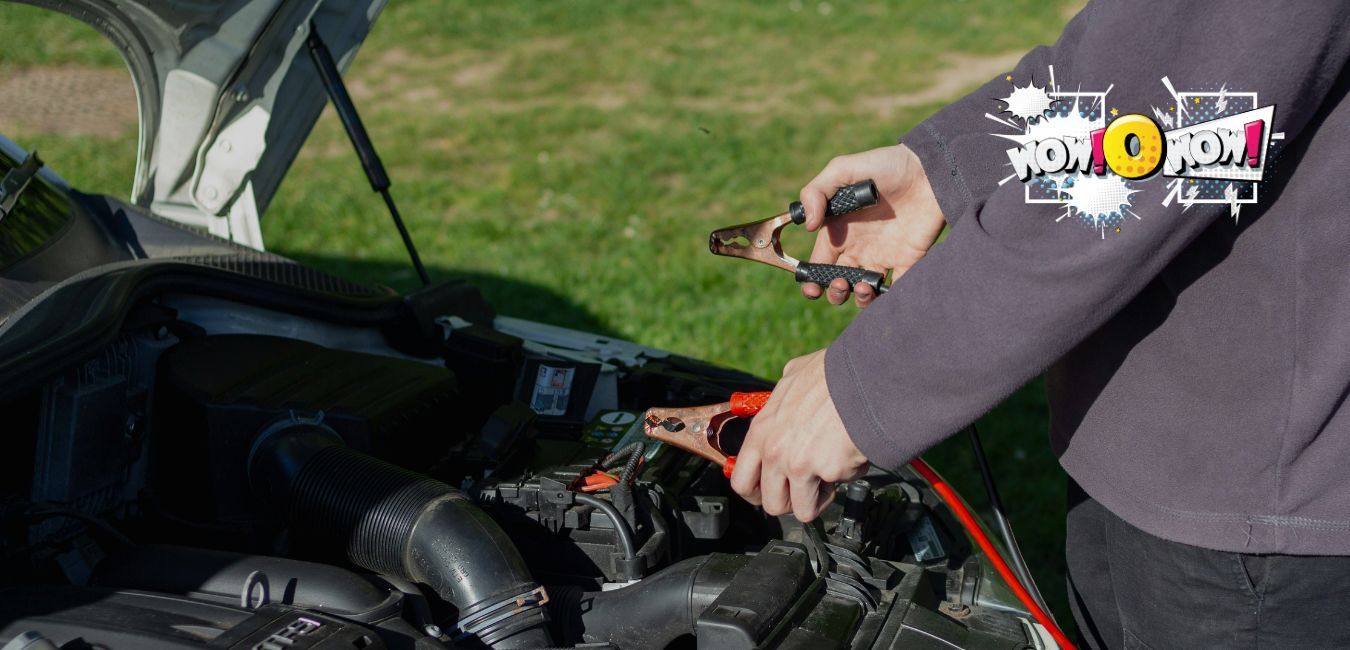
At a Glance
| What you’ll do | Connect a healthy 12V battery (or a jump pack) to a dead one in a set order |
| Difficulty | Easy to moderate |
| Time | About 10–15 minutes |
| Tools needed | Jumper cables or a portable jump pack, gloves, eye protection |
| The one hazard | Hydrogen gas — a spark at the battery can ignite it. Ground the last clamp away from the battery. |
This guide covers when you must not jump-start a battery at all, the four safety checks to run before the cables come out, the eight-step procedure with the reason behind each connection, what to do when the car still won’t start, and how hybrids and EVs differ. Confirm the sequence against your owner’s manual, because some vehicles specify a dedicated remote jump terminal instead of the battery itself.
Last updated: Procedures vary by vehicle — your owner’s manual overrules any general guide, including this one.
Table of Contents
When should you NOT jump-start a car?
Never jump-start a battery that is frozen, cracked, leaking, bulging, or visibly damaged, because it can rupture or explode when current is applied. This is the most important section on this page, which is why it comes before the steps. Walk away and call for roadside assistance if any of the following is true.
- The battery case is cracked, swollen, or bulging, or you can see leaking fluid.
- The battery is frozen. Look for a bulging case or visible ice in the cells in very cold weather. Per AAA’s battery guidance, a frozen battery may rupture if you try to charge or jump it.
- You smell rotten eggs or sulfur. That smell means the battery is venting hydrogen sulfide, and it may be overheating or shorted internally. Get away from it. Here’s more on why a car battery smokes or smells.
- The jumper cables are frayed or the clamps are corroded or damaged.
- You aren’t sure the vehicle uses a standard 12-volt system, or you can’t safely reach the battery.
Caution: a damaged battery is not a job to attempt in a parking lot. Call roadside assistance or have it towed. No jump-start is worth an acid burn or a ruptured case.
What you’ll need
Gather three things before you start: a power source, protection, and a working knowledge of where the battery is. Tools here are generic, and any equivalent will do.
- Jumper cables in good condition, or a portable jump pack. A heavier cable gauge carries current better.
- A donor vehicle with a healthy 12-volt battery, if you’re using cables.
- Eye protection and gloves. Batteries contain sulfuric acid.
A portable jump pack is worth knowing about, because it removes the donor car from the equation entirely. That means no second vehicle, no risk of the two cars touching, and no need to find a stranger willing to help. Follow the instructions that came with the pack, since each one differs slightly.
Before you connect anything: 4 safety checks
Run these four checks before the cables come out. Each one takes seconds and each one prevents a specific failure.
- Put both cars in Park (or Neutral), set the parking brakes, and switch both ignitions OFF. Connecting with an ignition on risks a voltage spike.
- Make sure the two cars are not touching. Body-to-body contact can create an unintended circuit.
- Inspect the dead battery for cracks, bulging, leaks, or ice. If you find any, stop and refer to the section above.
- Turn off accessories in both cars and unplug aftermarket electronics such as phone chargers and dash cams, because a jump can send a spike through them.
Caution: remove rings, watches, and metal jewelry before you reach into the engine bay. Metal jewelry can complete a circuit across a battery terminal and cause a severe burn. Keep loose sleeves clear of the belts and the cooling fan, which can start without warning. On a keyless-ignition car, keep the smart fob well away from the vehicle while you connect the cables.
How to jump-start a car in 8 steps
Follow this sequence exactly. The order is not a preference. It exists so that the one connection that can spark is made far from the battery that vents hydrogen.
- Park the donor car close, nose to nose if possible, without the cars touching. The cables need to reach both batteries comfortably. Leave slack so nothing pulls tight.
- Locate both batteries and identify the terminals. Positive is marked with a plus sign and usually wears a red cover; negative is marked with a minus sign. Some vehicles place the battery in the trunk or under a seat and provide a dedicated remote jump terminal under the hood. Check your owner’s manual and use that terminal if your car has one.
- Connect the red clamp to the dead battery’s positive terminal. Wiggle it so the metal bites down. A loose clamp is the single most common reason a jump fails.
- Connect the other red clamp to the donor battery’s positive terminal. Keep the two black clamps apart and off any metal while you work.
- Connect a black clamp to the donor battery’s negative terminal. Three connections down, one to go, and this last one is the critical one.
- Connect the final black clamp to bare, unpainted metal on the dead car’s engine — never to the dead battery’s negative post. A sturdy unpainted bolt or bracket on the engine block, several inches away from the battery, is ideal.
Caution: this connection completes the circuit and can spark. Made at the battery post, that spark sits right where the battery vents hydrogen gas. - Start the donor car and let it run for 2–5 minutes, then start the dead car. Crank for no more than about 5 seconds at a time, and rest between attempts so the starter doesn’t overheat.
- Disconnect in exact reverse order once the car is running: the ground clamp off the dead car first, then black off the donor battery, then red off the donor, then red off the revived battery. Never let the clamps touch each other or any metal while any of them are still connected.
Why the last clamp goes to bare metal, not the battery
The final clamp goes to bare engine metal because that connection completes the circuit and can throw a spark. A lead-acid battery vents hydrogen gas, especially when it’s discharged, and hydrogen is flammable. A spark at the battery’s own negative post can ignite that gas and rupture the case, spraying acid. Grounding to the engine block puts the spark several inches away from the gas, which is the whole point of the sequence.
What if the car still won’t start?
A jump that doesn’t work is a diagnosis, not a dead end. What you hear when you turn the key tells you where to look next.
| What happens | What it points to | Next step |
|---|---|---|
| Rapid clicking, or a single click | Still not enough current: a loose clamp, thin cables, or a weak donor battery | Re-seat every clamp, let the donor run 5 more minutes, try again |
| Nothing at all, no click | A bad connection, or a failed starter | Check the ground clamp is on clean bare metal, then suspect the starter |
| Engine cranks but won’t fire | Not a battery problem: likely fuel or ignition | Stop jumping. The battery isn’t the fault here. |
| Starts, then dies moments later | A failing alternator | See why a car dies after a jump |
Stop after three or four failed attempts and call for help. Repeated cranking overheats the starter and drains the donor battery too. A battery that repeatedly needs jumping has usually reached the end of its life, and most last only 3–5 years.
Can you jump-start a hybrid or an electric car?
Most hybrids and electric cars have a separate 12-volt accessory battery that can be jump-started, and a flat 12-volt battery is a common reason an EV won’t power up even with a full traction battery. The procedure is broadly similar, but it varies by make, so your owner’s manual is the authority here rather than any general guide.
Caution: never touch, open, or attempt to jump the high-voltage traction battery or anything connected to the orange high-voltage cables. Those components can be lethal and are strictly professional territory. AAA also advises against using an EV or hybrid as the donor vehicle when jumping another car, because it can damage the donor’s electrical systems. When in doubt with a hybrid or EV, call roadside assistance rather than improvising.
Common mistakes to avoid
Five mistakes cause nearly every jump-start that ends in damage or injury:
- Reversing the polarity by clamping red to a negative terminal. This can damage the ECU and electronic modules in both cars.
- Clamping the last lead to the dead battery’s negative post instead of an engine ground, putting a spark next to venting hydrogen.
- Letting the clamps touch each other or any metal while the other end is connected.
- Cranking for too long. Keep attempts to about 5 seconds, and rest in between.
- Shutting the car off right after it starts, before the battery has recovered any charge.
After the jump: what to do next
Drive the car for at least 20–30 minutes after a successful jump-start, and don’t just idle it in the driveway. An alternator’s output scales with engine speed, so idling recharges a battery slowly and poorly, while road-speed driving does real work. Shutting the engine off too early often means it won’t restart.
Treat the jump as a rescue, not a repair. Have the battery and charging system tested afterward: a healthy battery rests at about **12.6 volts**, and a healthy charging system reads about **13.5–14.7 volts** with the engine running. If the car dies again soon after, the alternator is the likely culprit, not the battery. See our guides on how often to start and drive a parked car and the signs of a dying battery.
When to stop and call a professional
Some situations are simply not DIY. Call roadside assistance or a shop if the battery is frozen, cracked, bulging, or leaking, or if you smell rotten eggs near it. Hand the job to a professional the moment high-voltage EV components are involved, because orange cables and traction batteries are never an owner-level repair.
It’s also time to stop if the car won’t start after three or four proper attempts, if it dies again immediately after the jump, or if you’re not confident about which terminal is which. Have an ASE-certified technician test the battery and charging system rather than repeating jump-starts on a battery that has already failed. If you’re stranded on a road, get the car fully off the travel lane, switch on your hazards, and stay clear of traffic while you wait, as NHTSA advises for any breakdown.
Jump-starting a car — FAQ
Which cable do you connect first when jump-starting?
Connect the red positive clamp to the dead battery’s positive terminal first. Then attach red to the donor battery’s positive, black to the donor battery’s negative, and finally the last black clamp to bare unpainted metal on the dead car’s engine. Never clamp that final lead to the dead battery’s negative post.
Can jump-starting damage my car’s electronics?
Jump-starting is safe for your electronics when it’s done correctly. Reversing the clamps and putting red on a negative terminal sends reversed voltage through the system and can damage the ECU and other modules in both cars. Confirm which terminal is positive before you connect anything, and unplug aftermarket accessories first.
How long should you run the car after a jump-start?
Drive the car for at least 20–30 minutes after a jump-start so the alternator can recharge the battery. Idling in the driveway charges it poorly, because an alternator produces only a fraction of its output at idle speed. Drive at road speed instead, and have the battery tested soon afterward.
Can you jump-start a car alone, without another car?
A portable jump pack starts a car without a donor vehicle. It is often the safer choice, because it removes the second car, the risk of the two vehicles touching, and the need to find help. Charge the pack before storing it, and follow the instructions supplied with it.
Why does my car die again right after a jump-start?
A car that dies again shortly after a jump usually has a failing alternator, because the alternator, not the battery, powers the car once the engine is running. A jump only refills the battery, so it cannot fix a charging fault. Have the charging system tested rather than jumping the car repeatedly.
What to do now
Jump-start a car by connecting red to the dead positive, red to the donor positive, black to the donor negative, and the **final black clamp to bare unpainted metal on the dead car’s engine, never the battery’s negative post**.
Caution: that last connection can spark, and a battery vents flammable hydrogen. Never jump a frozen, cracked, or leaking battery at all. Once the car is running, drive it 20–30 minutes and get the battery tested, because a jump is a rescue and not a repair. For everything on keeping your 12-volt system healthy, see our complete car battery guide, part of our car care and troubleshooting hub
