

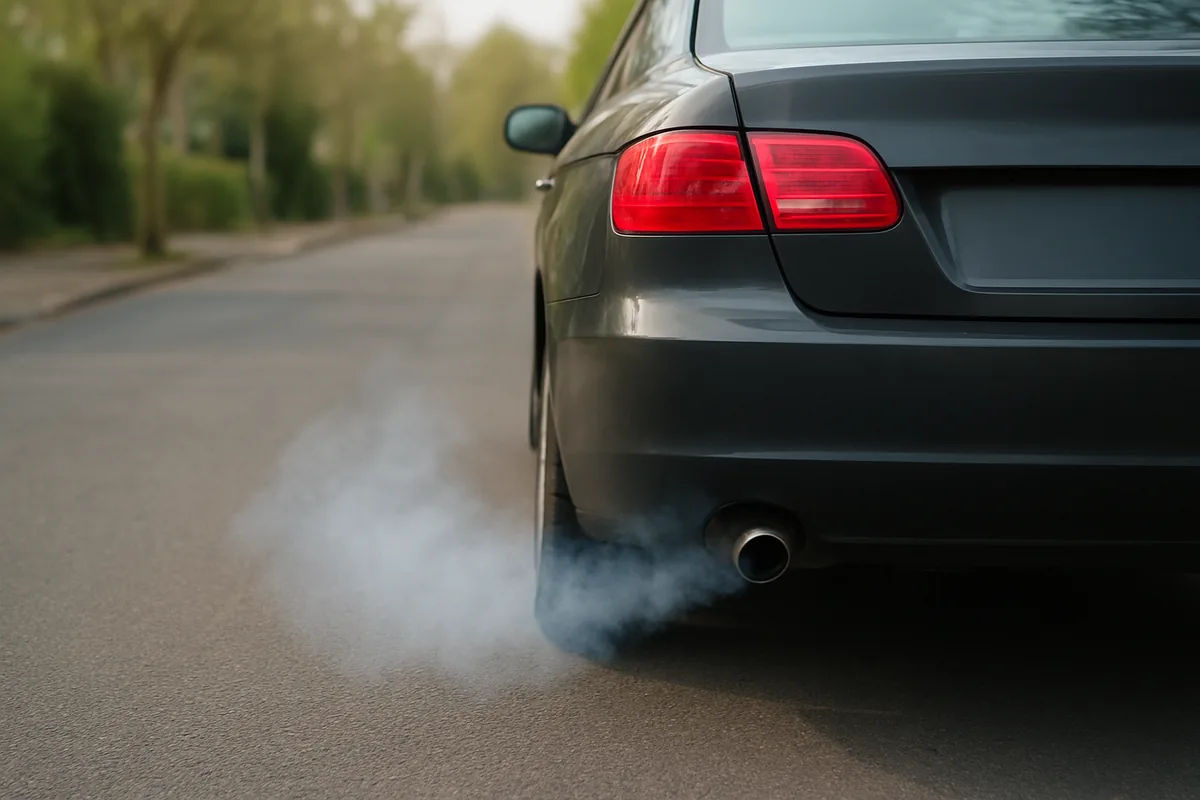
| What it is | Engine oil burning in the cylinders or the exhaust |
| #1 tell | When it smokes: startup, acceleration, deceleration, or after idling |
| Safe to drive? | Short-term, yes, with the oil kept topped up. Stop if the oil pressure light comes on. |
| Fast test | Check the dipstick; is the oil level dropping between changes with no leak? |
| Cheapest causes | Overfilled oil or a stuck PCV valve |
| Typical cost | Low for a PCV valve, major for piston rings (varies by engine) |
Blue smoke is the exhaust color that almost always means the same fluid, and that makes it easier to diagnose than white or black. The engine is burning oil. What varies is how the oil is getting in, and the timing of the smoke narrows that down before anyone has to take the engine apart. This guide shows you how to confirm the smoke really is oil, match its timing to the likely cause, and decide how urgently to act.
Every cost below is a broad typical range that varies by vehicle, region, and shop. Get a local quote before acting on any figure here, and check your owner’s manual for your engine’s oil capacity and acceptable oil consumption.
Table of Contents
What does blue smoke from the exhaust mean?
Blue smoke from the exhaust means engine oil is being burned, either inside the combustion chambers or in the hot exhaust stream. Oil is supposed to stay in the crankcase and cylinder head, sealed away from combustion by piston rings, valve stem seals, and gaskets. When one of those seals wears, oil slips past it, burns with the fuel, and leaves the tailpipe as a blue or blue-gray haze.
Burning oil also has a distinct smell: sharp and acrid, like a hot frying pan, rather than the sweet smell of coolant or the raw smell of fuel. The smoke is often thinner than the dense white clouds of a head gasket failure, and it can be easier to see in a mirror at night under headlights or on a cold morning. The steady companion of real oil burning is an oil level that keeps dropping between changes with no puddle under the car.
Is it safe to drive with blue smoke from the exhaust?
Blue smoke from the exhaust is usually safe to drive on short-term as long as you check the oil level often and keep it topped up, but stop driving immediately if the oil pressure warning light comes on or the engine starts knocking. Burning oil is a wear problem, not usually a sudden one. The danger is running the engine low on oil without noticing.
An engine that burns oil steadily can lose enough between checks to starve its bearings, and low oil pressure can destroy an engine quickly. Check the dipstick at every fill-up until the cause is fixed, and add the oil grade listed in your owner’s manual whenever the level nears the minimum mark. Our guide to whether low oil can make a car shut off explains what happens when the level falls too far, and our guide to what the oil light means covers the warning itself.
Burning oil also does slow damage that is easy to miss. The ash from burned oil can foul spark plugs, causing misfires, and it gradually clogs the catalytic converter. A flashing check engine light means an active misfire, so stop driving as soon as it is safe if you see one.
Caution: check the oil only with the engine off, the car on level ground, and the engine cool enough to touch around the dipstick. Oil spilled on a hot exhaust manifold can smoke and, in rare cases, catch fire.
How do blue, white, and black exhaust smoke differ?
Blue or gray smoke means burning oil, white smoke means burning coolant or harmless condensation, and black smoke means too much fuel. The color is the first clue, because it names the fluid reaching the combustion chamber. Thickness, timing, and smell then confirm it, and the table below lays out all three colors side by side.
| Smoke color | What is burning | Typical smell | Most likely cause |
|---|---|---|---|
| Blue or blue-gray | Engine oil | Sharp, acrid, like hot oil | Worn valve seals, piston rings, turbo seals, or a PCV fault |
| Thin white vapor | Condensation | Normal exhaust | Cold or humid starts; clears within minutes |
| Thick white | Coolant | Sweet, syrupy | Head gasket, cracked head, or intake gasket |
| Black | Excess fuel | Raw fuel | Clogged air filter, leaking injector, or a sensor fault |
Gray-white smoke can be hard to call in daylight. Look at the smoke against a dark background, and note the smell and whether the oil or coolant level is the one dropping. If the smoke is thick, white, and sweet, see our guide to white smoke from the exhaust instead.
Why does my car blow blue smoke? When it smokes tells you why
The timing of blue smoke is the best clue to its cause, because each worn seal leaks oil under different conditions. Smoke only at startup points to valve stem seals, steady smoke that grows under acceleration points to piston rings, and smoke on a turbocharged engine often points to the turbo’s seals. The table matches each timing pattern to its most likely cause.
| When it smokes | Most likely cause | Why it happens then | Repair level |
|---|---|---|---|
| A puff at startup that clears in seconds | Worn valve stem seals | Oil seeps down the valve stems while the car sits, then burns off at startup | Moderate to major |
| A puff after idling, then pulling away | Worn valve stem seals or guides | High vacuum at idle pulls oil past the worn seals | Moderate to major |
| When lifting off the throttle or coasting downhill | Worn valve guides or seals | High engine vacuum on deceleration draws oil down the valve stems | Moderate to major |
| Steady smoke, worse under hard acceleration | Worn piston rings or cylinder walls | Combustion pressure forces past the rings and oil gets into the cylinder | Major |
| Under boost, or after idling, on a turbo engine | Leaking turbocharger seals | Oil passes the turbo shaft seals into the intake or exhaust | Moderate to high |
| Smoke plus oil in the air intake, sometimes a whistle | Stuck or clogged PCV valve | Crankcase pressure pushes oil mist into the intake | Low |
| Right after an oil change | Overfilled oil or spilled oil | Excess oil gets whipped up and burned, or spilled oil cooks off hot parts | Low |
Worn valve stem seals
Valve stem seals are small rubber seals around each valve stem that stop oil in the cylinder head from dripping into the cylinders. As they harden with heat and age, they leak. The classic symptom is a puff of blue smoke at startup, especially after the car has sat overnight, that clears once the engine runs. The engine may otherwise run perfectly.
Leaking valve seals are a shop repair. On many engines, a mechanic can replace them without removing the cylinder head, while on others the head has to come off. The job is far less than a full engine rebuild, but it is still a significant labor bill.
Worn piston rings
Piston rings seal the gap between each piston and its cylinder wall. When they wear, stick, or break, oil gets into the combustion chamber on every stroke and combustion gases push down into the crankcase. The result is steady blue smoke that gets worse under load, rising oil consumption, lower compression, and often reduced power.
Worn piston rings are the expensive cause. Replacing them usually means taking the engine apart, which on an older, high-mileage car can cost more than the car is worth. A compression test and a leak-down test show whether the rings are the problem before anyone recommends that repair. Oil-burning engines also sometimes suffer stuck rings caused by carbon buildup, which a shop may be able to address without a teardown.
Leaking turbocharger seals
A turbocharger spins on a shaft lubricated by engine oil, with seals keeping that oil out of the intake and exhaust sides. When those seals wear, or when the turbo’s oil drain line is restricted, oil leaks past them. The smoke often appears under boost or after a long idle, and there may be oil pooled in the intercooler piping.
A turbo repair is separate from internal engine work, and replacing or rebuilding the turbo usually cures the smoke. Have the oil drain line and the PCV system checked at the same time, because a blocked drain or high crankcase pressure can push oil past healthy turbo seals.
A stuck PCV valve or overfilled oil
The PCV system vents pressure from the crankcase back into the intake. If the PCV valve sticks or its hoses clog, crankcase pressure rises and pushes oil mist into the intake, where it burns. Signs include oil in the air filter housing or throttle body, a whistling noise, or oil leaks at seals that were fine before. A PCV valve is usually one of the cheapest parts in the engine to replace.
An overfilled engine can also smoke, because the spinning crankshaft whips excess oil into foam and more of it gets pushed into the intake and past the rings. If the smoke started right after an oil change, check the dipstick first. Our guide on what happens if you put too much oil in your car covers how to deal with it.
How do I confirm my car is burning oil?
You confirm oil burning by checking the smoke color, tracking the oil level between changes, and ruling out an external leak. These checks cost nothing and separate oil burning from a coolant or fuel problem. They also give a mechanic the evidence to go straight to the right test instead of guessing.
- Look at the smoke against a dark background. A blue or blue-gray tint with an acrid smell points to oil. Thick, sweet white smoke points to coolant, and black, sooty smoke points to fuel.
- Track the oil level. Check the dipstick with the engine off and the car on level ground, following your owner’s manual, and note the level. Check again every few hundred miles to see how fast it drops.
- Rule out a leak. Look for fresh oil spots under the parked car and wet, oily areas on the engine. A leak that drips onto the exhaust can smoke from under the hood, which is a different fix.
- Check the tailpipe. Wipe the inside of the tailpipe with a rag. A wet, oily black residue supports oil burning, while dry gray soot is normal.
- Note when it smokes. Record whether the smoke appears at startup, after idling, on deceleration, or under acceleration, and match it to the timing table above.
- Check the oil level after an oil change. If the smoke began right after a service, confirm the level is not above the full mark.
Hand the car to a shop once those checks point to oil burning. A mechanic can pull the spark plugs to see which cylinders are oil-fouled, run a compression test and a cylinder leak-down test to separate worn rings from worn valve seals, and inspect the PCV system and turbo. If the oil keeps disappearing with no visible smoke at all, see our guide to a car losing oil with no leak or smoke. For choosing a shop, ASE’s resources for drivers explain what its technician certification means.
What if the blue smoke comes from under the hood?
Blue smoke from under the hood, rather than the tailpipe, usually means oil is leaking onto a hot part of the engine or exhaust and cooking off. The most common source is a leaking valve cover gasket dripping onto the exhaust manifold. It smells strongly of burning oil and often shows up after a drive, when the engine is hottest.
This is a leak, not internal oil burning, and it is usually a cheaper fix. It still deserves prompt attention, because oil on a very hot exhaust is a fire risk. Pull over and shut the engine off if the smoke is heavy, and do not open the hood while you see flames. For a smoke source you cannot place, our guide to why a car is smoking from the hood covers the other possibilities.
How much does it cost to fix blue smoke from the exhaust?
Fixing blue smoke costs anywhere from a low-cost part to a major engine repair, depending on which seal is leaking. Correcting an overfill and replacing a PCV valve sit at the bottom of the range, turbo and valve seal work in the middle, and piston rings at the top. Every figure below is a broad typical range that varies by vehicle, region, and shop, so get a local quote.
| Cause | Typical cost range (verify locally) | What drives the price |
|---|---|---|
| Overfilled oil | Free to low | Draining the excess or an oil change |
| PCV valve or hoses | Low | Part location; easy on some engines, buried on others |
| Valve cover gasket leak (under-hood smoke) | Low to moderate | Engine layout and number of valve covers |
| Diagnosis (compression and leak-down tests) | Low, usually about an hour of labor | Local labor rate |
| Turbocharger rebuild or replacement | Moderate to high | Turbo type, new vs rebuilt, access |
| Valve stem seals | Moderate to major | Whether the cylinder head must come off |
| Piston rings | Major, often near rebuild cost | Engine teardown labor, machine work, engine value |
Start with the cheap causes before approving an expensive repair, and ask which test pointed to the rings or seals. Search your VIN on NHTSA’s recall lookup as well, since some engines have had recalls or manufacturer programs related to oil consumption.
On an engine that is not worth a major repair, some owners manage mild oil burning with a high-mileage oil and frequent level checks. That approach can slow consumption on some engines, but it does not repair worn parts. Our guide on how to stop a car from burning oil lays out the full repair path from the cheapest fix to the biggest.
Keep the catalytic converter in mind when deciding whether to wait. Burned oil can foul it over time, and the EPA’s emissions warranty FAQ notes that a manufacturer can deny warranty coverage when an emissions component fails because of improper use or maintenance rather than a defect.
Frequently asked questions
Is it safe to drive with blue smoke from the exhaust?
Driving with blue smoke from the exhaust is usually safe for a short time if you keep the oil level topped up, because burning oil runs the level down and low oil can ruin an engine. Stop immediately if the oil pressure light comes on. Get the cause fixed, since sustained oil burning also damages the catalytic converter.
Why does my car blow blue smoke on startup?
A car that blows blue smoke on startup usually has worn valve stem seals. Oil seeps past the hardened seals and into the cylinders while the car sits, then burns off in a puff when the engine starts. The smoke often clears within seconds, but the seals keep leaking and are the repair to price.
Does blue smoke always mean an engine rebuild?
Blue smoke does not always mean an engine rebuild. Cheaper causes include overfilled oil, a stuck PCV valve, a leaking turbo seal, and worn valve stem seals, which can often be replaced without a full teardown. Worn piston rings are the expensive case, so a compression and leak-down test should confirm the cause first.
Can a turbo cause blue smoke?
A turbo can cause blue smoke when its shaft seals wear or its oil drain line is restricted, letting oil into the intake or exhaust. The smoke often shows under boost or after a long idle, sometimes with oil in the intercooler piping. Replacing or rebuilding the turbo usually fixes it, without internal engine work.
Why does my car blow blue smoke when accelerating?
Blue smoke that appears or gets worse when accelerating usually points to worn piston rings or cylinder walls, because combustion pressure is highest under load. On a turbocharged engine, leaking turbo seals are also a strong possibility. A compression test and a cylinder leak-down test separate the two causes before any major repair.
What to do now
Confirm the smoke is blue or blue-gray and smells of burning oil, then note exactly when it appears. A puff at startup points to valve stem seals, steady smoke under acceleration to piston rings, and smoke on a turbo engine to the turbo seals. Check the dipstick now, and rule out an overfill or a stuck PCV valve before paying for bigger work.
Keep driving only while you check the oil at every fill-up and keep it topped up, and stop immediately if the oil pressure light comes on, the engine knocks, or the check engine light flashes. For the full repair path, see our guide on stopping a car from burning oil, and for smoke, overheating, and every other symptom, use the complete car troubleshooting guide. For oil changes, grades, and levels, see our engine oil guide, and for keeping the whole vehicle healthy, visit our complete automotive care hub.
