

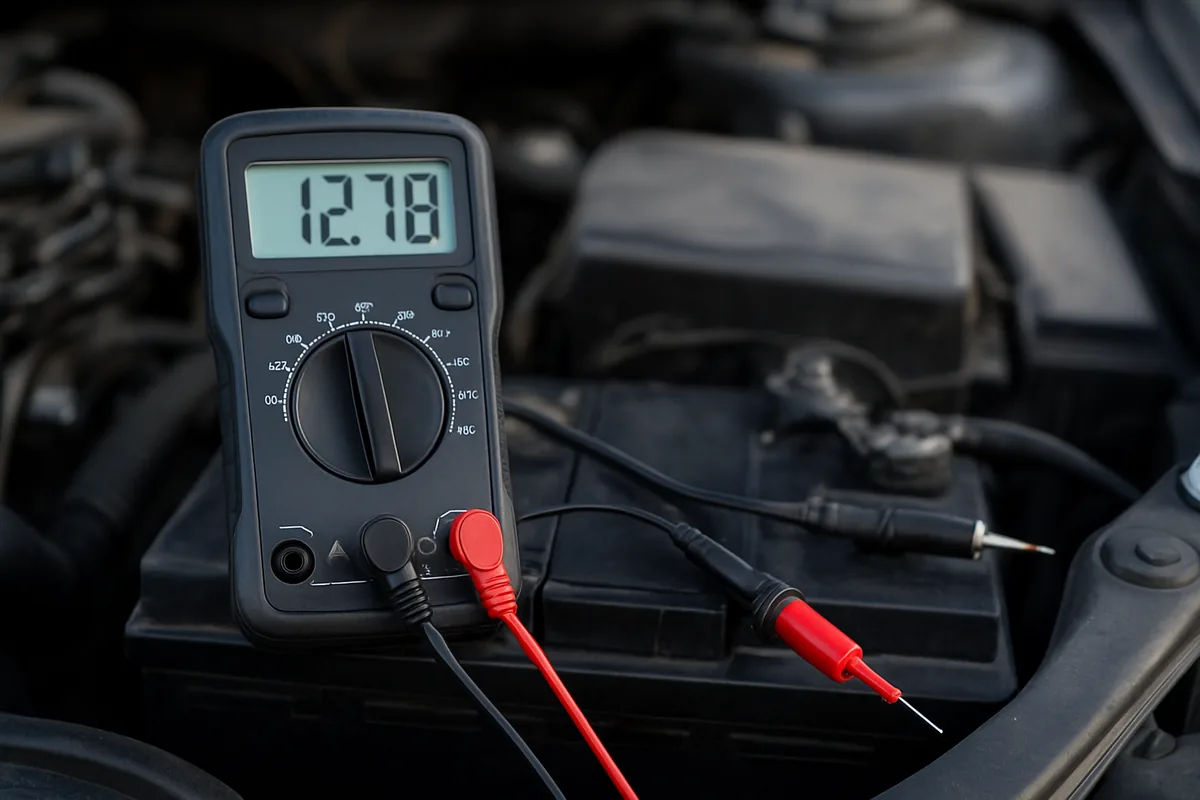
| Fully charged (engine off) | 12.6 to 12.7 volts, measured after the battery has rested |
| Normal while running | 13.5 to 14.7 volts at the battery terminals |
| Recharge threshold | Below 12.4 volts at rest |
| Considered flat | 11.9 volts or lower at rest |
| Cranking floor | Roughly 9.6 volts minimum while the engine turns over |
| Two things that skew a reading | Cold temperature and leftover surface charge |
A voltmeter reading is the fastest honest answer you can get about a car battery, but only if you know which number you are looking at. A battery sitting overnight, a battery with the engine running, and a battery mid-crank all produce completely different voltages, and all three are normal in their own context. Reading the wrong number against the wrong scale is how a healthy battery gets replaced and a dying one gets kept.
The tables below separate those contexts. Every figure is a standard 12-volt lead-acid reference range published by battery manufacturers and the Battery Council International; confirm the exact numbers for your battery against its label or your owner’s manual, since chemistry and design vary. For the procedure itself, see the companion guide on how to test a car battery with a multimeter.
Table of Contents
What should a car battery read at rest? (The main voltage chart)
A resting car battery reads 12.6 to 12.7 volts when fully charged, and the voltage drops in a predictable curve as the charge falls. Take the reading with the engine off and the battery settled, ideally after several hours parked, because a battery that was just driven or charged reads artificially high. This chart is the reference most drivers are looking for.
| Resting voltage | Approximate state of charge | What it means |
|---|---|---|
| 12.6 to 12.7V | 100% | Fully charged and healthy |
| 12.4 to 12.5V | About 75% | Usable, but no longer full |
| 12.2 to 12.3V | About 50% | Undercharged, recharge soon |
| 12.0 to 12.1V | About 25% | Very low, may struggle to start |
| 11.9V or lower | Effectively 0% | Flat, and at risk of permanent damage |
The curve is tight on purpose. A car battery spends its whole working life inside a window less than one volt wide, which is why a difference of two tenths of a volt genuinely matters here and why a cheap digital multimeter that reads to one decimal place is not precise enough. Use one that shows two decimal places.
Voltage alone measures charge, not health. A battery can sit at a perfect 12.6V and still fail the moment a starter motor pulls current from it, which is why the cranking test further down exists.
What is normal charging voltage with the engine running?
Charging voltage measured at the battery terminals with the engine running should sit between 13.5 and 14.7 volts. That number reflects the alternator and voltage regulator doing their job, not the battery’s own charge. A reading outside that band points at the charging system rather than the battery itself.
| Running voltage | Reading | What to do |
|---|---|---|
| Below 13.0V | Not charging | Have the alternator, belt, and ground connections checked |
| 13.0 to 13.4V | Undercharging | Suspect a weak alternator or a corroded connection |
| 13.5 to 14.7V | Normal | Charging system is working as expected |
| Sustained above 14.7V | Overcharging | Stop relying on the car and get the regulator checked |
Undercharging is the quiet one. A car that starts fine every morning can still be running its battery down over weeks if the alternator is only putting out 13.2V, and the first symptom is often a no-start after a cold night rather than any warning light. If the battery keeps arriving at the morning flat, the charging system is the first place to look, ahead of the battery itself. That pattern is covered in more depth in the guide to a car battery that keeps draining fast.
Overcharging is the dangerous one. Sustained voltage above roughly 14.7V boils electrolyte out of the battery, which can make the case swell, force acid past the vents, and release hydrogen gas around a hot engine bay. Caution: battery electrolyte is dilute sulfuric acid, which the ATSDR describes as highly corrosive and capable of burning skin and eyes, so keep your face away from a battery that looks swollen or wet and do not lean over one while the engine is running. Overcharging is a shop job, not a driveway fix. Hand it to a professional as soon as you see a reading that stays above 14.7V, because a faulty voltage regulator will keep cooking every replacement battery you fit. A battery that has already been overcooked often announces itself by smell, which is explained in the piece on why a car battery smells like rotten eggs.
What is normal cranking voltage under load?
Cranking voltage is the dip you see while the engine turns over, and it should stay above roughly 9.6 volts on a healthy battery at normal temperature. This is the single most useful number on the page, because it tests the battery under real current draw instead of at rest. A battery that reads 12.6V parked and collapses to 8V mid-crank is a failing battery with a good surface reading.
| Lowest voltage during cranking | What it indicates |
|---|---|
| Above 10.5V | Strong battery with healthy reserve |
| 9.6 to 10.5V | Acceptable, near the normal floor |
| Below 9.6V | Weak battery, a bad cell, or a poor connection |
| Drops near 5V with a loud click | Severe voltage collapse, often a dead cell |
Cold shifts this threshold downward, so a January reading slightly under 9.6V on an otherwise healthy battery is not automatically a death sentence. What matters more is the pattern: a battery that sags further each week is on its way out regardless of where it sits on a single morning.
A single loud click with a heavy voltage drop usually means the battery cannot hold up under the starter’s draw, while rapid machine-gun clicking points the same direction with even less reserve. Both patterns are unpacked in the guide to a car that will not start and just clicks.
Do AGM batteries have different voltage numbers?
AGM batteries read slightly higher than standard flooded batteries at the same state of charge, with a full AGM resting around 12.8 to 12.9 volts against 12.6V for flooded. Read an AGM against the flooded column and you will mistake a normal battery for an overcharged one. Check the label on your battery before you interpret any reading.
| State of charge | Flooded (standard) resting voltage | AGM resting voltage |
|---|---|---|
| 100% | 12.6 to 12.7V | 12.8 to 12.9V |
| About 75% | 12.4 to 12.5V | 12.6V |
| About 50% | 12.2 to 12.3V | 12.3V |
| About 25% | 12.0 to 12.1V | 12.0V |
| Discharged | 11.9V or lower | 11.8V or lower |
AGM is the absorbed glass mat design, where the electrolyte is held in fiberglass matting rather than sloshing freely. Vehicles with automatic stop-start systems, heavy electrical loads, or a battery mounted in the cabin or trunk very often use AGM from the factory. The offset above is small in absolute terms and large in consequence, since 12.6V on an AGM is not a full battery but a battery already down to about three quarters.
The charging side differs too. Many AGM batteries want a slightly higher charging voltage than flooded types, so a charger set to the wrong chemistry undercharges them for years without ever looking broken. Match the charger setting to the battery, and if you are swapping types, read the note on whether you can use any battery in a car first.
How do temperature and surface charge change the reading?
Cold temperature lowers both the voltage a battery shows and the power it can actually deliver, while a recently driven or freshly charged battery holds a temporary surface charge that reads high. These two effects push in opposite directions and account for most confusing readings. Correct for both before you conclude anything.
Cold is the bigger factor. The chemical reaction inside a lead-acid battery slows as temperature drops, and AAA notes that this happens exactly when starting the engine demands more power, which is why marginal batteries die on the first hard freeze rather than in August. The US Department of Energy makes the same point from the charging side, observing that cold reduces battery performance and makes it harder for the alternator to keep the battery charged. A reading taken at 20°F will sit below the same battery’s reading at 70°F, so judge winter numbers with a little latitude and weight the trend over any single measurement. The seasonal side of this is covered in how cold weather affects a car battery.
Surface charge is the opposite trap. Immediately after a drive or a charge, a battery can show 13V or more, which is not its true resting state and will fade over the following hours. To clear it, either let the car sit for a few hours before measuring, or switch the headlights on for about a minute with the engine off and then let the battery settle briefly before taking the reading. Skipping this step is the most common reason a weak battery reads as fine.
Neither correction turns a voltmeter into a load tester. If the numbers look acceptable but the car still cranks slowly, have a shop run a proper load or conductance test, since that equipment measures the battery’s ability to deliver current rather than the charge sitting on its plates.
What should you do at each voltage level?
Each voltage band maps to a specific action, from driving normally to recharging immediately. Use the resting voltage from the main chart, then match it to the row below. The lower the reading sits and the longer it stays there, the more likely the battery has suffered permanent capacity loss rather than a simple discharge.
| Resting voltage | Action | Why |
|---|---|---|
| 12.6V and up | Drive normally | Fully charged, nothing to do |
| 12.4 to 12.5V | Monitor | Slightly down, and normal after short trips |
| 12.2 to 12.3V | Recharge soon | Sitting here invites sulfation over time |
| 12.0 to 12.1V | Recharge now | Starting is marginal and plate damage begins |
| 11.9V or lower | Recharge, then test | Deep discharge often leaves lasting damage |
Sulfation is the mechanism behind that urgency. Lead sulfate crystals form on the plates whenever a battery sits partly discharged, and they harden over weeks into a layer that a normal charger cannot reverse. A battery left at 12.0V through a winter of short trips can lose capacity permanently even though nothing ever failed outright, which is one of several failure paths described in what causes a car battery to die.
Recharging a flat battery is a slow charger’s job rather than a long drive’s. An alternator is built to maintain a charged battery, not to bring a deeply discharged one back, and hours of driving to revive a flat battery mostly just works the alternator hard. Leave it to a mechanic when the battery reads flat again within a day or two of a full charge, when the case looks swollen or is leaking, or when the charging voltage is also out of range, because at that point you are chasing a fault rather than a low charge. Ahead of winter it is worth doing anyway: NHTSA advises having a mechanic check the battery, charging system, and belts before cold weather arrives, since starting a cold engine draws more current than a marginal battery can supply.
Frequently asked questions
What is a healthy car battery voltage?
A healthy car battery reads 12.6 to 12.7 volts at rest with the engine off, and 13.5 to 14.7 volts with the engine running while the alternator charges it. Readings below about 12.4 volts at rest mean the battery is partly discharged and due for a recharge rather than immediately faulty.
Is 12.4 volts a good battery?
At 12.4 volts a car battery is roughly 75 percent charged, which is usable but not full. It will normally still start the engine without trouble. If the battery keeps returning to 12.4 volts after driving, the cause is usually short trips, a parasitic drain, or an alternator that is undercharging.
At what voltage is a car battery dead?
A car battery resting at 11.9 volts or below is considered fully discharged, and at 12.0 volts it holds only about 25 percent of its charge. It may not start the engine at that point. Recharge it with a proper charger, then have it load tested, because deep discharge often causes permanent damage.
Why does my battery read over 14 volts?
A reading between 13.5 and 14.7 volts with the engine running is normal charging voltage from the alternator, not a fault. Sustained readings above about 14.7 volts indicate overcharging from a failing voltage regulator, which boils off electrolyte and shortens battery life. Have the charging system checked promptly.
What to do now
Match your reading to the right chart before you act on it: 12.6V rested is full, 12.4V is about 75 percent, below 12.0V needs charging now, and 13.5 to 14.7V with the engine running is a healthy charging system. Clear any surface charge first, allow for cold weather, and check whether your battery is AGM or flooded before comparing numbers. If the voltage looks fine but the engine still cranks slowly, the battery needs a load test rather than another voltmeter reading.
For the step-by-step method behind these numbers, see how to test a car battery. For charging, corrosion, lifespan, and replacement, start at the complete car battery guide, or browse everything in the automotive care and repair section.
