

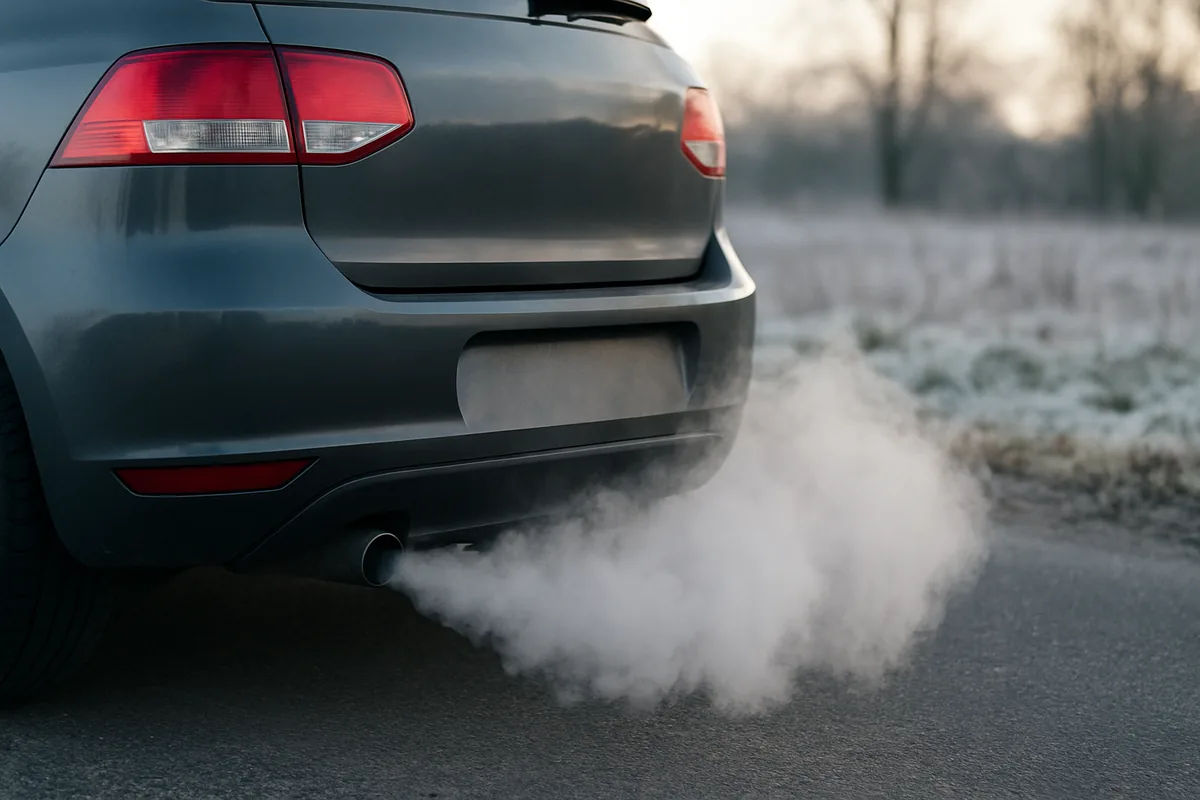
| What it is | Water vapor if thin and brief; burning coolant if thick and constant |
| #1 serious cause | A blown head gasket letting coolant into the cylinders |
| Safe to drive? | Thin vapor that clears: yes. Thick smoke with overheating or coolant loss: stop now. |
| Fast test | Does it clear once the engine is warm, and is the coolant level dropping? |
| Other colors | Blue or gray = burning oil; black = too much fuel |
| Typical cost | Nothing for condensation; a major repair for a head gasket (varies widely by engine) |
White smoke is the exhaust color that causes the most needless panic and the most expensive damage, often in the same week. On a cold morning almost every car puffs white vapor for a minute, and that is completely normal. The same color, thicker and longer-lasting, is also the classic sign of an engine burning its own coolant. This guide shows you how to tell the two apart in minutes, what else to check, and exactly when to stop driving.
Every cost below is a broad typical range that varies by vehicle, region, and shop. Get a local quote before acting on any figure here, and check your owner’s manual for anything make-specific.
Table of Contents
What does white smoke from the exhaust mean?
White smoke from the exhaust means water is leaving the tailpipe as vapor, and the only question is where that water came from. When the smoke is thin and brief, the water is ordinary condensation from the exhaust system and from combustion. When the smoke is thick and constant, the water is coolant leaking into the engine’s cylinders and being burned along with the fuel.
Coolant is mostly water mixed with antifreeze, so when it burns it produces dense white clouds that hang in the air behind the car. Condensation behaves differently: it is lighter, thins out quickly, and stops as soon as the exhaust gets hot enough to evaporate the moisture before it reaches the tailpipe. There are 3 details that separate them reliably: how thick the smoke is, whether it stops after the engine warms up, and whether the coolant level in the reservoir is going down.
Is it safe to drive with white smoke from the exhaust?
Keep driving if the white smoke is thin and disappears within a few minutes of starting, but stop driving if thick white smoke continues after warm-up, especially with a rising temperature gauge, a sweet smell, or a coolant level that keeps dropping. Thin vapor is normal. Thick, persistent smoke means coolant is being burned, and an engine losing coolant can overheat and damage itself quickly.
Continuing to drive with a failing head gasket turns a large repair into a larger one. Overheating can warp the cylinder head, and coolant mixing into the oil ruins its ability to lubricate the bearings. If the gauge climbs toward the red, pull over as soon as it is safe, shut the engine off, and have the car towed rather than driven. Our guide to why a car overheats covers what to do at the roadside.
Caution: never open the radiator cap or coolant reservoir cap on a hot engine. The cooling system is pressurized, and hot coolant can spray out and cause serious burns. Wait until the engine is completely cool before checking anything, and keep children and pets away from any coolant puddle, since antifreeze is poisonous if swallowed.
Thin white smoke vs thick white smoke: how do I tell?
Thin white smoke is wispy, thins out within a foot or two of the tailpipe, and stops once the engine warms up, while thick white smoke is dense, billows behind the car, and keeps coming at operating temperature. Watching the smoke for five minutes after a cold start tells you which one you have. The table below lists the other signs that confirm it.
| Sign | Thin white vapor (normal) | Thick white smoke (burning coolant) |
|---|---|---|
| How it looks | Light, wispy, fades quickly | Dense clouds that hang in the air |
| When it happens | Cold or humid starts, short trips | Continues after the engine is fully warm |
| How long it lasts | A few minutes at most | Every drive, often worse under acceleration |
| Smell | Normal exhaust smell | A sweet, syrupy smell behind the car |
| Coolant level | Stays steady | Drops with no visible leak |
| Temperature gauge | Normal | May creep up or overheat |
| Engine oil | Looks normal | May look milky or light brown |
| What to do | Nothing, keep driving | Stop driving and get it diagnosed |
Why is there white smoke from my exhaust on a cold start?
White smoke on a cold start is usually condensation burning off. Burning fuel produces water vapor, and on a cold or humid day some of that moisture condenses inside the cold exhaust pipes and muffler overnight. When you start the car, the hot exhaust pushes that moisture out as a thin white cloud until the whole system heats up.
The vapor is most noticeable in winter, on damp mornings, and after a string of short trips that never let the exhaust get fully hot. It often comes with a few drips of clear water from the tailpipe, which is normal too. A car that only makes short trips can puff vapor for longer, because the muffler never gets hot enough to dry out completely.
The test is simple. If the white cloud thins out and stops within a few minutes of driving, there is nothing to fix. If it is still pouring out after a 15 to 20 minute drive, when the engine and exhaust are fully warm, the moisture is not condensation, and you should move on to the coolant checks below.
What causes thick white smoke from the exhaust?
Thick white smoke from the exhaust is caused by coolant getting into the combustion chambers and burning with the fuel. There are 4 common ways that happens. They are a blown head gasket, a cracked cylinder head or engine block, a failed intake manifold gasket on engines that route coolant through the intake, and a leaking EGR cooler on engines that have one.
| Cause | How likely | Telltale signs | Typical cost (verify locally) |
|---|---|---|---|
| Blown head gasket | Most common serious cause | Coolant loss, overheating, bubbles in the reservoir, milky oil | Major, varies widely by engine |
| Cracked cylinder head or block | Less common, often after overheating | Same signs as a head gasket, sometimes worse | Major, may mean an engine replacement |
| Intake manifold gasket | Specific engine designs | Coolant loss, smoke at startup, sometimes an external leak | Moderate, mostly labor |
| EGR cooler leak | Mainly diesels and some gas engines | Coolant loss, white smoke, EGR fault codes | Moderate to high |
A blown head gasket
A blown head gasket is the most common cause of thick white smoke. The head gasket seals the joint between the engine block and the cylinder head, keeping combustion pressure, coolant, and oil in their own passages. When it fails, often after an overheating episode, coolant can seep into a cylinder and leave the tailpipe as white smoke.
A failed head gasket usually shows several signs at once. The coolant level drops with no puddle under the car, the reservoir may bubble while the engine runs, the temperature gauge climbs, and the engine may misfire, especially right after a cold start. Our guide to why a car goes through coolant so fast covers the coolant-loss side in detail.
Leave this repair to a professional. Replacing a head gasket means removing the cylinder head, checking it for warping, and reassembling the engine to exact specifications. Bottled head gasket sealers exist, but they are at best a temporary measure on a minor leak and do not repair a failed gasket.
A cracked cylinder head or engine block
A cracked cylinder head or engine block produces the same white smoke and coolant loss as a head gasket, and it is usually the result of serious overheating or coolant freezing in the engine. The difference only shows up in testing, which is why a shop confirms the cause before quoting. A crack is typically the costlier diagnosis, and on an older car it can make an engine replacement the more sensible repair.
An intake manifold gasket or EGR cooler
Some engines run coolant through the intake manifold, and a failed intake gasket can let coolant be drawn into the engine and burned, which often shows as white smoke right after startup. Diesels and some gas engines also have an EGR cooler that uses coolant to cool recirculated exhaust gas, and an internal leak there sends coolant straight into the intake. Both are less severe than a cracked head, and both are shop jobs.
How do I confirm the engine is burning coolant?
You confirm coolant burning by checking the coolant level, the oil, and the exhaust smell with the engine cold, then letting a shop run pressure and combustion-gas tests. The home checks take a few minutes and cost nothing. They tell you whether a professional diagnosis is urgent, even if they cannot pinpoint the exact failed part.
- Check the coolant level cold. With the engine completely cool, note the level in the reservoir against its markings, then check it again after a day of driving. A steady drop with no puddle is a strong sign of an internal leak.
- Check the oil. Pull the dipstick and look under the oil filler cap. Oil that looks milky, foamy, or like chocolate milk means coolant is mixing with it. Stop driving if you see this.
- Smell the exhaust. Burning coolant usually leaves a sweet, syrupy smell behind the car, which is different from normal exhaust. Our guide to a car that smells sweet like coolant covers the other places that smell comes from.
- Watch the temperature gauge. A gauge that creeps above its usual position, or overheats in traffic, supports a coolant leak.
- Look for puddles. A coolant puddle under the car points to an external leak, which is usually simpler and cheaper than an internal one.
Hand the diagnosis to a shop once those checks point to coolant loss. A mechanic can pressure-test the cooling system to see where it loses pressure, run a combustion leak test that detects exhaust gas in the coolant, and do a compression or leak-down test to find the affected cylinder. When choosing a shop, ASE’s resources for drivers explain that certified technicians must retest every 5 years to keep their credentials current.
What do the different exhaust smoke colors mean?
Exhaust smoke color names the fluid being burned: white is water or coolant, blue or gray is engine oil, and black is too much fuel. The color is the fastest first clue to what is wrong, although the thickness, the timing, and the smell all matter too. The table below covers all three colors.
| Smoke color | What is burning | Most likely cause | Safe to drive? |
|---|---|---|---|
| Thin white vapor | Condensation | Normal on cold or humid starts | Yes |
| Thick white, sweet smell | Coolant | Head gasket, cracked head, or intake gasket | No if overheating or losing coolant |
| Blue or blue-gray | Engine oil | Worn piston rings, valve seals, PCV fault, or turbo seals | Short trips; check oil often and fix soon |
| Black | Excess fuel | Clogged air filter, leaking injector, or sensor fault | Short trips; diagnose soon |
Blue smoke has its own guide on how to stop a car from burning oil, which covers checking the oil level and the causes of oil consumption. Black smoke usually means the engine is running rich and wasting fuel, and it often comes with poor fuel economy and a check engine light. For the overall picture of smoke, overheating, and every other symptom, see the complete car troubleshooting guide.
What if the white smoke comes from under the hood, not the tailpipe?
White smoke from under the hood is usually steam from coolant leaking onto hot engine parts or boiling over from an overheating engine, not smoke from the exhaust. It is a different problem with a different urgency. Pull over, shut the engine off, and do not open the hood until the steam stops, then look for the source once everything has cooled.
Smoke under the hood can also come from oil dripping onto the exhaust manifold, which smells burnt rather than sweet. Our guide to why a car is smoking from the hood covers those cases. If the car is producing smoke of any kind while the temperature gauge stays normal, see why a car smokes but does not overheat.
There is also a less common white smoke that has nothing to do with coolant. On a diesel, white or gray smoke on a cold start can be unburned fuel from weak glow plugs or injector problems, and it smells of raw diesel rather than sweet coolant. On some older cars with a vacuum-operated transmission, a leaking modulator can draw transmission fluid into the engine. Both need a shop diagnosis.
How much does it cost to fix white smoke from the exhaust?
Fixing white smoke from the exhaust costs nothing when it is condensation and a major repair when it is a head gasket or a cracked head. The price depends almost entirely on the engine design, because the labor to remove a cylinder head varies enormously between a simple four-cylinder and a V6 or V8. Every figure below is a broad typical range that varies by vehicle, region, and shop, so get a local quote.
| Repair | Typical range (verify locally) | What drives the price |
|---|---|---|
| Condensation | Free, no repair needed | Nothing |
| Cooling system pressure and combustion leak tests | Low, usually about an hour of diagnosis | Local labor rate |
| Intake manifold gasket | Moderate, mostly labor | Engine layout and access |
| EGR cooler replacement | Moderate to high | Part price and location on the engine |
| Head gasket replacement | Major, varies widely | Engine type, number of heads, head machining |
| Cracked head or block | Major, sometimes an engine replacement | Extent of damage and vehicle value |
Two things are worth doing before you approve a big repair. First, search your VIN on NHTSA’s recall lookup, because some engines have had recalls or extended coverage for cooling-system and gasket problems. Second, ask the shop which tests confirmed the diagnosis. A quote for a head gasket without a pressure test or a combustion leak test is a quote worth questioning.
Caution: drain and dispose of old coolant properly. The ATSDR fact sheet on ethylene glycol, the main ingredient in most antifreeze, warns that swallowing larger amounts can cause serious illness or death, and advises keeping antifreeze out of children’s reach and off the ground.
Frequently asked questions
Is white smoke from the exhaust bad?
White smoke from the exhaust is not bad when it is thin vapor that clears within a few minutes of a cold start, because that is normal condensation. Thick white smoke that continues after warm-up is bad, since it means coolant is burning, often from a head gasket. Check the coolant level and temperature gauge to tell them apart.
Why is white smoke coming out only on startup?
White smoke that appears only on startup and clears within a few minutes is usually condensation burning off, especially in cold or humid weather. Moisture collects in the cold exhaust overnight and leaves as vapor. If the smoke is thick, smells sweet, or the coolant level keeps dropping, have the intake gasket and head gasket checked.
Can I drive with white smoke from the exhaust?
Driving with thin white vapor that clears is fine. Driving with thick, persistent white smoke is not, because it usually means coolant is burning and the engine may overheat. Stop driving if the temperature gauge rises, the coolant level drops, or the oil looks milky, and have the car towed to a shop.
Does white smoke always mean a blown head gasket?
White smoke does not always mean a blown head gasket. Thin startup vapor is only condensation, and thick white smoke can also come from a cracked cylinder head or block, a failed intake manifold gasket, or a leaking EGR cooler. A cooling system pressure test and a combustion leak test confirm the actual source.
What does white smoke with a sweet smell mean?
White smoke with a sweet, syrupy smell almost always means the engine is burning coolant. Coolant is entering the cylinders through a failed head gasket, a crack, or a leaking gasket, and burning with the fuel. Check the coolant level with the engine cold, watch the temperature gauge, and get a diagnosis before driving much further.
What to do now
Watch the smoke after a cold start. If it is thin and stops within a few minutes, it is condensation and you can keep driving. If it is thick and continues once the engine is warm, check the coolant level with the engine cold, look at the oil for a milky color, and note any sweet smell or rising temperature.
Stop driving if thick white smoke comes with overheating, a dropping coolant level, or milky oil, and have the car towed for a pressure test and a combustion leak test rather than risking the engine. For the overheating side of the problem, see our guide to what to do when your car overheats, and for every other symptom, use the car troubleshooting hub. For keeping the whole vehicle healthy, visit our complete automotive care hub.
