

| What you’ll do | Measure tread depth with a coin, the wear bars, or a gauge |
| Difficulty | Easy, no tools required |
| Time | About 2 minutes for all four tires |
| Legal minimum | 2/32″ in most states, and the tire is done |
| Safer replace point | 4/32″, especially if you drive in rain or snow |
| New tire depth | About 10/32″ to 11/32″ |
Tread depth is the one safety measurement you can take with pocket change in about two minutes, and it decides how your car behaves the next time you brake on a wet road. Tread exists to channel water out from under the tire. As it wears away, that ability drops off long before the tire looks bald to a casual glance.
This page covers four ways to check: the penny test for the legal limit, the quarter test for the safer threshold, the built-in wear bars that need no tools at all, and a gauge for an exact number. It also covers what uneven wear is telling you, because a tire worn on one edge is reporting a different problem entirely. For everything else about tires, see the complete car tire guide.
Tread depth in the US is measured in 32nds of an inch. The 2/32″ figure is the legal minimum in most states, though a few set it lower and a few have no standard, so check your state’s rule.
Table of Contents
How to do the penny test, step by step
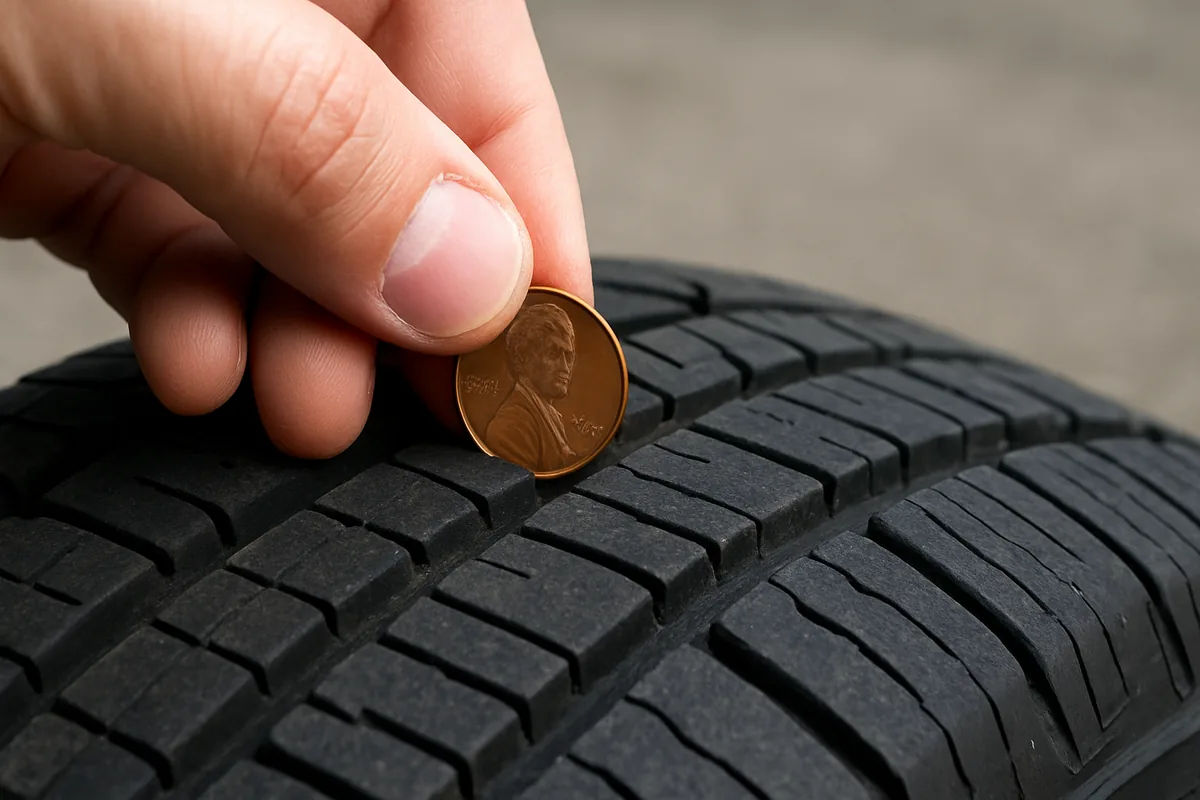
The penny test checks whether a tire has reached the 2/32″ legal minimum, using the distance from a penny’s rim to the top of Lincoln’s head. NHTSA endorses the method directly, advising drivers to place a penny in the tread with Lincoln’s head upside down and facing you, and replace the tires if you can see the top of his head. It takes seconds per tire.
- Find the shallowest groove. Look across the tread for the area that appears most worn. Testing only the deepest groove gives you a falsely reassuring answer.
- Insert the penny head-first, upside down. Push it into the groove so Lincoln’s head points down into the tire and his face is toward you. Press it all the way to the bottom of the groove.
- Look at the top of his head. If tread covers any part of Lincoln’s hair, you have more than 2/32″ left. If the top of his head is fully visible, the tread is at or below 2/32″ and the tire needs replacing.
- Repeat across the width of the tire. Check the inner edge, the center, and the outer edge. A tire can be legal in the middle and worn out on one shoulder, and that shoulder is what fails first.
- Repeat at three or four points around the tire. Roll the car forward a few feet and test again. Wear is not always even around the circumference.
- Check all four tires. Front and rear tires wear at different rates, and on front-wheel-drive cars the fronts usually go first.
The penny test has one honest limitation: it is a pass/fail check at the legal minimum, not a measurement. It tells you a tire is finished. It cannot tell you whether you have 4/32″ or 8/32″ left, which is the more useful question if you are trying to plan a purchase.
The quarter test: a safer threshold
The quarter test checks the 4/32″ mark, which is the point at which wet performance has already deteriorated meaningfully. Insert a quarter into the groove with Washington’s head upside down and facing you. If the tread reaches his head, you have more than 4/32″ left. If the top of his head is fully visible, you are below 4/32″ and should start shopping.
This is where the legal minimum and the safe threshold part company, and the gap is larger than most drivers expect. AAA tested new all-season tires against tires worn to 4/32″ and found that worn tires increased average wet stopping distance by 87 feet for a passenger car and cut handling ability by 33 percent. Their researchers put it starkly: braking from 60 mph on wet pavement, a car on 4/32″ tires would still be doing about 40 mph at the point where a car on new tires had already stopped.
That is at 4/32″, which is twice the legal limit. AAA’s position is that tires should be replaced once tread reaches 4/32″ rather than waiting for 2/32″. If you drive in rain or snow with any regularity, treat the quarter as your working test and the penny as the emergency backstop.
How to read the tread wear indicator bars
Tread wear indicator bars are raised strips of smooth rubber molded across the bottom of the tread grooves at the 2/32″ level, and they require no coin at all. NHTSA describes them as raised sections running between the tread; when the surrounding tread wears down level with a bar, the tire has reached the replacement point.
Finding them is the only trick. Look along the sidewall for small triangles, the letters TWI, or a manufacturer’s logo marking their position, then follow that mark inward to the tread. Most tires carry six sets spaced around the circumference. Run your fingertip across the groove: if the bar sits noticeably below the tread surface you have depth left, and if the bar is flush with the tread the tire is done.
Wear bars are the fastest check of the four and worth learning because they work without a coin, a gauge, or good light. They share the penny test’s limitation, though. They flag the legal minimum only, and by the time they show flush you are well past the point where wet grip started falling away.
Using a tread depth gauge for an exact reading
A tread depth gauge gives an exact reading in 32nds rather than a pass/fail verdict, which makes it the only method that tells you how much life is left. Press the base flat against the tread ribs, push the probe down into the groove until it bottoms out, and read the scale. Inexpensive pencil-style and dial gauges both work, and either beats guessing.
| Tread depth | What it means | What to do |
|---|---|---|
| 10/32″ to 11/32″ | New or nearly new | Nothing, check monthly |
| 8/32″ | Lightly worn, plenty of life | Monitor, rotate on schedule |
| 6/32″ | Roughly halfway through | Start watching wet performance |
| 5/32″ | Marginal for snow | Replace now if you run winter tires |
| 4/32″ | Wet grip measurably reduced | Start shopping, replace soon |
| 3/32″ | Nearly at the legal limit | Replace |
| 2/32″ or less | Legally worn out | Replace immediately |
Measure at three points across each tire and record the numbers. A single reading tells you almost nothing about how the tire is wearing, while three readings across the width tell you whether the problem is wear or something else. New tires start around 10/32″ to 11/32″, so 4/32″ means roughly two thirds of the usable tread is already gone. Why a set can reach that point faster than expected is covered in why new car tires wear out so fast.
What uneven tread wear tells you
Uneven tread wear is a diagnostic signal, not just a measurement problem. Where a tire wears tells you what is wrong with inflation, alignment, or rotation habits, and fixing the tire without fixing the cause simply wears the replacement out the same way. Compare your inner, center, and outer readings before you buy anything.
| Wear pattern | Likely cause | Fix |
|---|---|---|
| Both outer edges worn, center fine | Chronic underinflation | Set pressure to the door placard figure and check monthly |
| Center worn, edges fine | Overinflation | Reduce to the placard pressure |
| One edge only | Alignment out of spec, usually camber | Get an alignment |
| Patchy or scalloped cupping | Worn suspension or an out-of-balance wheel | Have suspension and balance checked |
| Fronts far worse than rears | Rotation overdue | Rotate on the manufacturer’s schedule |
Inflation is the cheapest fix on that list and the most commonly wrong. The correct pressure is the figure on the placard in your driver’s door jamb, not the maximum number molded into the tire sidewall, which is a limit rather than a recommendation. The Department of Energy notes that keeping tires properly inflated improves fuel economy as well as safety, so it pays twice. The specifics are in the correct tire pressure for your car.
Cupping and scalloped wear deserve a shop visit rather than a new tire. That pattern usually means a worn shock, strut, or an out-of-balance wheel, and the vibration often shows up in the steering before the wear becomes obvious. Diagnosing it is covered in how to tell which tire is out of balance.
When should you replace your tires?
Tread depth is only one of four reasons to replace a tire, and a tire can be dangerous with plenty of tread left. Replace a tire when any one of these is true, not only when the penny test fails.
- Tread has reached 2/32″, or 4/32″ if you want a genuine wet-weather margin
- The tread is flush with the wear bars anywhere on the tire
- One area is worn to the limit even if the rest looks fine
- The sidewall has a bulge, a deep cut, cracking, or exposed cords
- The tire will not hold pressure, or vibration persists after balancing
- The tire is old, regardless of how it looks
Age matters more than most drivers realize because rubber degrades whether the tire is driven or not. NHTSA notes that some vehicle and tire manufacturers recommend replacing tires that are six to 10 years old regardless of treadwear, and that you can date a tire from the DOT Tire Identification Number on the sidewall. The last four digits give the week and year of manufacture, so a code ending 0322 means the third week of 2022. Check both sides, since the full number may appear on only one.
Caution: a bulge in the sidewall means the internal structure has failed and the tire can blow out without warning. Replace it rather than driving on it, and do not attempt a repair. Sidewall damage is not repairable, unlike a simple tread puncture.
Have a tire shop handle mounting, balancing, and disposal. If you are replacing fewer than four, the choice of how many and which axle matters more than people expect, especially on all-wheel-drive vehicles, and that decision is worked through in whether you can replace just one tire.
Frequently asked questions
What tread depth means I need new tires?
Tires are legally worn out at 2/32″ of tread depth, but 4/32″ is the safer replacement point, especially for wet driving. New tires start around 10/32″ to 11/32″, so a tire at 4/32″ has already lost roughly two thirds of its usable tread and most of its wet grip.
Does the penny test really work?
The penny test reliably flags the 2/32″ legal minimum, because the distance from a penny’s rim to the top of Lincoln’s head is about that depth. It works as a pass/fail check. For a safer margin use a quarter, which marks roughly 4/32″, or a tread depth gauge for an exact figure.
How often should I check my tread?
Check tread depth about once a month, at the same time you check tire pressure, and again before any long trip. NHTSA recommends this monthly cadence. Also check any time you notice a pull to one side, a new vibration, or visibly uneven wear across a tire.
Is 2/32 tread safe to drive on?
At 2/32″ a tire is at the legal limit and no longer safe in the wet, since grip and hydroplaning resistance are both badly reduced by that point. Replace it. Testing shows wet stopping distances lengthen substantially even at 4/32″, which is twice the legal minimum.
What to do now
Grab a penny for the 2/32″ legal check, a quarter for the safer 4/32″ point, or a gauge if you want a real number, then test the shallowest groove at several points across and around each tire. Treat 2/32″ as the absolute floor rather than the target, and replace at 4/32″ if you drive in rain or snow. If the wear is uneven, fix the inflation, alignment, or rotation problem behind it before fitting new tires, or the new set wears out the same way. Replace any tire with a sidewall bulge, deep cracking, or an age past roughly six to 10 years, whatever the tread looks like.
For pressure, rotation, wear, and replacement, see the complete car tire guide, or browse the wider automotive care and repair section.
