

| Max speed | About 50 mph, and check your spare’s sidewall |
| Max distance | About 50 to 70 miles |
| What it’s for | Reaching a tire shop, nothing else |
| Donut pressure | Higher than normal tires, often around 60 psi |
| AWD or 4WD? | Minimize use or tow. Mismatched diameter can damage the drivetrain. |
| In the rain | Slow down further. Shallow tread clears water poorly |
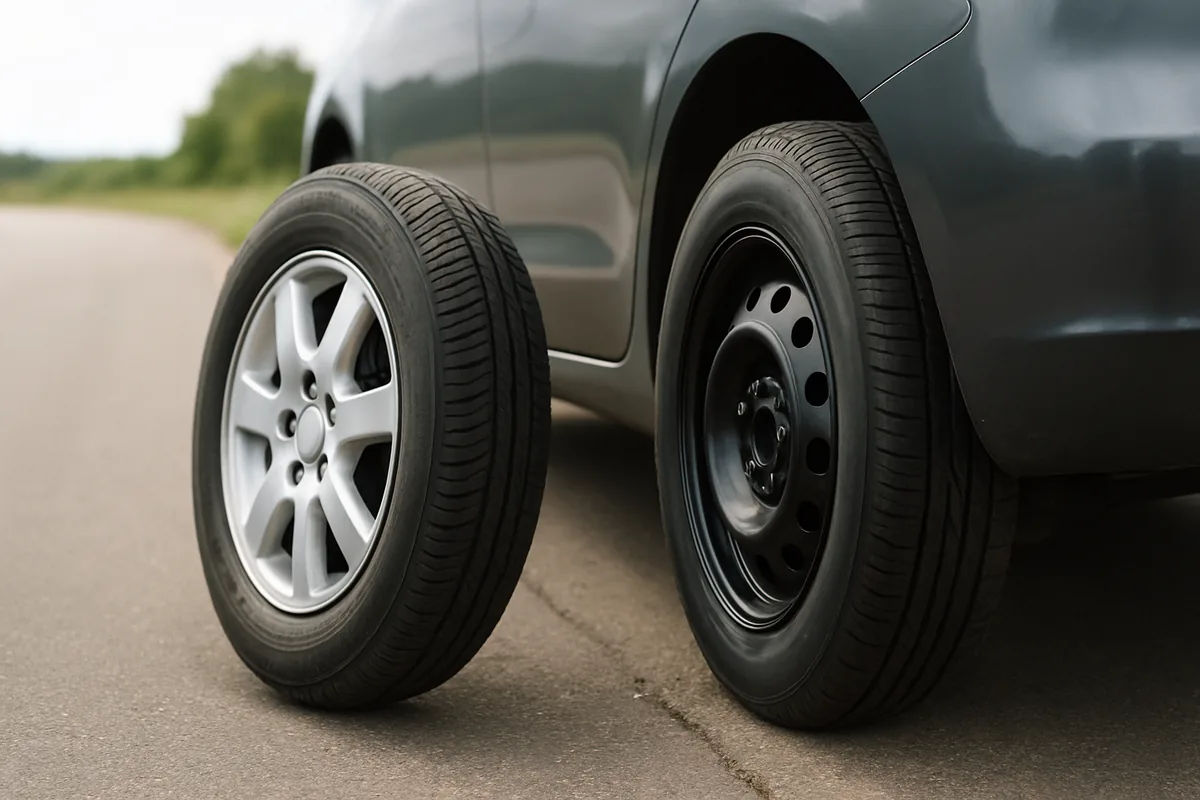
A donut is a get-you-to-help tire. It is smaller, narrower, and more thinly treaded than the tire it replaced, and every limit attached to it follows from that. The rule most people remember is the 50/50 rule: roughly 50 mph, roughly 50 miles.
Treat those as a ceiling rather than a target, and check your own spare before relying on the general figure. This page covers the speed and distance limits and why they exist, the drivetrain warning that matters most on all-wheel drive, how a donut differs from a full-size spare or a run-flat, and the pressure check that decides whether your spare is usable at all. For everything else about tires, see the complete car tire guide.
The 50 mph and 50 to 70 mile figures are the common guidance published by automakers and tire manufacturers, and they vary by vehicle. The limits for your spare are printed on its sidewall and in your owner’s manual, and those override any general rule.
Table of Contents
How fast can you drive on a donut?
Keep a compact spare under about 50 mph. That figure is standard guidance across most automakers, though a few permit slightly more, and the number that applies to you is printed on the spare itself. Check it before you pull away rather than trusting a remembered rule.
The limit exists because a smaller tire spins faster to cover the same ground, and higher rotational speed means more heat. A donut’s lighter construction sheds that heat poorly, and heat is what causes tread separation and blowouts. Speed also compounds every other weakness a donut has: less rubber on the road, less grip in a corner, and a longer stopping distance.
Avoid the freeway if there is any alternative. If you cannot, stay in the right-hand lane, put your hazards on where local rules allow it, hold a steady speed below the sidewall limit, and take the first exit that gets you to a shop. Being the slowest vehicle on a highway carries its own risk, which is another reason a surface route at 40 mph often beats a freeway at 50.
How far can you drive on a donut?
Drive no more than about 50 to 70 miles on a compact spare. Some vehicles specify a little more and some less, so check the sidewall. The distance limit is not a countdown to failure at mile 71, but it is the point past which the risk climbs sharply, and there is no reason to find out where your particular limit sits.
Shallow tread is the reason. A donut carries far less rubber than a full tire, and it wears at a rate that would be alarming on a normal tire. Combine that with the heat a small tire generates and you have a component being consumed while you drive on it.
Head straight to a tire shop rather than running errands on the way. If the original tire has a simple tread puncture, a proper plug-and-patch repair is often possible and far cheaper than replacement, which is covered in how to fix a slow leak in a car tire. If the flat happened at speed or the sidewall is damaged, the tire is scrap and the question becomes replacement instead.
Caution: a donut is not a reason to keep driving on a tire that is already destroyed. If you are weighing whether to fit the spare at all, see whether you can drive a car with a flat tire, because driving on a flat wrecks the wheel and can put you off the road.
Why donut spares have these limits
A donut is smaller in diameter, narrower, and shallower in tread than a normal tire, so it delivers less grip, longer braking distances, and different handling on that corner of the car. The limits are not manufacturer caution for its own sake; they reflect what the tire can physically do.
Tread depth is the part with measurable consequences. AAA’s testing of worn tires found that shallow tread increased average wet stopping distance by 87 feet and reduced handling ability by 33 percent compared with new tires. A donut starts life with less tread than a worn tire has, which is exactly why wet weather demands a further speed reduction. How to judge tread on your regular tires is covered in how to check tire tread depth.
There is also a braking imbalance nobody mentions. Your car now has three tires with one grip level and a fourth with considerably less, so hard braking and hard cornering load that corner differently than the chassis expects. Stability control and ABS will work harder to compensate. Drive as though those systems are your last resort rather than your safety margin: brake earlier, steer smoothly, leave more following distance, and take corners slower than feels necessary.
Several conditions shrink the usable limits further, and they stack. Treat the 50/50 rule as the best case rather than the normal case.
| Condition | Why it matters | Adjust |
|---|---|---|
| Rain or snow | Shallow tread clears water poorly | Well below 50 mph, brake much earlier |
| Fully loaded car | More weight on a small tire means more heat | Reduce speed, shorten the trip |
| Hilly or twisty roads | Cornering loads the weak corner hardest | Slow into bends, no sudden steering |
| Hot weather or long climb | Heat builds faster and is what fails the tire | Stop and let it cool if it is a long run |
| Donut on a drive wheel | It has to transmit power as well as grip | Gentle throttle; shortest route to a shop |
| All-wheel drive | Diameter mismatch strains the drivetrain | Minimize distance or tow |
The all-wheel drive and four-wheel drive warning
On an all-wheel-drive or four-wheel-drive vehicle, a donut’s smaller diameter forces that wheel to rotate faster than the other three, and the drivetrain interprets the mismatch as slip. Sustained, that can overheat and damage a center differential, transfer case, or coupling, which is a repair costing far more than a tire. This is the single most important thing on this page for AWD owners, and most general spare-tire articles omit it entirely.
Minimize use rather than relying on the 50-mile figure. On AWD, the safest options in order are having the car flat-bedded to a shop, driving the shortest possible distance at the lowest practical speed, or fitting a full-size matching spare if you carry one. Your owner’s manual is the authority here, and many AWD manuals set tighter limits than the general rule or advise against donut use altogether.
The same mismatch logic explains why AWD vehicles need closely matched tread depths even when all four tires are full size, which is why replacing a single tire on AWD is its own decision. That is worked through in whether you can replace just one tire on your car.
Donut vs full-size spare vs run-flat
Three different things live in the trunk under the word “spare,” and they allow very different amounts of driving. Identify which you have before deciding how far you can go.
| Type | Speed limit | Distance | Notes |
|---|---|---|---|
| Compact “donut” spare | About 50 mph | About 50 to 70 miles | Temporary only; strict limits on AWD |
| Full-size matching spare | Normal | Normal, if it matches | Must match size and be reasonably close in tread |
| Full-size non-matching spare | Reduced | Short | Different tread depth still stresses AWD systems |
| Run-flat tire (no spare) | Typically about 50 mph | Commonly around 50 miles | You drive on the punctured tire itself |
| Tire sealant kit (no spare) | Reduced | To the nearest shop | Temporary seal on small tread punctures only |
A full-size spare is not automatically a free pass. If it has been in the trunk for eight years while the other four wore down, its tread depth no longer matches, and on an AWD vehicle that difference matters. Check its pressure and give it a look before assuming you can drive normally.
Run-flats change the question entirely, because there is no spare to fit. The tire’s reinforced sidewalls carry the car for a limited distance at reduced speed after losing pressure, and the specific limits are set by the tire and vehicle maker. The flat-tire decision, including run-flats, is covered in whether you can drive a car with a flat tire.
Checking and inflating your spare
Compact spares need much higher pressure than normal tires, commonly around 60 psi, and the required figure is printed on the spare’s own sidewall. That is different from your regular tires, where NHTSA points out that the correct pressure comes from the vehicle’s placard or owner’s manual rather than the number molded into the tire. For a donut, read the spare itself.
Spares lose air sitting in the trunk. A donut ignored for five years is very often too soft to be safe, and an underinflated compact spare handles badly and overheats faster. Check yours at the same time you check the other four, which is the habit that turns a spare from a hopeful object into a working one.
Temperature moves it too, since air pressure falls as it gets colder, and a spare that read correctly in July can be well down in January. The mechanism is explained in whether car tires lose air in cold weather, and the general pressure question in the correct tire pressure for your car. Keeping tires at their specified pressure is also one of the maintenance items the Department of Energy links to safety and fuel economy.
Leave the change itself to roadside assistance if you are on a highway shoulder, on a slope, in the dark, or in traffic. Changing a wheel beside moving vehicles is genuinely dangerous, and no tire is worth standing in a live lane for.
Frequently asked questions
How long can you leave a donut on your car?
A donut spare is meant to get you to a tire shop, not to stay on the car. Replace or repair the original tire within a day or two, and stay inside the roughly 50 to 70 mile limit in the meantime. The thin tread and reduced grip are not built for extended driving.
Can you drive on the highway with a donut?
Avoid highway driving on a donut where you can. Compact spares are limited to about 50 mph, below normal highway speeds, and they offer less grip and stability. If the highway is unavoidable, stay in the right lane, hold a steady speed under the sidewall limit, and exit as soon as possible.
Is it safe to drive on a donut in the rain?
Drive with extra caution on a donut in the rain, because its shallow tread clears water poorly and raises the risk of hydroplaning. Reduce speed well below the 50 mph limit, brake earlier and more gently, avoid sudden steering, and increase your following distance considerably.
Can driving on a donut damage my car?
On a two-wheel-drive car, brief careful use within the limits causes no damage. On an all-wheel-drive or four-wheel-drive vehicle, the donut’s smaller diameter can strain and damage the differential or transfer case. Minimize the distance, keep the speed low, or have the vehicle towed instead.
What to do now
Check the limits printed on your spare, then hold to roughly 50 mph and 50 to 70 miles as a ceiling. Drive gently, brake earlier than usual, slow down further in the wet, and go straight to a tire shop rather than treating the donut as a working tire. On an all-wheel-drive vehicle, keep the distance as short as possible or have the car towed, because a mismatched wheel diameter can damage the drivetrain. Once the real tire is sorted, check the spare’s pressure and put it back properly, so it works the next time.
For pressure, tread, wear, and replacement, see the complete car tire guide, or browse the wider automotive care and repair section.
