

At a Glance
| Fully flat tire | Do not drive. Creep to safety only, then stop. |
| Run-flat tire | Limited distance at reduced speed, then replace. Check the manual. |
| Slow leak, still holding air | Drive gently to an air pump or shop |
| #1 risk of driving flat | Wrecked tire and wheel, then loss of control or a blowout |
| How far on a full flat? | Metres, not miles. Only to reach a safe spot. |
| First move | Slow down gradually, signal, pull off the road, hazards on |
“Can you drive on a flat” is really three questions, because a fully flat tire, a run-flat, and a slow leak are completely different situations with completely different answers. Treating them the same is how people turn a repairable puncture into a new tire and a bent wheel. This guide sorts out which one you are dealing with, gives the honest distance you can cover in each case, and walks through what to do the moment you feel a tire go, including the one roadside mistake that actually gets people hurt.
Run-flat distances and speeds vary by vehicle and tire. Confirm the limits for your car against the owner’s manual and the tire’s sidewall markings, and never treat a general figure as a guarantee.
Table of Contents
Which do you have: flat, run-flat, or slow leak?
Work out which of three situations you have before you decide whether to drive, because the safe answer is different for each. A fully flat tire cannot be driven except to reach safety. A run-flat is engineered to keep going a limited distance at reduced speed. A slow leak that still holds some air can be nursed to a shop. The fastest way to tell them apart is to look at the tire and check whether it is a run-flat, which is marked on the sidewall.
| Situation | Can you drive? | How far / how fast |
|---|---|---|
| Fully flat (no air, tire collapsed on the rim) | No, except to creep to safety | Metres at walking pace, only to get off the road |
| Run-flat (reinforced, marked on the sidewall) | Yes, briefly, within its limit | A limited distance at reduced speed, then replace |
| Slow leak (soft but still holding air) | Yes, gently and briefly | Straight to an air pump or shop, checking pressure |
You can spot many run-flat tires by sidewall markings such as RFT, ROF, ZP, DSST, EMT, or SSR, and by the fact that the car has no spare and does have a tire-pressure monitoring system. If you are not sure, assume it is a standard tire until the sidewall or owner’s manual tells you otherwise. To tell a slow leak from a full flat, the tire that still has some shape and is losing air gradually is a slow leak, while a tire folded flat against the rim is a full flat. NHTSA’s tire-safety guidance recommends checking tire pressure and tread at least once a month so a slow leak is caught before it strands you. If your tire keeps going soft, our guide to how to fix a slow leak covers the repair.
What happens if you drive on a flat?
Driving on a fully flat tire damages the car from the tire outward, and the cost climbs with every mile. First the tire shreds as the collapsed sidewall overheats and tears apart, then the bare wheel rim rides on the road and bends or cracks, and from there the brakes, suspension, and wheel well can take damage. On top of the repair bill, a flat or shredding tire makes the car hard to steer and can cause a loss of control or a blowout.
| What gets damaged | What happens |
|---|---|
| The tire | The sidewall folds, overheats, and tears apart, turning a repairable puncture into a total loss |
| The wheel/rim | With no air cushion, the metal rim rides on the road and bends or cracks, often within a short distance |
| Brakes and suspension | Components near the wheel can be damaged as the car sits and drags unevenly |
| Control of the car | Steering pulls hard toward the flat; a sudden failure at speed can cause loss of control |
Caution: a tire that is low but not yet flat is its own hazard, because an underinflated tire builds heat at speed and can blow out suddenly. NHTSA urges checking any tire that will not hold its proper pressure, and warns against relying on a damaged tire. That heat-and-blowout risk is why a slow leak should be aired up or fixed promptly, not ignored. If you feel a vibration or wobble building at speed, our guide to a car that shakes at 60 mph covers what a failing or damaged tire feels like before it lets go.
How far can you drive on a flat in an emergency?
On a fully flat tire you can drive only far enough to reach a safe spot, which means metres at very low speed, not miles. The moment the tire is running flat, the damage is already happening, so the goal is to get out of the traffic lane and onto a stable, level place off the road, then stop. There is no safe mileage on a fully deflated standard tire; there is only the shortest distance to safety.
A run-flat is the exception, because it is designed for exactly this. Run-flat tires are commonly cited as good for up to around 50 miles at up to about 50 mph after losing pressure, a figure Bridgestone gives for its run-flat line, but the real limit depends on the tire, the load, and the road, so your owner’s manual and the sidewall are the authority. Treat any number as a ceiling to stay well under, not a target to drive to. If you are running on a space-saver spare instead, that has its own limits, covered in our guide to how far you can drive on a spare.
What should you do when you get a flat?
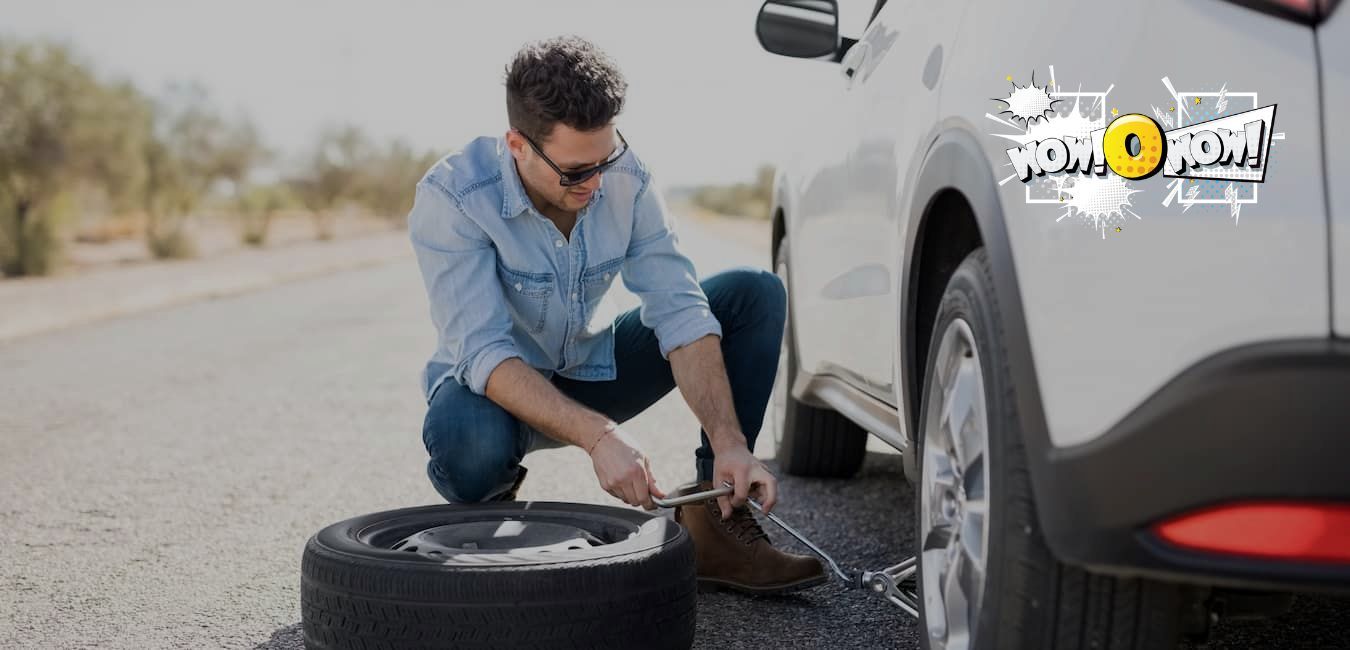
Follow 6 steps when a tire goes flat, and the first ones are about getting stopped safely, not fixing anything. Ease off the accelerator, keep the car straight, and bring it down gradually rather than braking hard, then signal, move to a safe flat spot well off the road, and turn on your hazards. Only once you are safely clear do you decide between the spare, an inflator kit, or a call for help.
- Slow down gradually and keep control. Grip the wheel firmly, ease off the gas, and let the car slow. Do not brake hard or swerve, because a flat already makes the car pull to one side.
- Signal and move well off the road. Get onto a flat, stable surface as far from moving traffic as you can, ideally a parking area or wide shoulder rather than a narrow one.
- Turn on your hazard lights. Make the car visible to other drivers, especially in poor light or weather.
- Assess which situation you have. A full flat, a run-flat within its limit, or a slow leak decides your next move. Check the sidewall and the pressure if you can do so away from traffic.
- Change to the spare, or use an inflator kit, only if it is safe. A sealant or inflator kit is a temporary fix to reach a shop. Fitting the spare needs level, firm ground.
- Call for help if the spot is unsafe. On a narrow highway shoulder, in the dark, or anywhere you cannot get clear of traffic, stay in the car with your seatbelt on and hazards running, and call roadside assistance.
Caution: never change a tire on the traffic side of the car or on soft or sloping ground, because a car can slide off a jack and kill someone. If you cannot get safely clear of moving traffic, do not attempt a roadside change at all. Leave it to roadside assistance if you are on a live highway shoulder, if it is dark or the weather is bad, or if you cannot secure the car on firm level ground. Getting hurt changing a tire is far worse than a ruined tire.
Can you drive on a run-flat with no air?
You can drive on a run-flat tire after it loses air, but only for a limited distance at a reduced speed, and then it usually has to be replaced. Run-flat tires have reinforced sidewalls or an internal support ring that holds the tire’s shape without air, so the car stays stable and controllable long enough to reach a shop. They are a limp-to-safety design, not a way to keep driving indefinitely on a damaged tire.
Two things about run-flats catch people out. First, the distance is an emergency window, not a promise the tire survives; drive gently, avoid sharp turns and hard braking, and head straight for help rather than finishing your errands. Second, a run-flat that has been driven on while flat is usually not repairable and must be replaced, because the reinforced sidewall can hide internal damage. That repairability question is covered more broadly in our guide to a tire plug versus a patch. A run-flat also depends on the tire-pressure monitoring system to warn you at all, since the tire can look normal while flat.
Frequently asked questions
How far can you drive on a flat tire without damaging the rim?
On a fully flat tire you can drive almost no distance without risking the rim, because the metal wheel is riding on the road through the collapsed tire. Even a short distance can bend or crack it. Move only far enough to reach a safe spot off the road, then stop and assess.
Is it better to drive on a flat or change it on the highway?
Neither is ideal, so do the least dangerous thing. Do not drive far on a flat, but do not change a tire on a live highway shoulder either. Move at low speed to the safest spot you can reach, and if that spot is still exposed to traffic, stay in the car and call for help.
Can you put air in a flat tire and drive?
You can put air in a tire and drive if it holds pressure, which can get you to a shop. If it goes flat again quickly, the puncture is too big and driving on it will destroy it. A sealant or inflator kit is a temporary fix for a small puncture, not a repair.
Does driving on a flat make the tire unrepairable?
Driving on a flat usually makes the tire unrepairable, because it damages the sidewall beyond what a safe repair can fix, so the tire must be replaced rather than patched. A run-flat that has been driven on while deflated is also generally not safe to repair and should be replaced.
How do I know if I have run-flat tires?
You can tell you have run-flat tires from sidewall markings such as RFT, ROF, ZP, DSST, EMT, or SSR, and from the car having no spare but a tire-pressure monitoring system. If you cannot find a marking, check the owner’s manual or ask a tire shop, and until you confirm it, assume the tire is a standard one.
What to do right now
Work out which situation you have and act on it. A fully flat tire should not be driven beyond creeping to a safe spot, because you will destroy the tire and likely the wheel within a mile. A run-flat can carry you a limited distance at reduced speed before it needs replacing, and a slow leak that still holds air can be driven gently to a pump or shop. Whatever you have, get off the road first, put your hazards on, and never change a tire on the traffic side or on unstable ground. For pressure, tread, repair, and replacement in one place, see our complete car tire guide. If your tire keeps losing air, start with why your tires keep losing air, and more car care and troubleshooting help lives on our car care and troubleshooting hub.
