

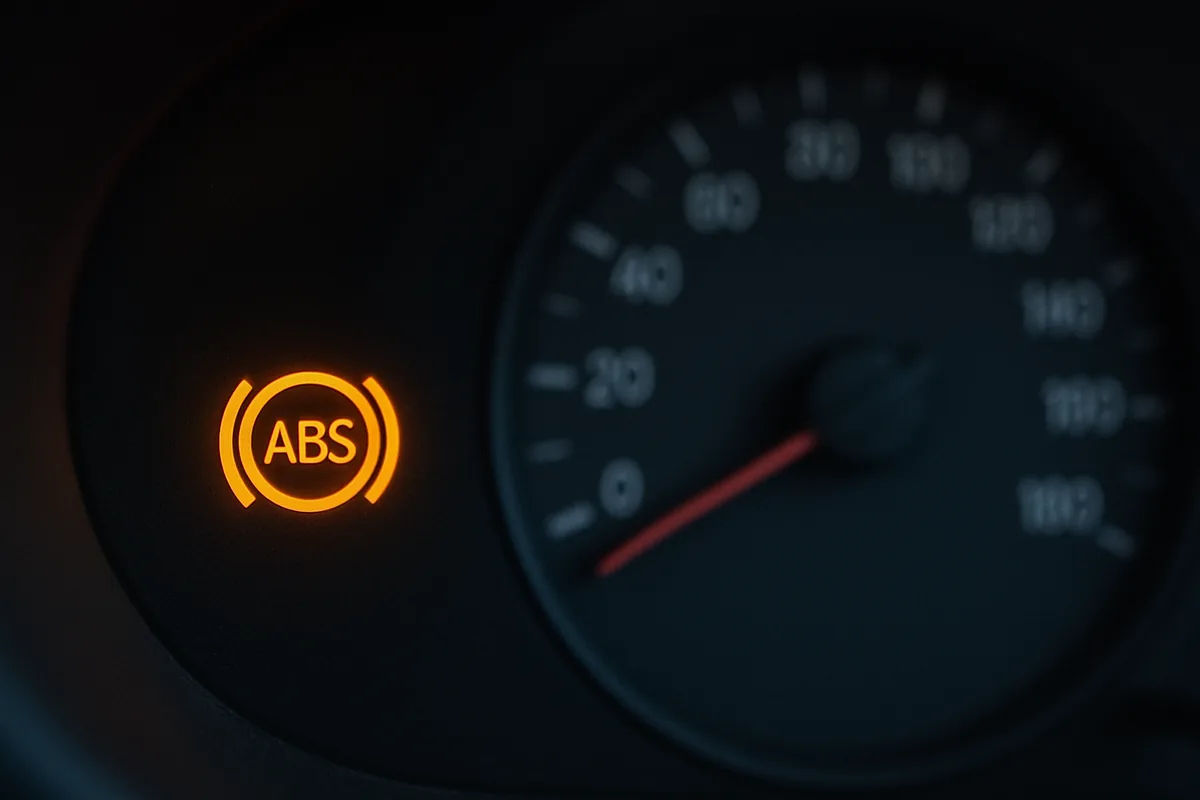
| What it is | A fault in the anti-lock braking system (ABS) |
| Safe to drive? | ABS light alone: usually yes, carefully. ABS plus red brake light: no, urgent. |
| What you lose | Anti-lock assist; the wheels can lock during hard braking |
| Most common cause | A faulty or dirty wheel speed sensor |
| Check first | The brake fluid level |
The ABS light is one of the most misunderstood warnings on the dashboard, because on its own it is far less alarming than it looks, yet paired with the red brake light it becomes urgent. What follows is what the light means, the two-light difference that decides how worried to be, what you actually give up when ABS is off, the ranked causes, and how it gets diagnosed.
Repair costs below are broad typical ranges that shift with your make, model, and local labor rates, so treat them as ballpark figures and confirm a quote for your vehicle.
Table of Contents
What does the ABS light mean on a car?
The ABS light means the anti-lock braking system has detected a fault and shut itself off, usually shown as an amber “ABS” symbol or the letters in a circle. Anti-lock braking works alongside your normal brakes, using a wheel speed sensor at each wheel and a hydraulic control unit to keep the wheels from locking during hard braking. When the system spots a problem it cannot work around, it turns on the warning light and stores a trouble code. A NHTSA study on the long-term effect of anti-lock brakes found that ABS lets a driver steer while braking and, on many surfaces, shortens stopping distances, which is the protection the light is telling you may be off.
The light itself does not name the cause. It tells you the anti-lock system is disabled and a code is waiting to be read. To decode the rest of your dashboard, see our complete guide to dashboard warning lights and terms.
ABS light alone vs ABS and brake light together
The ABS light alone and the ABS light with the red brake light are two very different situations. The ABS light on its own means anti-lock is disabled but your base braking is intact, so you can drive with care and get it diagnosed soon. The ABS light together with the red brake warning light points to a problem in the primary braking system, such as low brake fluid or a hydraulic fault, and that combination is urgent.
| Which lights | What it usually means | What to do |
|---|---|---|
| ABS light only (amber) | Anti-lock is off, but normal braking still works | Drive carefully, avoid hard braking on slick roads, get it diagnosed soon |
| ABS light + red brake light | A wider brake-system fault, possibly low fluid or hydraulic pressure | Slow down, brake gently, and stop if the pedal feels soft or weak |
| Red brake light only | Often the parking brake, low fluid, or worn pads | Confirm the parking brake is off, then check fluid; treat a real fault as urgent |
Caution: a soft, spongy, or sinking brake pedal with either light on means your ability to stop may be compromised, so do not drive and call for help. A pedal that drops toward the floor is covered in our guide to a brake pedal that goes to the floor, and losing braking on the road is covered in brake failure on the road.
What do I actually lose when the ABS light is on?
With the ABS light on, you lose the anti-lock assist, which means the wheels can lock during a hard or emergency stop. A locked wheel skids instead of gripping, so the car slides straight ahead and you cannot steer around an obstacle while braking. On wet, icy, or loose surfaces that skid also lengthens how far it takes to stop. In normal, gentle braking you may feel no difference at all.
According to NHTSA’s guidance on anti-lock brakes, ABS works with your foundation brakes and simply keeps them from locking up, and the correct technique is to keep firm, steady pressure on the pedal rather than pumping it. With the system off, that automatic protection is gone, so leave extra following distance and avoid hard stops until it is fixed, especially in the rain or on ice.
What causes the ABS light to come on?
The ABS light has a handful of common triggers, and a wheel speed sensor is by far the most frequent. Ranked from most to least common, the usual causes are a faulty or dirty wheel speed sensor, a damaged sensor ring, low brake fluid, a blown ABS fuse, a failing ABS module or pump, and damaged wiring. Because the anti-lock system shares its wheel speed sensors with traction and stability control, one bad sensor often lights those warnings at the same time.
| Likely cause | How to confirm | Typical repair | Typical cost (varies) |
|---|---|---|---|
| Faulty or dirty wheel speed sensor | ABS code points to a specific wheel | Clean or replace the sensor | $100 to $400 per wheel |
| Damaged sensor / tone ring | Code plus inspection at the hub | Replace the ring, often with the hub | $200 to $600+ |
| Low brake fluid | Check the reservoir; often lights the red brake light too | Top up and find the leak | Fluid is cheap; leak repair varies |
| Blown ABS fuse | Check the fuse box | Replace the fuse | A few dollars for the fuse |
| Failing ABS module or pump | Scan reports a module fault | Repair or replace the module | $300 to $1,000+ |
Low brake fluid is the one cause an owner can check and sometimes fix. If the reservoir is low, top it up with the fluid specified in your owner’s manual and look for the reason it dropped, because brake fluid does not disappear on its own. See how to put brake fluid in a car for the correct fluid and level.
How do I get the ABS light diagnosed?
Diagnosing the ABS light starts with reading its code, which points to the faulty sensor or circuit rather than leaving you to guess.
- Use an ABS-capable scanner. Many basic code readers only pull engine codes and cannot read ABS or chassis codes, so you may need a scanner that reads the brake system specifically.
- Read and write down the code. The code identifies which wheel or component is at fault, which saves replacing parts on a guess.
- Check the brake fluid first. If the fluid is low, top it up and inspect for a leak, since low fluid can trigger the ABS light and the red brake light together.
- Hand the repair to a professional. Confirming and replacing a wheel speed sensor, module, or hydraulic part is skilled brake work, and swapping the module on a code alone often wastes money.
Leave the actual repair to a qualified mechanic whenever it involves the ABS module, the hydraulic unit, or anything you cannot confirm, because the braking system is not the place for trial-and-error. To check that your base brakes are still working well in the meantime, see how to test brakes on a car.
Can I turn the ABS light off?
The ABS light usually turns itself off once the underlying fault is fixed, and no manual reset is needed on most cars. A scan tool can clear the code, but clearing it without repairing the cause only hides a disabled safety system, and the light returns the next time the system checks itself. Do not mask the light to make it look fixed, because a cleared code with an unrepaired fault means your anti-lock brakes are still off. Ignoring brake warnings tends to cost more later, as laid out in the cost of ignoring brake problems.
Frequently asked questions
Is it safe to drive with the ABS light on?
Driving with the ABS light on alone is usually safe for short, careful trips, because your normal brakes still work. What you lose is anti-lock assist, so avoid hard braking, leave extra distance, and get it diagnosed soon. If the red brake warning light is also on, treat it as urgent and have the car checked before driving far.
Why are my ABS and traction control lights on together?
ABS and traction control lights often come on together because they share the same wheel speed sensors. A single failed or dirty sensor can trigger both warnings at once, since traction and stability control rely on the same signals as the anti-lock system. Diagnosing and fixing that one sensor usually clears both lights.
Will the ABS light fail an inspection?
An illuminated ABS light can fail a safety inspection in many places, because anti-lock braking is a safety system, though the rules vary by state and region. Clearing the code without a repair does not help, since the fault and the light usually return. Have the actual cause fixed before an inspection rather than masking the warning.
Can low brake fluid cause the ABS light?
Low brake fluid can trigger the ABS light, and it often lights the red brake warning light at the same time. Check the reservoir, and if it is low, top it up with the correct fluid and look for a leak, because the level should not drop on its own. Low fluid that keeps returning points to worn pads or a leak that needs a shop.
What does the ABS light look like?
The ABS light usually appears as the letters ABS inside a circle, or simply the letters, glowing amber or yellow. It briefly lights during startup as a bulb check on most cars, which is normal, and then goes out. If it stays on while you drive, the anti-lock system has logged a fault and switched off.
How much does it cost to fix the ABS light?
Fixing the ABS light ranges from almost nothing to over a thousand dollars, depending on the cause. A wheel speed sensor, the most common culprit, often runs about $100 to $400 per wheel, while an ABS module or pump can cost $300 to $1,000 or more. These are broad ranges that change with your vehicle and local labor, so get a quote before approving the work.
What to do now
Read the two lights before you worry. An ABS light on its own means your normal brakes still work, so drive gently and get it scanned soon, and check the brake fluid first since that is the one owner-fixable cause. The ABS light together with the red brake light is the urgent case: brake carefully, and stop if the pedal feels soft or wrong. Do not simply clear the code, because that leaves a safety system switched off.
If a check engine light is on too, see what the check engine light means. For everything else, visit our car care and troubleshooting hub.
