

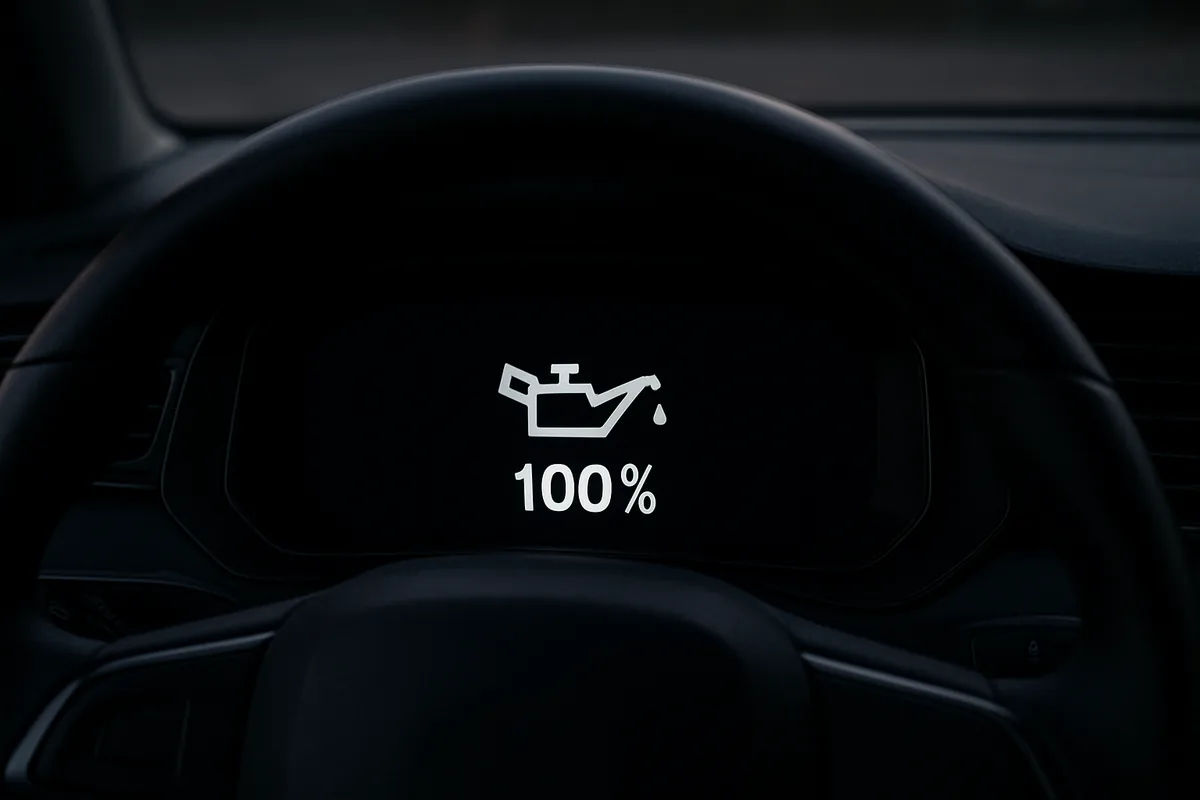
At a Glance
| What it means | How much service life your car estimates the oil has left |
| What it is not | Your oil level, and not a lab test of the oil |
| How it is produced | Calculated from engine data, not read from an oil sensor |
| Typical reminder point | Around 15% on many systems |
| Also applies | Your manual’s time limit, whatever the number says |
| Must you reset it? | Yes, after every oil change, or the number is wrong |
The number on your dash is doing something cleverer than most drivers assume, and something less clever than the rest assume. It is not counting miles. It is also not analysing your oil. It sits between those two ideas, and knowing which one it is changes how much you should trust it.
This page explains what the percentage is, how your car arrives at it, why it has nothing to do with your oil level, what to do at each reading, and why the reset step matters more than people think. For intervals, oil types and everything else, see the complete oil and engine oil guide.
Reminder thresholds and reset procedures differ by manufacturer and model year. The figures below are typical manufacturer guidance and are attributed to the carmaker that publishes them. Your own owner’s manual is the authority for your car.
Table of Contents
How is oil life percentage calculated?
Oil life percentage is calculated by your car’s computer from engine operating data, not measured by a sensor sitting in the oil. The system tracks things like engine revolutions, operating temperature, trip length and load, then applies a model that estimates how quickly the oil is aging under that specific use. A few premium systems use a genuine oil quality sensor, but the common type does not.
Honda states this plainly in its owner’s manuals, explaining that the onboard computer calculates remaining engine oil life from engine operating conditions and accumulated engine revolutions and displays the result as a percentage. Chevrolet describes its own system the same way, as one that estimates how long the oil will last based on how you use the vehicle.
The practical upshot is that the number responds to your driving. Steady highway miles age oil slowly and the percentage falls slowly. Short winter trips where the engine never fully warms age it quickly, and the number drops faster than the odometer suggests it should. That adaptiveness is the whole point, and it is why the reading beats a fixed mileage number for most drivers.
It also means the system is trusting some assumptions. It assumes the correct oil grade went in, that the level is right, and that somebody reset it at the last change. Break any of those and the percentage is confidently wrong.
Oil life percentage is not your oil level
Oil life percentage tells you how aged the oil is. It tells you nothing about how much oil is in the engine. These are two separate systems measuring two separate things, and confusing them is the single most common mistake drivers make with this number. You can sit at 90% oil life and still be dangerously low on oil.
Nothing in the oil life calculation looks at the level, because the level is not one of its inputs. A car burning or leaking oil will keep counting down normally while the sump empties. Honda’s own maintenance guidance treats these as separate jobs, listing the engine oil level as an owner check to perform every time you fill the fuel tank, independent of the Maintenance Minder display. The dipstick method takes about a minute and is set out in how to check your engine oil level.
The warnings are different too. A low oil life percentage is a service reminder. A red oil pressure warning is an emergency. Chevrolet separates them explicitly, telling drivers that a “Change Engine Oil Soon” message means service as soon as possible, while an “Oil Pressure Low, Stop Engine” alert means stop the vehicle safely and do not restart it, because running an engine with low oil pressure damages it.
Caution: never use the oil life percentage as evidence that your oil level is fine. Check the dipstick on its own schedule, whatever the dashboard says.
What the percentages actually mean
Oil life percentage counts down from 100% to 0%, with most systems raising a reminder somewhere in the mid teens and a firmer message near zero. The exact trigger points differ by manufacturer. The pattern below reflects Honda’s published thresholds and is typical of how these systems behave generally.
| Reading | What it means | What to do |
|---|---|---|
| 100% | Fresh oil, monitor recently reset | Nothing. Note the date |
| 99 to 40% | Oil comfortably within its service life | Nothing, but keep checking the level |
| 40 to 20% | Oil aging normally | Start thinking about booking the change |
| 15% | Reminder point on many systems, including Honda’s | Book the service now |
| 10 to 5% | Past the reminder, service message appearing | Get it done rather than deferring again |
| 0% or negative | Past the estimated service life of the oil | Change it promptly |
One rule sits above the whole table. The time limit in your manual applies regardless of the percentage, because oil ages whether or not the car moves. Chevrolet is explicit that the engine oil and filter must be changed at least once a year even on a car driven so gently that the monitor never asks. Consumer Reports makes the same point from the chemistry side, noting that oil breaks down over time even when a car is parked for an extended period.
If what you actually want is the interval itself, meaning how many miles or months your car should go between changes, that is a different question and it is answered in how long a car can go without an oil change.
Can I keep driving at low oil life percentage?
A low oil life percentage is safe to drive on. It is a maintenance reminder, not a stop-driving warning, and reaching 0% does not mean the engine is in danger this afternoon. Book the change and carry on in the meantime. Chevrolet frames the window as servicing within the next several hundred miles once the change message appears rather than immediately.
Do not let that become permission to ignore it for months. The percentage is an estimate of when the oil stops protecting properly, and driving well past zero means running on oil the manufacturer has already written off. The number reaching zero is the beginning of the overdue period, not a grace period.
The distinction that matters is which light you are looking at. An oil life reminder is amber-grade information. A red oil pressure warning is an immediate stop, and the two get confused constantly because both mention oil. Which dashboard symbol is which, and what each one is asking of you, is covered in what the oil light means.
Resetting the oil life percentage after a change
Reset the oil life monitor to 100% after every oil change, or it keeps counting down from the old value and quietly misleads you from then on. The reset is not automatic on most vehicles. A dealer or shop normally does it as part of the service, but an independent garage or a driveway change can easily miss it.
Honda’s manual is unusually direct about the consequences, warning that doing the service without resetting the display, or resetting it without doing the service, means the system no longer shows the proper maintenance intervals and that this can lead to serious mechanical problems. Chevrolet likewise states that the oil life system must be reset as part of the annual oil and filter change.
The method varies. Most cars use a sequence in the driver information display or a button held for several seconds with the ignition on and the engine off, and your owner’s manual has the exact steps for your model. Ask whoever changes your oil to confirm they reset it, then check the display reads 100% before you drive away. That confirmation belongs on the oil change checklist alongside the other post-service checks.
Frequently asked questions
At what oil life percentage should I change my oil?
Plan the change as the reading approaches about 15%, which is the reminder point on many systems, and have it done by the time it reaches 0%. Your manual’s time limit applies as well, so change the oil at that interval even if the percentage is still high.
Does a low oil life percentage mean I am low on oil?
A low oil life percentage does not mean the oil level is low. The percentage tracks how aged the oil is, while the level is a separate thing you check on the dipstick. A car can show plenty of remaining oil life and still be running low on oil.
Is oil life percentage accurate?
Oil life percentage is a reliable guide because it adapts to how the car is actually driven, counting down faster under hard use. It remains an estimate rather than a laboratory analysis, so pair it with your manual’s time limit and an occasional look at the oil on the dipstick.
Why did my oil life drop so fast?
Severe use makes the monitor count down faster, because short trips, towing, heavy loads, idling and extreme temperatures all age oil more quickly. A rapid drop usually reflects tough driving conditions rather than a fault. Compare it against how you have actually been using the car.
What to do now
Read the percentage as an aging estimate rather than a measurement: plan the change as it nears 15%, have it done by 0%, and change the oil at your manual’s time limit even if the number is still high. Check your oil level separately on the dipstick, because the percentage knows nothing about how much oil is in the engine. Confirm the monitor reads 100% before you leave the shop after any change. A low percentage is a reminder you can drive on, but a red oil pressure warning means stop the car and do not restart it.
For intervals, oil types, leaks and consumption, see the complete oil and engine oil guide, or browse the wider automotive care and repair section.
