

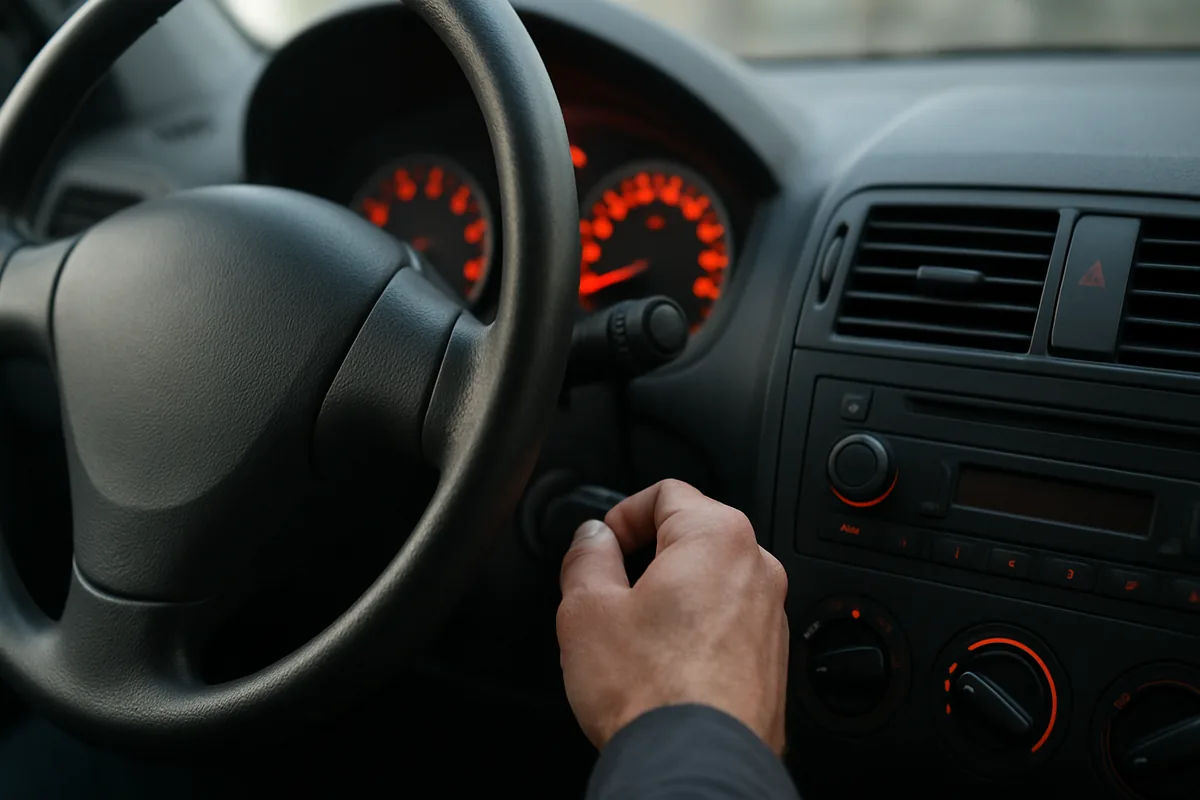
At a Glance
| What it means | The starter works and the engine turns over, but it will not fire |
| Most likely causes | Fuel delivery or ignition (spark), not the battery |
| Battery or fuel/spark? | If it cranks, the battery is fine; look at fuel and spark |
| Fast free check | Listen for the fuel-pump hum when you turn the key to on |
| Safe to drive? | Not until it starts. Crank in short tries, then tow it for testing |
| Typical fix cost | From fresh fuel or a filter up to a fuel pump or timing repair |
This guide covers the cranks-but-no-start: why a turning engine still will not fire, how to tell a fuel problem from a spark problem, the immobilizer and flooded-engine cases, a diagnosis order you can follow, and rough repair costs.
Fuel pressures, immobilizer behavior, and repair costs are make-specific. Confirm anything numeric against your owner’s manual or a quote for your vehicle, and never keep cranking to force a start.
Table of Contents
Cranks vs clicks: which problem do you have?
The first thing to settle is whether the engine cranks or just clicks, because the two point to different systems. If the engine turns over, the rhythmic whir as it spins, but never fires, the battery and starter are doing their job, and the problem is fuel, spark, or compression. If it only clicks or does not turn over at all, that is a battery, connection, or starter problem instead.
| What you hear | What it means | Where to look |
|---|---|---|
| Engine spins and whirs but never fires | Battery and starter are fine; no fuel, spark, or compression | This page: fuel and ignition |
| A single click or rapid clicking, no spin | Weak battery, bad connection, or starter | The clicking guide |
| Nothing at all, no crank or click | Dead battery, ignition switch, or safety switch | Battery and starting checks |
If yours only clicks, read our guide to a car that won’t start and just clicks instead. If the dash and radio work but it will not turn over at all, see why the car won’t start but the radio works.
Fuel problems: no fuel to fire
A cranking no-start often means fuel is not reaching or igniting in the cylinders. The common fuel causes are a failed fuel pump, a bad fuel-pump relay or fuse, a clogged fuel filter, or bad, contaminated, or simply empty fuel despite what the gauge says. AAA lists a failed fuel pump or relay among the top reasons a car with a charged battery still will not start.
Confirm it without tools: turn the key to on, without cranking, and listen at the back of the car for a short hum as the fuel pump primes. No hum can mean a dead pump, relay, or fuse, though some cars only run the pump while cranking, so check your owner’s manual.
Caution: fuel is flammable, so keep sparks and flames away, and do not crank repeatedly if you smell raw gas. Hand it to a shop once it needs fuel-pressure testing. For the roadside workaround and its limits, see whether you can start a car with a bad fuel pump.
Spark and ignition problems: no spark to fire
No spark is the other big cause, because without a spark at the right instant the fuel cannot ignite. The usual culprits are worn spark plugs, a failed ignition coil, or a bad crankshaft or camshaft position sensor that stops telling the computer when to fire. A telling pattern is a no-start that happens only when the engine is hot and clears once it cools, which often points to a crankshaft position sensor.
Ignition faults usually need a scan tool or a spark tester to pin down, so this is mostly shop territory. If your no-start is tied to temperature, whether it fails hot or only when very cold, see our guide to a car that won’t start when cold but starts when warm, and for the sensor workaround, how to start a car with a bad crankshaft sensor.
Compression, timing, and the flooded-engine case
Two less-common causes and one quick fix round out the picture. Low compression or a jumped or broken timing belt means the engine spins freely but cannot build the pressure it needs to fire, and that is a major repair. A flooded engine, where too much fuel has wet the spark plugs, is the one case you can often clear yourself.
| Cause | How to tell | What to do |
|---|---|---|
| Flooded engine | Strong raw-fuel smell after several crank attempts, often in the cold | Clear it as below; stop cranking if you smell fuel |
| Jumped or broken timing belt | Engine spins fast and freely but never fires; may have quit while driving | Tow to a shop; this is a major repair |
| Low compression | A long history of rough running; fails a compression test | Shop diagnosis; often a major engine repair |
To clear a flooded engine on most modern cars, hold the accelerator pedal to the floor while cranking for several seconds, which tells the computer to cut fuel so the excess can clear. Check your owner’s manual first, since the exact method varies by make and model. A no-start right after a fill-up can also be a flooded engine or a tank of bad fuel, covered in our guide to a car that won’t start after getting gas.
Caution: stop cranking if fuel drips or the smell is strong, and crank only in short bursts, since continuous cranking overheats the starter.
Is it the anti-theft or immobilizer?
If the car cranks but will not start and a security or key-shaped light is flashing, the immobilizer may not recognize the key and is blocking the fuel or spark. A dead key-fob battery, a worn or copied key, or a key that was never fully programmed can all trigger it. Try your spare key, and replace the fob battery if the engine starts or the light behaves with a different key. Immobilizer behavior varies by make, so your owner’s manual is the reference for what the light means on your car.
How to diagnose it, in order
Work through these owner-level checks in order before spending on parts, since they narrow a cranking no-start quickly.
- Confirm it cranks, not clicks. Make sure the engine actually turns over. A click or no spin is a battery or starter problem, not this one.
- Listen for the fuel-pump hum. Turn the key to on without cranking and listen for a short hum from the tank. No hum points at the pump, relay, or fuse.
- Check the security light. If a security or key light is flashing, suspect the immobilizer and try your spare key.
- Scan for trouble codes. An OBD-II scanner can flag a crankshaft-sensor, fuel, or ignition fault the computer has stored.
- Note hot versus cold. A no-start only when hot points toward a crankshaft position sensor; only when very cold can point to fuel or a flooded engine.
- Stop and hand it off. Once it needs fuel-pressure or spark testing, that is shop work. Have it inspected by an ASE-certified technician rather than guessing at parts.
Caution: crank only in short tries of a few seconds, since continuous cranking overheats the starter and drains the battery.
What does it cost to fix?
Costs range widely by cause and vehicle, so confirm the cheap ones first and get a quote for your car. Ordered from least to most expensive, here is roughly what each common fix involves.
| Fix | What it involves | Typical range (confirm a quote) |
|---|---|---|
| Bad or empty fuel | Drain and refill with fresh fuel | Low, sometimes just a fill-up |
| Fuel filter | Replace a clogged filter | Modest |
| Spark plugs or a coil | Replace worn plugs or a failed coil | Moderate |
| Crankshaft position sensor | Replace the sensor | Moderate |
| Fuel pump | Replace the in-tank pump | Higher |
| Timing belt or compression repair | Major engine work | High |
A premium part or a hard-to-reach in-tank fuel pump pushes the top of each range higher, so treat these as general figures to verify against a local quote.
Frequently asked questions
What does it mean when a car cranks but won’t start?
A car that cranks but will not start means the starter is turning the engine over, but the engine cannot fire, so it is missing fuel, spark, or compression rather than having a battery or starter fault. Fuel delivery and ignition problems are the most common reasons, and the battery is usually fine.
Why does my car crank but not start when hot?
A no-start that happens only when the engine is hot often points to a failing crankshaft position sensor, which can cut out at high temperature and stop the computer timing the spark. It usually restarts once the engine cools down. Fuel-vapor problems can cause a similar hot-only no-start.
Why does my car crank but not start after getting gas?
A no-start right after refueling can be a stuck EVAP purge valve flooding the engine with fuel vapor, or simply bad or contaminated fuel from the last fill. Try cranking with the accelerator held steady, and if it keeps happening, have the EVAP system and the fuel checked.
Can a bad battery make a car crank but not start?
A bad battery does not usually make a car crank but not start, because if it is cranking normally the battery has enough power to run the ignition and fuel systems. A weak battery causes slow cranking or clicking instead. A cranking no-start is a fuel or spark problem.
What to do now
Because the engine cranks, stop suspecting the battery and work fuel, spark, and security in order: listen for the fuel-pump hum, check for a flashing security light, scan for codes, and note whether it fails hot or cold. Safe to drive? Not until it starts. Crank only in short tries, and if it will not catch, have it towed for fuel-pressure and spark testing rather than draining the battery. For a full picture, see our complete car won’t start guide, or browse more automotive guides.
