

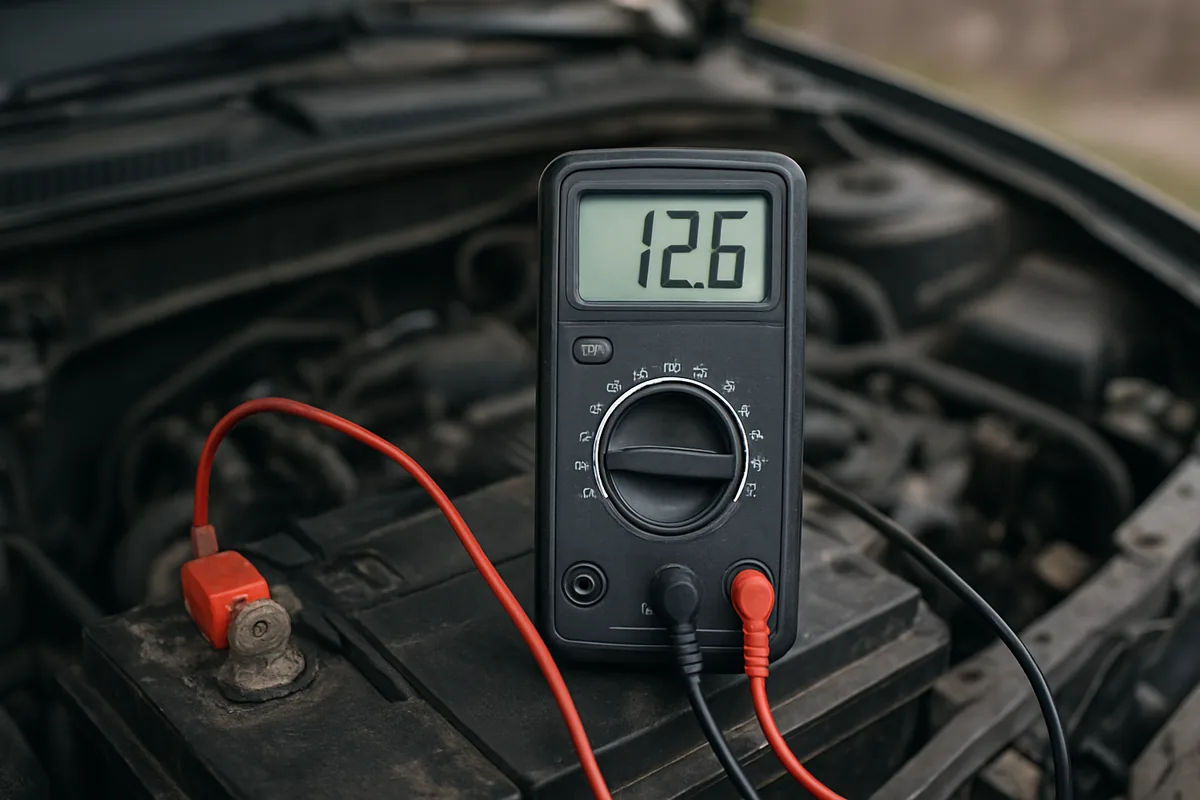
| What you’ll do | Read battery voltage at rest, while cranking, and while charging |
| Tool needed | A digital multimeter set to DC volts, 20V range |
| Healthy resting voltage | About 12.6V, fully charged |
| Under cranking | Should stay above roughly 9.6 to 10V |
| Engine running (charging) | About 13.5 to 14.7V from the alternator |
| Main hazard | Hydrogen gas and acid; no sparks, wear eye protection |
This guide walks through the three voltage tests that reveal a car battery’s health with nothing but a multimeter: the resting voltage that shows its state of charge, the cranking voltage that tests it under load, and the charging voltage that checks the alternator. It also covers the surface-charge step most guides skip.
The voltages here are standard reference values for a 12-volt lead-acid battery. Temperature shifts them and your exact figures can vary, so treat them as a guide and confirm against your battery’s label or maker.
Table of Contents
What you’ll need and how to set up the multimeter
You need a digital multimeter, eye protection, and gloves. Set the meter to DC voltage, shown as a V with a solid and a dashed line above it, and choose the 20-volt range so it can read up to 20 volts. Keep the engine and all accessories off for the resting test, and make sure the terminals are clean, since corrosion can skew the reading.
- A digital multimeter set to DC volts, 20V range
- Eye protection and gloves
- Engine and accessories off for the resting test
- Clean, corrosion-free battery terminals
If your multimeter has separate sockets, plug the black lead into the COM port and the red lead into the port marked for volts, usually a V with the ohm symbol; the wrong ports are a common reason a reading looks off. The positive terminal is marked with a plus and is usually the red one. If you are not sure which is which, see whether red is positive on a car battery before you connect the probes.
Caution: work in a ventilated spot, keep sparks and flames away, and wear eye protection, since a battery gives off hydrogen gas and contains acid.
Test 1: resting voltage (state of charge)
The resting voltage shows how charged the battery is. For an accurate reading, test after the car has sat a few hours, or remove the surface charge first so it does not read falsely high. A battery that has just been driven holds a surface charge that can read falsely high, sometimes over 13 volts, so the resting number is only trustworthy once that charge has bled off. Then compare your number to the state-of-charge chart.
- Remove the surface charge. Let the car sit a few hours, or turn the headlights on for about 30 seconds and then off.
- Set the meter to DC volts. Choose the 20-volt range so it reads up to 20 volts.
- Connect the probes. Touch the red probe to the positive terminal and the black probe to the negative terminal.
- Read and compare. Note the voltage and compare it to the chart below.
| Resting voltage | State of charge |
|---|---|
| 12.6V or higher | 100% (fully charged) |
| About 12.4V | About 75% |
| About 12.2V | About 50% (discharged) |
| About 12.0V | About 25% |
| Below 12.0V | Nearly flat |
Temperature shifts these numbers, since cold lowers the reading and a healthy battery can look low on a freezing morning. AAA notes that a battery can lose a large share of its strength in the cold, so it is worth testing before winter. For more on that effect, see how cold weather affects a car battery, and for how long a battery holds charge while parked, see how long a car battery lasts without driving.
Test 2: cranking voltage (the battery under load)
A resting voltage can look fine on a battery that collapses under load, so test it while the engine cranks. This is the step that catches a battery which passes the resting check but still fails to start the car.
- Keep the probes connected. Leave the red and black probes on their terminals.
- Have a helper crank the engine. Watch the voltage as the starter turns the engine over.
- Check the low point. The voltage should dip but stay above roughly 9.6 to 10 volts. A drop well below that means a weak battery, even if the resting reading looked healthy. Starting pulls hundreds of amps for a moment, far more than any other load, so a cell that is breaking down can hold a resting charge yet collapse the instant that draw hits.
Caution: keep the meter leads, your hands, and loose clothing clear of the belt, fan, and hot parts while the engine cranks, and crank only in short bursts. A battery that fails this test is a common reason a car won’t start and just clicks.
Test 3: charging voltage (is the alternator working?)
The charging test checks the alternator, not the battery. With the engine running, the alternator should raise the voltage across the battery well above its resting level.
- Start the engine. Leave the probes on the terminals, red to positive and black to negative.
- Read the running voltage. It should rise to about 13.5 to 14.7 volts as the alternator charges the battery.
- Judge the result. A reading that stays near 12 volts means the alternator is not charging, while a sustained reading above about 14.7 volts means it is overcharging.
For a fuller check, switch on the headlights and blower with the engine running and confirm the voltage still holds in the mid-13s to high-14s under that load; a charging voltage that sags with the lights on points to a tiring alternator. Both of those are charging-system problems, not battery problems. If the charging voltage is fine but the battery still goes flat overnight, the cause is usually a parasitic drain, which is measured in amps rather than volts. That test is covered in why a car battery drains so fast.
What the readings mean
Put the three readings together to reach one verdict. Use this table to turn the numbers into a next step.
| Your readings | What it means | Next step |
|---|---|---|
| 12.6V rest, holds above 9.6V cranking, 13.5 to 14.7V running | Healthy battery and charging system | Nothing needed |
| Good rest and cranking, but low running voltage | Battery is fine; the alternator is not charging | Have the charging system checked |
| Good rest, but drops below 9.6V while cranking | A weak battery failing under load | Charge and re-test, or replace |
| Will not hold 12.6V at rest after charging | The battery cannot hold a charge | Replace the battery |
For what wears a battery out in the first place, see what causes a car battery to die.
When you need a load tester instead
A multimeter reads voltage, but it cannot measure cold-cranking amps, the battery’s real ability to deliver current. For a marginal battery, a dedicated load tester or a shop’s conductance tester applies a real load and gives the definitive answer, and many auto parts stores test batteries for free. Cold-cranking amps, or CCA, is the rating a battery is sold on, and it falls as the battery ages; a conductance tester estimates the CCA left in seconds, which a voltmeter simply cannot show. Cold also saps battery power, so NHTSA advises having the battery and charging system checked before winter. If your results are borderline, have it load-tested by an ASE-certified technician.
Frequently asked questions
What voltage should a car battery read?
A healthy car battery reads about 12.6 volts at rest when fully charged, and around 13.5 to 14.7 volts with the engine running as the alternator charges it. Below about 12.4 volts means it is partly discharged, and below 12.0 volts it is nearly flat and needs charging.
How do I know if my battery is bad or just discharged?
Charge the battery fully, then test it. If it will not hold about 12.6 volts at rest, or the voltage drops well below 9.6 volts while cranking, the battery is failing rather than just flat. A load test at a shop or parts store confirms whether it needs replacing.
Should I test the battery with the engine on or off?
Test the resting voltage with the engine off, ideally after the car has sat, and test the charging voltage with the engine running. The off reading checks the battery’s state of charge, while the running reading checks whether the alternator is charging it properly. They are two different tests.
Why does my battery read 12.6V but the car won’t start?
A battery can show a healthy 12.6 volts at rest yet still fail under the heavy load of starting, because a weak cell collapses when the starter draws hundreds of amps. Watch the cranking voltage or have a load test done, since resting voltage alone cannot catch this.
What to do now
Testing a car battery takes three quick reads: check the resting voltage against the chart, where about 12.6 volts is full; watch it while cranking, where it should stay above roughly 9.6 volts; and check it with the engine running, where about 13.5 to 14.7 volts shows a working alternator. Get a free load test if the result is borderline.
Caution: keep sparks away and wear eye protection near the battery. For everything else on keeping a battery healthy, see our complete car battery guide, or browse more automotive guides.
