

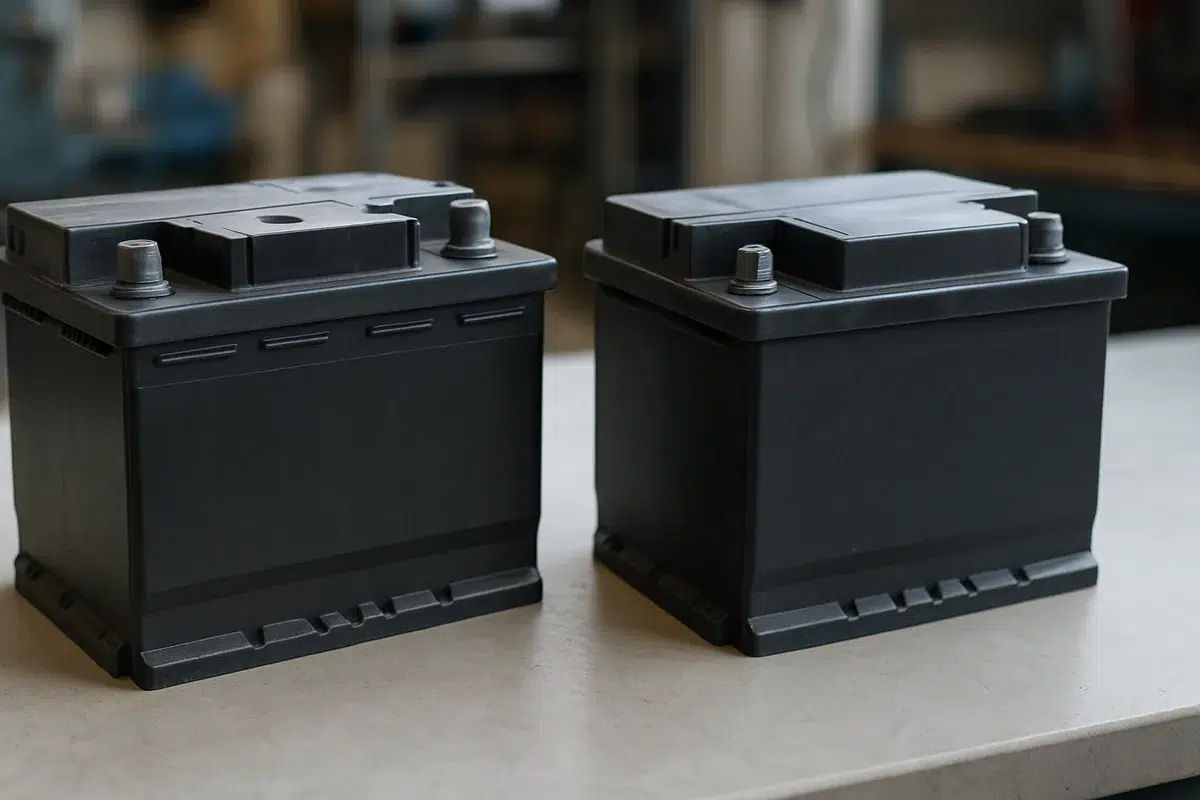
| Verdict | AGM if the car requires it or has start-stop; standard otherwise |
| Best for AGM | Start-stop, heavy accessory loads, short trips, rough roads |
| Best for standard | Older or basic cars with modest electrical demands |
| Cost difference | AGM costs noticeably more; get local prices for your group size |
| The rule that matters | Upgrading to AGM is usually fine; downgrading from AGM is not |
| Where to check | The old battery’s label and your owner’s manual |
AGM and standard flooded batteries are both 12-volt lead-acid batteries, so the choice is about construction rather than chemistry. That difference decides how much abuse the battery tolerates, how well it suits a modern electrical system, and how much you pay. This guide compares the two attribute by attribute, then answers the question that actually settles it: what does your car require?
Lifespan and price figures below are broad typical ranges that vary by vehicle, climate, and region. Check the label on your current battery and your owner’s manual for the type your car specifies, and get a local quote before you buy.
Table of Contents
What is the difference between an AGM and a standard battery?
An AGM battery holds its acid in absorbent glass mats packed between the lead plates, while a standard flooded battery holds liquid acid that surrounds the plates. That single construction change makes AGM sealed, spill-resistant, and far more tolerant of vibration and deep discharges. A flooded battery is the traditional, cheaper design that has powered cars for a century.
The practical consequences follow from the mats. Because the acid cannot slosh or spill, an AGM battery can be mounted in a trunk or under a seat and shrugs off rough roads. Because its internal resistance is lower, it accepts a charge faster and delivers current more readily for heavy loads. A flooded battery gives up some of that durability, and some designs still have removable caps for topping up, but it does the same starting job for far less money.
AGM vs standard: side by side
AGM wins on durability, cycling, and lifespan. Standard flooded wins on price. The table compares the two across the attributes that decide a purchase, and the figures are typical ranges rather than guarantees, because climate, driving pattern, and build quality all move them. Read the last row with the charging section below in mind.
| Attribute | AGM | Standard (flooded) |
|---|---|---|
| Price | Noticeably higher | Lowest of the two |
| Typical lifespan (varies by climate and use) | Often longer than flooded | Commonly about 3 to 5 years |
| Start-stop systems | Suitable, and usually required | Not suitable |
| Heavy accessory loads | Handles sustained draw well | Adequate for modest loads |
| Deep discharge and recovery | Tolerates it better | Damaged more easily by deep discharge |
| Vibration resistance | High; mats cushion the plates | Moderate |
| Maintenance and mounting | Sealed, spill-resistant, mounts in more positions | May have fill caps; must stay upright and vented |
| Resting voltage when full | Slightly higher, around 12.8V to 12.9V | About 12.6V |
| Charging | Needs a charger with an AGM setting | Standard charging profile |
Those last two rows trip people up. An AGM battery reads a little higher at rest than a flooded one, so a reading that looks healthy for one type can be slightly low for the other. Our car battery voltage chart covers how to read each type correctly. On price, the gap between types is only part of what you pay, and why car batteries have become expensive explains the rest.
Does your car require AGM? Check this first
Many modern cars require AGM, and that requirement outranks every other point on this page. Vehicles with start-stop systems, regenerative braking, a battery mounted in the cabin or trunk, or unusually heavy electrical demands are typically designed around AGM. Fitting a cheaper flooded battery in one of those cars invites poor charging and a short battery life.
Finding out takes two minutes. Read the label on the battery currently in the car: AGM batteries usually say “AGM” or “absorbed glass mat” on the case, and they are sealed with no removable fill caps. Then check your owner’s manual, which normally specifies the type along with the group size and cold cranking amps. If either source says AGM, buy AGM. Matching the specs matters as much as the type, which our guide on whether you can use any battery in a car covers in full.
When is an AGM battery worth the extra money?
An AGM battery is worth the extra money when the car demands more than a basic starting battery. There are 5 situations where the premium pays for itself. They are a start-stop system, heavy accessory or aftermarket electrical loads, frequent short trips, rough or off-road driving, and a battery mounted somewhere that rules out a vented flooded case.
The common thread is cycling and abuse. A start-stop car restarts the engine dozens of times a trip, and heavy accessories drain the battery while the engine is off, so the battery is repeatedly discharged and recharged rather than simply used to start the car once. AGM handles that pattern far better. Vibration is the other case: on rough roads, a flooded battery’s plates take a beating that the glass mats cushion. A battery that sits unused is a third consideration, since AGM holds its charge longer, which matters for the storage cases covered in how long a car battery lasts without driving.
When is a standard battery fine?
A standard flooded battery is fine for an older or basic vehicle without start-stop, with modest electrical demands, and with the battery in a conventional engine-bay tray. If your car came with a flooded battery and nothing in the manual calls for AGM, a good-quality flooded replacement does the same job for less. Paying for AGM there buys durability you will not use.
Spend the difference on the specs instead. Matching or slightly exceeding the original cold cranking amps, getting the correct group size, and buying fresh stock matter more for day-to-day reliability than the battery type does. A flooded battery in a car designed for one is not a compromise; it is the correct part. What shortens its life is heat, chronic short trips, and deep discharges, and the early warnings are covered in the signs of a dying car battery. Neither type escapes the cold either: AAA notes a battery loses roughly 30% of its strength at 32°F, so a free load test before winter is worth more than the type on the label.
Can you replace a flooded battery with an AGM, or the other way around?
Upgrading a flooded battery to AGM is usually fine if the group size and cold cranking amps match, and modern charging systems handle AGM without trouble. Downgrading an AGM-equipped car to a flooded battery is a different matter and is not advised, because the charging system and the car’s electrical demands were designed around AGM.
Two extra steps come with the swap. First, many vehicles built from roughly the mid-2010s need the new battery registered or coded to the charging system with a scan tool, and skipping it can leave the car charging as though the old battery were still fitted. Second, if you charge the battery yourself, use a charger with an AGM mode, since the wrong profile can overcharge it. Leave the job to a shop if the battery sits under a seat or in the trunk, or if your car needs a registration you cannot perform. You can ask whether the technician holds ASE certification in electrical systems.
Caution: any lead-acid battery, AGM included, holds sulfuric acid and can vent flammable gas, so wear eye protection, keep sparks away, and disconnect the negative terminal first. Return the old battery to the retailer or a recycling point rather than binning it. Per Battery Council International, about 98% of lead batteries are recycled through an established collection network, and most sellers take the old one back.
Frequently asked questions
Is an AGM battery worth the extra money?
An AGM battery is worth the extra money if your car has start-stop, heavy electronics, or a manufacturer requirement for AGM, because it lasts longer and handles those loads better. For an older car with modest electrical demands, a cheaper standard flooded battery is usually all you need.
Can I put a standard battery in a car that came with AGM?
Putting a standard battery in a car that came with AGM is not recommended. The charging system and the electrical demands of an AGM-equipped car are built around that battery type, so a flooded replacement may charge poorly and wear out early. Stick with AGM when the car specifies it.
Does an AGM battery last longer than a standard one?
An AGM battery generally lasts longer than a standard flooded battery and tolerates deep discharges and vibration better, which is part of why it costs more. Actual life still depends on heat, driving pattern, and how often the battery is deeply drained, so treat any figure as a range.
How do I tell if my car has an AGM or standard battery?
Check the label on the battery for the letters “AGM” or the words absorbed glass mat, and look for fill caps. A sealed case with no removable caps is usually AGM, while a flooded battery often has caps along the top. Your owner’s manual lists the specified type.
What to do now
Check the type first, then compare prices. If the battery label or your owner’s manual specifies AGM, or the car has start-stop, buy AGM. If the car came with a flooded battery and nothing calls for AGM, a quality standard battery is the cheaper and correct choice. Match the group size and cold cranking amps either way, and ask whether your car needs the new battery registered.
For testing, charging, jump-starting, and replacement costs, see our complete car battery guide. More maintenance and troubleshooting help lives on the wowowow car care home page.
