

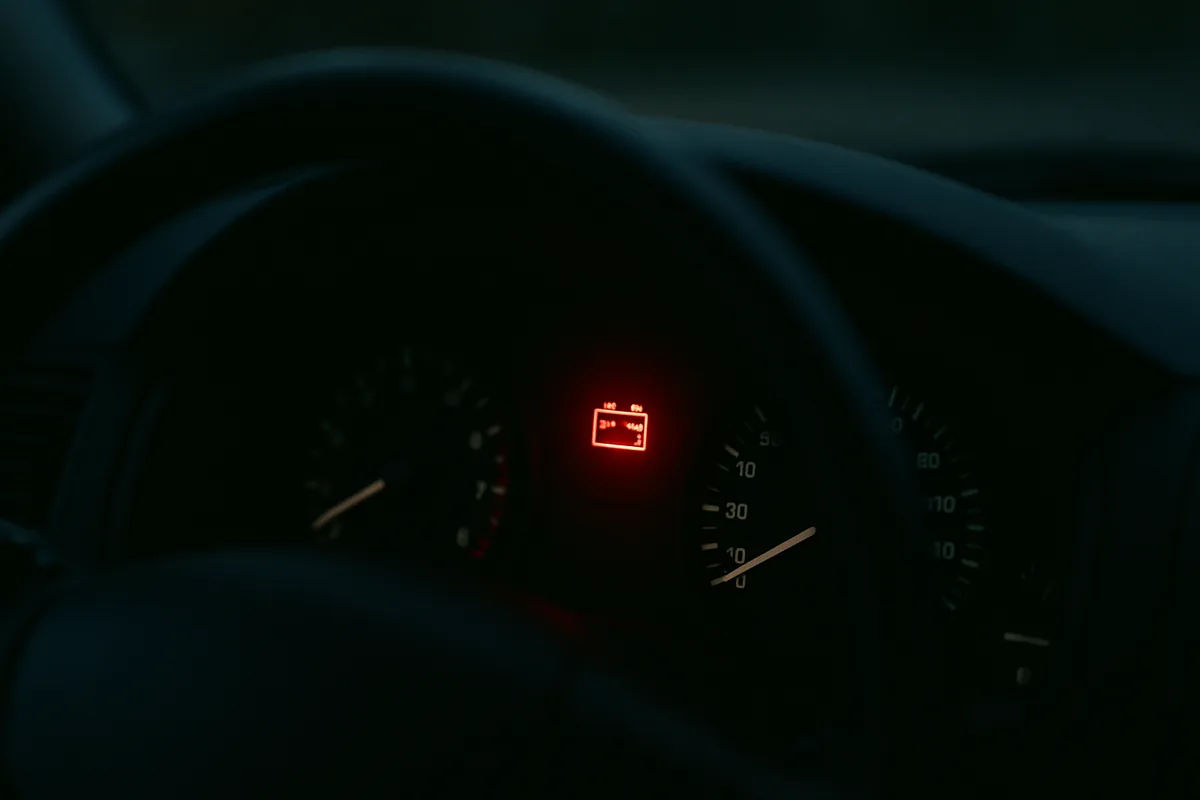
| What it is | A battery losing its ability to hold charge and deliver starting current |
| The number one sign | Slow, labored engine cranking |
| Safe to drive? | Usually yes, but expect to be stranded eventually. Stop relying on a battery that needs repeat jumps. |
| Fast confirm | Resting voltage check, then a load test at a shop |
| Typical lifespan | 3 to 5 years, shorter in hot climates |
| The one hard stop | A swollen case. Do not charge or jump it. |
A failing battery rarely dies without warning. It usually spends weeks or months dropping hints, and the drivers who get stranded are mostly the ones who read those hints as quirks. A slightly lazier crank on a cold morning, headlights that dip at idle, a radio that resets itself: each is easy to explain away individually, and together they are a battery telling you it is finished.
The seven signs below are ordered roughly by how often they show up first. Each one covers what it looks or sounds like, how to confirm it, and what to do about it. One important reframe runs through the whole list: several classic “battery” symptoms are actually the charging system, so the last section covers how to tell a dying battery from a dying alternator before you spend money on the wrong part.
Voltage figures on this page are standard 12-volt lead-acid reference values, and cost and lifespan ranges vary by vehicle and climate. Confirm specifics against your owner’s manual or your battery’s label.
Table of Contents
The 7 signs at a glance (and how urgent each one is)
Not every warning sign carries the same weight. Some mean test the battery within the next week, while one means stop and replace it before you charge anything. This table sorts the seven signs by urgency so you know which ones can wait for a convenient Saturday and which cannot.
| Sign | What it usually means | Urgency |
|---|---|---|
| Swollen or bloated case | Overcharging or heat damage | Replace now, do not charge or jump |
| Battery warning light on | Usually a charging system fault | Get somewhere safe, then diagnose |
| Frequent jump-starts | Battery near end of life, or a drain | Test this week |
| Clicking or no-start | Too weak to turn the starter | Test this week |
| Slow cranking | Losing capacity | Test soon |
| Dim lights, glitchy electronics | Voltage sagging under load | Test soon |
| Age of 3 to 5 years or more | Normal end of service life | Test annually from year three |
1. Slow or sluggish engine cranking
Slow cranking is the most common first sign of a dying car battery. The starter turns the engine over lazily, with a drawn-out “rur-rur-rur” instead of a crisp spin, and the car takes longer to fire than it used to. Cold mornings expose it first, because low temperatures thicken the oil and cut the battery’s available power at the same time.
Confirm it with two numbers rather than a feeling. A rested battery should read about 12.6 volts, and it should not collapse below roughly 9.6 volts while the engine cranks. A battery that reads fine parked but sags badly under the starter’s draw is failing even though its resting voltage looks healthy. The full breakdown of what each reading means is in the car battery voltage chart, and the measuring procedure is covered in how to test a car battery.
What to do: charge the battery fully, then have it load tested. A battery that passes after a charge may just have been undercharged by short trips. One that fails a load test needs replacing.
2. Dim headlights and glitchy electronics
Dim headlights, especially at idle, point to a battery struggling to hold voltage under load. Power windows crawl, the dome light fades when you crank, the radio or clock resets, and dashboard displays flicker on startup. AAA lists dim headlights and electrical problems among the key warning signs of a weak or failing battery, alongside slow cranking and frequent jump-starts.
There is a catch worth knowing. Once the engine is running, a healthy alternator supplies the electrical system and masks a weak battery almost completely, so the symptoms often disappear at speed and reappear at idle or at startup. Do not treat “it seems fine when I’m driving” as an all-clear.
What to do: watch when the dimming happens. Dimming at idle that clears when you rev suggests a charging or battery capacity problem. Dimming that gets steadily worse over days points at a battery losing its ability to hold charge.
3. Clicking or a no-start
Rapid clicking when you turn the key means the battery has enough power to pull in the starter solenoid but not enough to turn the engine. The solenoid engages, voltage collapses, it drops out, and it repeats several times a second. That machine-gun clicking is one of the clearest battery symptoms there is.
A single loud click is different and less conclusive. It can be a very flat battery, a bad connection, or a failed starter, and the three need separating before you buy anything. A jump-start is the quickest test available: if the car fires immediately on jumper cables or a jump pack, the battery is the prime suspect. If it still only clicks with a good power source connected, look at the starter and the cables instead.
What to do: check the terminals first, since corrosion and loose clamps mimic a dead battery for free. The full ranked diagnosis lives in the guide to a car that will not start and just clicks.
4. The battery warning light on the dash
The battery-shaped warning light usually indicates a charging system fault rather than a bad battery. Despite the icon, it means system voltage has fallen outside the expected range, which most often points at the alternator, the drive belt, or the voltage regulator. A car running with that light on is running on battery reserve alone.
Caution: if the battery light comes on while driving, you have limited time before the car loses electrical power and stalls. Turn off the stereo, air conditioning, and heated seats, avoid switching the engine off until you are somewhere you can safely stop, and head for home or a shop rather than continuing a long trip.
Confirm it by measuring voltage at the terminals with the engine running, which should sit between 13.5 and 14.7 volts. A reading below 13 volts means the alternator is not charging. What happens when a charging fault goes unaddressed is covered in whether a bad battery can cause a car to stall.
5. A swollen or bloated battery case
A swollen, bulging, or warped battery case means the battery has been overcharged or cooked by heat, and it is the one sign on this list with a hard stop attached. AAA identifies a bulging case as a sign of overcharging or overheating. Gas builds inside faster than the vents can release it, and the plastic deforms. That battery is finished, and it is no longer safe to charge.
Caution: do not charge or jump-start a swollen battery. Adding current to a battery that is already venting risks rupture and acid spray. Battery electrolyte is dilute sulfuric acid, which the ATSDR describes as very corrosive and able to burn skin and eyes, and it lists touching the residue on the outside of a car battery as a genuine exposure route. Wear gloves and eye protection, or let a shop handle it.
What to do: replace it, and let the retailer take the old one. The EPA notes that retailers, car dealerships, and household hazardous waste sites all serve as lead-acid battery drop-off points, and that most purchases include a refundable core charge you get back when you return the old battery. More on that in what to do with old car batteries. If the battery is also hot, hissing, or visibly leaking, treat it as urgent and read why a car battery smokes.
6. Frequent jump-starts or going flat after sitting
Needing repeat jump-starts is a definitive sign a battery can no longer hold a charge. A healthy battery jumped once should recover and stay usable. One that goes flat again within days is either worn out or being drained by something in the car, and those two causes need separating because replacing the battery will not fix a drain.
The distinction is straightforward. A worn battery starts the car progressively worse over weeks regardless of how long it sits. A parasitic drain kills a good battery specifically after the car sits, often within two or three days, and typically traces to an aftermarket accessory, a dash camera, a light staying on in the trunk or glovebox, or a module that fails to sleep. Normal key-off draw on most cars is small, and anything much above that range is worth investigating.
What to do: have the battery load tested first, since that is the cheaper and more likely answer. If it passes, move on to a key-off current draw test. The drain side is covered in why a car battery drains so fast, and the sitting-still case in how long a car battery lasts without driving.
7. Age of 3 to 5 years or more
Most car batteries last 3 to 5 years, so age alone is a legitimate warning sign once the others start appearing. AAA gives the same rule of thumb and recommends testing the battery yearly once it passes its third birthday, noting that time, heat, and vibration are the three factors that decide how long it survives.
Climate moves that window more than most drivers expect. AAA notes batteries often reach five years or more in cooler northern climates while roughly three years is typical in hot southern ones, since heat accelerates the chemical degradation that ends a battery’s life. Cold does not shorten battery life the same way, but it does expose weakness: NHTSA points out that battery power drops as temperature falls while engines need more of it to start, and recommends having a mechanic check the battery, charging system, and belts before winter.
Find the age on the battery itself. Most carry a date code on a sticker or stamped into the case, usually a letter for the month and a digit for the year, so a code beginning “C1” generally means March 2021. Check the code against the sticker a shop may have left on top, since the two often disagree.
What to do: from year three, test annually rather than waiting for symptoms. AAA is direct that not every failing battery gives clear warning first. Replacing a marginal five-year-old battery on your schedule costs the same as replacing it in a parking lot, minus the tow. The wider set of failure causes is in what causes a car battery to die.
Battery or alternator? How to tell them apart
The battery starts the engine and the alternator runs everything afterward, so the timing of your symptoms usually reveals which one is failing. Trouble that appears only at startup points at the battery. Trouble that appears while driving points at the alternator. Both produce dim lights and both can leave you stranded, which is why so many people replace the wrong part.
| Clue | Points to the battery | Points to the alternator |
|---|---|---|
| When symptoms appear | At startup, worse after sitting | While driving, worse with more accessories on |
| After a jump-start | Runs fine once started | Dies again shortly after the cables come off |
| Warning light | Often none until it fails | Battery light on while running |
| Voltage, engine running | 13.5 to 14.7V, normal | Below 13V, not charging |
| With a new battery fitted | Problem gone | Problem returns within days |
The jump-start test is the fastest home check on that list. Jump the car, then disconnect the cables and let it idle. A car that keeps running is being supplied by a working alternator, which makes the battery the problem. A car that stalls within a minute or two is not being charged at all, and the alternator is the likely fault.
Leave the diagnosis to a shop when the two disagree, when a new battery fails within weeks, or when the belt squeals and the lights dim together. Most auto parts stores test batteries and charging systems free, and a proper load test tells you far more than any voltmeter reading can.
Frequently asked questions
How do I know if my car battery is dying or dead?
A dying car battery cranks the engine slowly, dims the lights, and may need jump-starts, while a dead one will not crank at all. Test the resting voltage to tell them apart. Below about 12.4 volts means discharged, and a failed load test means the battery itself is failing.
Can a dying battery still start the car?
A dying battery often still starts the car for weeks or months, cranking slowly and struggling most in cold weather or after the car sits. That window closes without warning, usually on the coldest morning of the year. Test it once symptoms appear rather than waiting for a no-start.
How long does a car battery last?
Most car batteries last 3 to 5 years. Heat shortens that considerably, so batteries in hot southern climates often reach only about three years while cooler northern ones can pass five. Short trips, deep discharges, and vibration also cut lifespan. Test yearly from year three.
Is it the battery or the alternator?
Symptoms at startup point to the battery, and symptoms while driving point to the alternator. Jump the car and remove the cables: if it keeps running, the alternator is fine and the battery is failing. Charging voltage should read 13.5 to 14.7 volts with the engine running.
What to do now
Watch for the seven signs: slow cranking, dim lights and electrical glitches, clicking or a no-start, the battery warning light, a swollen case, repeat jump-starts, and an age past three years. A weak battery will not cause a crash, but it will strand you, so stop relying on one that needs regular jumps. Test the battery and the charging system together rather than guessing, since replacing a good battery will not fix a failing alternator. Replace a swollen battery immediately, and never charge or jump one.
Start with how to test a car battery to confirm what you are dealing with. For charging, corrosion, lifespan, and replacement, see the complete car battery guide, or browse the wider automotive care and repair section.
