

At a Glance
| What it is | Play in a worn joint, bushing or mount that should be tight |
| Most common cause | Worn sway bar links, which is the minor end |
| The dangerous ones | Ball joints and tie rod ends, which can fail outright |
| The tell that matters | Whether you feel it through the steering, or only hear it |
| DIY? | No. Suspension and steering are professional work |
| Safe to drive? | Depends entirely on which part. Get it inspected |
Most pages about this noise list the same six parts and leave you no wiser about whether to book a shop next week or stop driving today. That is the only question worth answering, because the range genuinely runs from a cheap wear item to a part whose failure can put a wheel where you did not intend it.
This page ranks the causes with a safety flag on each, explains the one tell that separates the minor from the serious, and is honest that none of it is a driveway job. For the full noise index, see the complete car noises guide.
Repair costs vary enormously by vehicle and by which corner is affected, so relative cost bands are given below rather than dollar figures. Get a quote for your car. Steering-component replacement usually requires a wheel alignment afterwards, which is a separate cost people forget to budget for.
Table of Contents
Why does my car clunk over bumps?
A car clunks over bumps because a suspension joint that should be tight has developed play. Your suspension is a set of pivots, bushings and mounts designed to let the wheel move up and down smoothly and quietly while staying located precisely. When one wears, the movement it should absorb becomes a small, sudden impact instead, and you hear that as a clunk.
Bumps expose it because bumps are when the suspension actually moves. On smooth pavement the joints barely travel, so a worn one sits quietly. Hit a pothole or a speed bump and the suspension cycles through its full range, the play takes up with a knock, and the noise appears.
That mechanism is why the noise tends to worsen gradually rather than appear overnight, and why it is worth acting on early. Play in a joint means the part is wearing, and wear accelerates once the protective grease and seals are compromised.
Most common causes, ranked, with safety flags
Six things cause a clunk over bumps, and they are not equally serious. The safe-to-drive column is the point of this table: two of these are wear items you can drive to a shop, and two can fail in a way that affects whether you can steer.
| Cause | How to confirm it | Safe to drive? |
|---|---|---|
| Worn sway bar links or bushings (most common) | A rattling clunk from one corner over bumps, with no change in how the steering feels | Usually yes, drive gently to a shop |
| Worn strut mounts, struts or shocks | Clunk plus a bouncy, unsettled ride, sometimes a clunk when turning slowly | Short term yes, but handling is affected |
| Worn control arm bushings | A deeper clunk over bumps and often when braking or pulling away | Inspect soon |
| Worn ball joints | Clunk plus vague or wandering steering, and often uneven tire wear | Inspect before driving far. Can fail |
| Worn tie rod ends | Clunk with looseness or play felt in the steering wheel itself | Inspect before driving far. Steering part |
| Something loose rather than worn | A rattle rather than a solid knock. Exhaust hanger, heat shield, jack or spare | Usually yes, fix when convenient |
One line separates the top half from the bottom half of that table, and it is worth committing to memory: a clunk you only hear is usually a wear item, while a clunk you feel through the steering is a steering or ball-joint problem until proven otherwise.
If the noise turns out to be tied to braking rather than bumps, you are on the wrong page and the stakes are different, which is covered in a grinding noise when braking.
The dangerous ones: ball joints and tie rod ends
Ball joints and tie rod ends matter more than the other causes because they can separate rather than simply wear out. A ball joint is the pivot connecting the control arm to the wheel hub, and a tie rod end connects your steering rack to the wheel. Both carry load and both are what keeps the wheel pointing where you aim it.
The consequence is documented in safety recall notices rather than being an internet exaggeration. A ball joint recall filed with NHTSA states plainly that failure of a ball joint while the vehicle is in motion may cause loss of vehicle control and increase the risk of a crash, and adds that as a ball joint approaches the end of its durability, the driver may hear noise and notice wandering in the steering.
That second half is the part worth sitting with. The official description of a ball joint nearing failure is noise plus vague steering, which is exactly the combination this page exists to explain. A clunk on its own is common and often minor. A clunk plus steering that wanders, feels loose, or needs constant small corrections is the documented warning sign.
Caution: do not treat a clunk with loose or wandering steering as a wait-and-see item. Have it inspected before you drive any distance, and do not drive it at highway speed to get there. Uneven or unusual tire wear alongside the clunk is another supporting sign, since worn joints let the wheel sit at the wrong angle, and that pattern is covered in the complete car tires guide.
The wear items: sway bar links and bushings
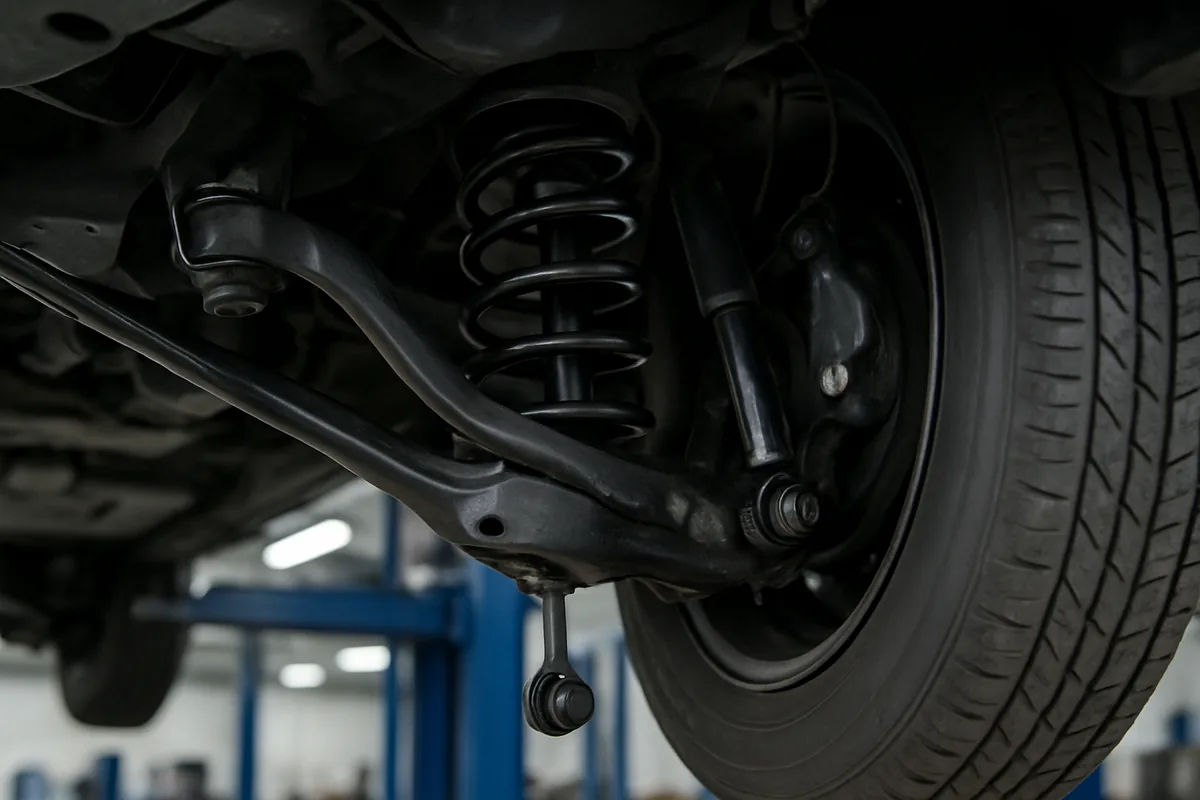
Worn sway bar links are the most common cause of this noise and the least alarming, which is worth saying clearly so the section above does not leave you assuming the worst. The sway bar, sometimes called the stabilizer bar, ties the left and right sides of the suspension together to reduce body roll in corners, and it connects to the suspension through small links with joints at each end.
Those links are relatively lightly loaded and wear out as a matter of routine. When they do, they knock over bumps because the bar is no longer firmly connected. The noise is often described as a rattle or a clonk from one corner, and it usually does not change how the car feels to steer.
Get them replaced rather than living with them, because a disconnected sway bar does affect handling in an emergency manoeuvre even if the car feels normal in daily driving. But a sway-bar-link clunk with normal steering is generally fine to drive carefully to a shop rather than something to stop for.
How to tell which one it is
You cannot safely identify this yourself, but you can gather the four observations that let a technician find it fast. Note them before you call, because a shop that knows where and when the noise happens can often locate it in a single test drive instead of billing you for diagnostic time.
- Where. Front or rear, left or right. Lower a window near a wall and drive slowly over a rough patch if you cannot place it.
- When. Only over bumps, or also when turning, braking, or pulling away? Turning and braking involvement points at different parts.
- Whether you feel it. Heard from a corner, or felt through the steering wheel? This is the single most important observation on the list.
- What else changed. Vague steering, a bouncy ride, uneven tire wear, or the car pulling to one side.
A clunk that appears when turning as well as over bumps shifts suspicion toward steering components and CV joints, and the turning-specific version of this noise is covered in why a car makes noise when turning.
Caution: leave the physical inspection to a professional. Checking these joints means raising the vehicle, supporting it correctly, and levering components to test for play, and the parts being tested are the ones holding the wheel on. ASE notes that its certified technicians must complete at least two years of qualified work experience and retest every five years to stay current, which is the level of person this belongs with. The wider safety picture for these systems will live in the brakes and steering guide at brakes and steering.
What does it cost to fix?
Costs run from modest to substantial depending entirely on which part it turns out to be, which is another reason a proper diagnosis beats replacing parts hopefully. The relative ordering below holds across most vehicles even though the actual figures do not.
| Repair | Relative cost | Note |
|---|---|---|
| Sway bar links | Lowest | Small parts, usually quick labor. Often replaced in pairs |
| Sway bar bushings | Low | Cheap parts, labor depends on access |
| Strut mounts | Moderate | Often done alongside struts, since the strut comes out anyway |
| Control arm bushings | Moderate to high | Sometimes only sold as a complete control arm |
| Ball joints | Moderate to high | Some press into the control arm, some come as a whole arm |
| Tie rod ends | Moderate | Add a wheel alignment afterwards. Not optional |
| Struts or shocks | Highest here | Replaced in pairs across an axle to keep handling even |
The alignment line catches people out. Any repair that disturbs steering geometry, tie rod ends especially, needs the alignment set afterwards, and skipping it wears a new set of tires unevenly within months. The US Tire Manufacturers Association lists wheel balancing and vehicle alignment among the professional tire services worth scheduling regularly, and after steering work it stops being optional.
Frequently asked questions
Is it safe to drive with a clunking suspension?
Safety depends entirely on which part is worn. A sway bar link clunk with normal steering is usually safe enough to drive gently to a shop. A clunk with loose or wandering steering can mean a worn ball joint or tie rod end, which can fail, so have it inspected before driving far.
What is the most common cause of clunking over bumps?
Worn sway bar links are the most common cause, because they are lightly built wear items with joints at each end that develop play over time. They are also among the least expensive suspension repairs. An inspection still matters, since it rules out the ball joint and tie rod causes that are not minor.
Can bad struts or shocks cause clunking?
Worn strut mounts, struts and shocks can all clunk over bumps, because they lose the ability to control suspension movement and the assembly knocks at the end of its travel. A bouncy or floaty ride alongside the noise supports it. Struts and shocks are replaced in pairs across an axle.
Why does my car clunk over bumps but not on smooth roads?
Bumps make the suspension travel through its full range, which takes up the play in a worn joint with an audible knock. Smooth pavement barely moves the suspension, so the same worn part stays quiet. That bumps-only pattern is itself the clue that points at suspension rather than the engine or brakes.
What to do now
Note four things before you call anyone: which corner the noise comes from, whether it happens only over bumps or also turning and braking, whether you feel it through the steering wheel, and whether the steering has become vague. The steering question is the one that sets urgency, because a clunk with loose or wandering steering matches the documented warning sign of a ball joint nearing failure. Book an inspection either way, since a technician can separate a routine sway bar link from a safety-critical joint in one test drive. Safe to drive: a heard-only clunk with normal steering is usually fine to take to a shop gently. A clunk you feel in the steering is not. Have suspension and steering work done by a professional.
For the full noise index, see the complete car noises guide, or browse the wider automotive care and repair section.
