

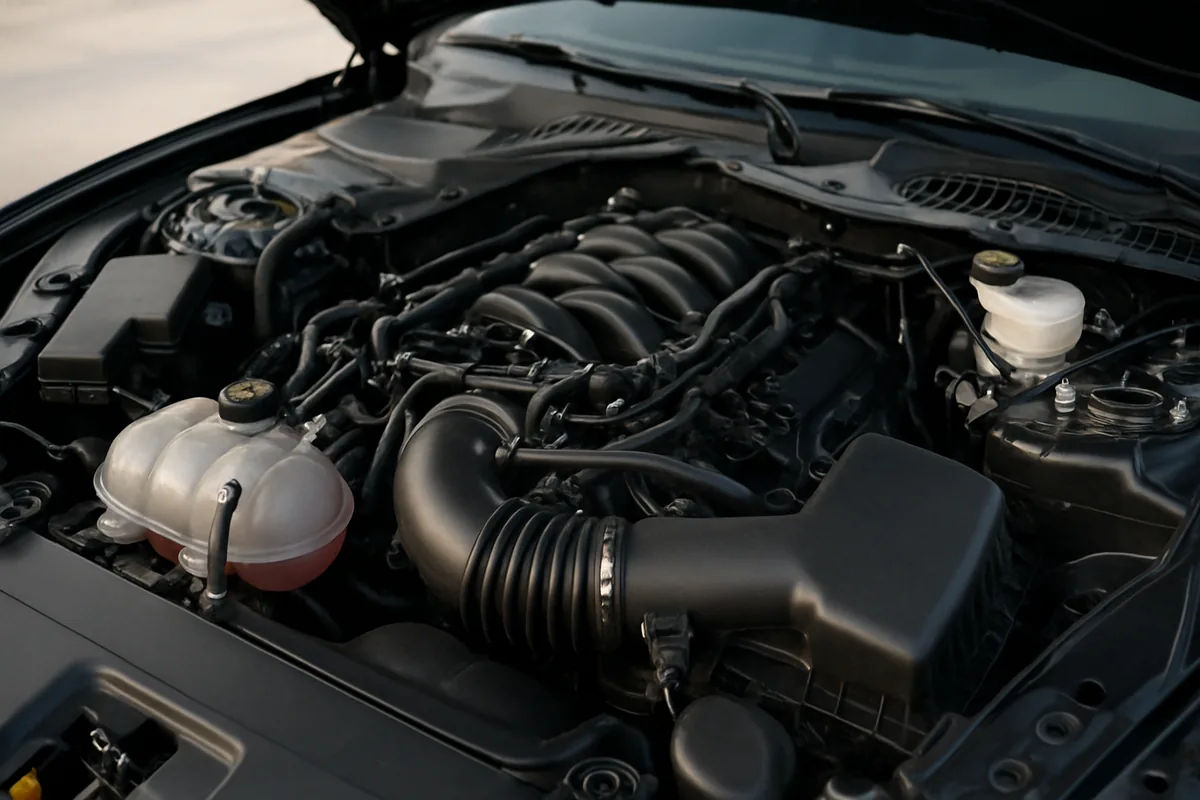
| What it is | A rough-running engine or worn mounts, felt most at low RPM |
| #1 cause | An engine misfire from worn spark plugs or a failing ignition coil |
| Safe to drive? | No if the check engine light is flashing: stop as soon as it is safe. Otherwise drive gently to a shop |
| Fast test | Does the shake ease in neutral? Mounts. Does it come with a warning light? Misfire |
| Idle vs speed | Shake at idle = engine; shake only at highway speed = wheels |
| Typical cost | Low for spark plugs or a vacuum hose, more for engine mounts (varies by vehicle) |
A shake at a red light is one of the easiest symptoms to narrow down, because it rules out half the car immediately. If the car is sitting still, the wheels, tires, and brakes are not turning, so the shake is coming from the engine or from the mounts that hold it. This guide ranks the causes, gives you two free tests that separate them, and tells you plainly when the shake means stop.
Every cost below is a broad typical range that varies by vehicle, region, and shop. Get a local quote before acting on any figure here, and check your owner’s manual for anything make-specific, including spark plug type and service intervals.
Table of Contents
Why does my car shake at idle but not when driving?
A car shakes at idle but not when driving because the engine turns slowly at idle, so any rough running or worn mount shows up clearly. As engine speed rises, each cylinder fires more often, the power pulses blend together, and road noise and motion mask what is left. That idle-only pattern points to the engine and its mounts, not the wheels.
Every engine vibrates a little. At idle, the engine turns slowly enough that each combustion pulse is a separate push, and the engine mounts are designed to absorb that. When one cylinder misfires, the rhythm breaks and the engine stumbles, which you feel as a shudder through the seat and steering wheel. When a mount wears out, even a healthy engine’s normal vibration reaches the cabin.
The opposite pattern is a different problem. A shake that appears only at a certain road speed, often around highway speed, and smooths out above or below it is almost always a wheel balance or tire issue. Our guide to why a car shakes when you hit 60 mph covers that side.
Is it safe to drive a car that shakes when idling?
Stop driving as soon as it is safe if the car shakes at idle and the check engine light is flashing, because a flashing light means an active misfire that sends unburned fuel into the exhaust and can overheat and destroy the catalytic converter. A steady check engine light, or no light at all, usually means the car is driveable to a shop, but the shake should be diagnosed soon.
A misfire that is left alone gets expensive quickly. The unburned fuel that reaches the catalytic converter burns inside it, and the heat can melt the converter’s internal honeycomb. That turns a spark plug or coil repair into a far larger bill. Our guide to a flashing check engine light with a shaking car explains what to do in that situation.
Worn mounts are not usually an emergency, but they do get worse. A badly broken mount lets the engine move more than it should, which can strain hoses, wiring, the exhaust, and the axles. Have the car checked promptly if you hear a clunk when shifting into drive or reverse, or if the engine visibly lurches.
Caution: if you test the car with the engine running and a helper watching, keep the parking brake set and your foot firmly on the brake, and make sure no one stands in front of or behind the vehicle.
What are the most common causes of shaking at idle?
There are 4 common causes of a car shaking at idle. They are an engine misfire, worn engine or transmission mounts, a vacuum leak, and a dirty throttle body or idle control valve. The table ranks them from most to least likely and shows how to tell them apart before anyone replaces a part.
| Cause | How likely | Telltale signs | How to confirm | Typical cost (verify locally) |
|---|---|---|---|---|
| Engine misfire (plugs, coils, injectors) | Most common | Uneven, stumbling shake; check engine light; sometimes a loss of power | Scan for misfire codes with an OBD-II scanner | Low to moderate |
| Worn engine or transmission mounts | Common on older cars | Steady buzz or shake, worse in drive, often a clunk when shifting | Shake eases in neutral; engine lurches when shifting | Moderate, per mount |
| Vacuum leak | Common | Rough or hunting idle, hissing or whistling, lean codes | Visual hose check; shop smoke test | Low to moderate |
| Dirty throttle body or idle control valve | Less common | Idle speed too low or unstable, stalling when stopping | Inspect for carbon buildup; scan idle data | Low to moderate |
Other causes are less common but worth knowing. A dirty mass airflow sensor, a clogged fuel filter or weak fuel pump, a faulty oxygen sensor, and a stretched timing chain or worn timing belt can all make the idle rough. A shake that appears only when the AC is on has its own pattern, which our guide to car vibration when the AC is on covers.
Can a misfire make my car shake at idle?
A misfire makes a car shake at idle because one cylinder stops firing properly, and the engine runs out of balance. The most common causes are worn spark plugs, a failing ignition coil, and a clogged or leaking fuel injector. A misfire usually turns on the check engine light, and it tends to feel like an uneven stumble rather than a steady buzz.
How to confirm a misfire
A misfire is the easiest cause to confirm, because the engine computer records it. An inexpensive OBD-II scanner plugged into the port under the dashboard reads the stored codes. A P0300 code means a random or multiple-cylinder misfire, while codes from P0301 onward point to one specific cylinder, such as P0301 for cylinder 1. Many auto parts stores will read codes free of charge.
A single-cylinder code usually means a plug, coil, or injector on that cylinder. A shop often swaps the coil with a neighboring cylinder and checks whether the misfire code follows it, which separates a bad coil from a bad plug or injector. A random misfire across several cylinders points instead to something shared, such as a vacuum leak, low fuel pressure, or a dirty sensor.
How to fix it
Spark plug replacement is a manageable job on some engines and an awkward one on others, particularly V6 engines where the rear plugs sit under the intake. Use the plug type and gap listed in your owner’s manual, and replace them at the interval it specifies. Our guide on whether bad spark plugs can make a car shake covers the symptoms in more detail.
Leave it to a mechanic if the misfire code points to an injector, if the plugs are buried under the intake, or if the misfire continues after new plugs and coils. Fuel injector work involves the high-pressure fuel system, which is not a driveway job. A compression test can also rule out a mechanical cause inside the engine.
Can bad engine mounts cause shaking at idle?
Bad engine mounts cause shaking at idle because they stop absorbing the engine’s normal vibration. Engine and transmission mounts are rubber, or rubber and fluid, blocks that hold the engine to the car’s frame. When the rubber cracks or the fluid leaks out, the engine’s vibration passes straight into the body, and you feel it through the seat, steering wheel, and floor.
The shake from worn mounts usually feels like a steady buzz or drone rather than a stumble, and the engine itself runs fine. It is often worst in drive at a stop, because the transmission is trying to push the car forward against the brakes and the engine rocks against the mounts. A clunk or thud when you shift into drive or reverse, or when you accelerate hard from a stop, is another strong sign.
Try the neutral test. At a stop, with your foot firmly on the brake, shift from drive to neutral. If the shake eases noticeably in neutral, worn mounts are the likely cause. A helper standing safely to the side of the car, never in front, can also watch the engine while you shift between drive and reverse. An engine that lurches or twists sharply has a broken mount.
Mount replacement is a shop job on most vehicles, because the engine has to be supported while the old mount comes out. Replace a mount promptly if it is broken rather than just worn, since the remaining mounts carry the extra load and can fail sooner.
Can a vacuum leak or dirty throttle body cause a rough idle?
A vacuum leak or a dirty throttle body can cause a rough, shaky idle because both disturb the air entering the engine. A vacuum leak lets in extra air that the engine’s sensors do not measure, so the air-fuel mix runs lean. A dirty throttle body or idle control valve restricts the small amount of air the engine needs at idle, so the idle speed drops or hunts.
A vacuum leak
A vacuum leak usually produces a rough or surging idle, sometimes a hissing or whistling sound from the engine bay, and often a check engine light with lean-condition codes. With the engine off and cool, look over the vacuum hoses and the intake boot between the air filter and the throttle body for cracks, splits, or loose connections. Our guide to a car making a whistling noise covers how a vacuum leak sounds. A shop can find a hidden leak quickly with a smoke test.
A dirty throttle body or idle control valve
Carbon builds up inside the throttle body over time, narrowing the gap the engine breathes through at idle. The typical symptoms are an idle that is lower than usual, an unsteady idle, or an engine that nearly stalls when you come to a stop. Some older engines use a separate idle air control valve that can stick for the same reason. Cleaning the throttle body is a straightforward job on many vehicles, but electronic throttle bodies can be damaged by forcing the plate open by hand, so follow your owner’s manual or have a shop handle it. Some vehicles also need an idle relearn procedure afterward.
How do I figure out why my car shakes at idle?
You figure out why a car shakes at idle by checking for warning lights and codes first, then testing whether the shake changes with the gear selector and engine speed. These checks take a few minutes and cost little or nothing. Do them only with the parking brake set, your foot on the brake, and nobody standing in front of or behind the car.
- Check the dashboard. A flashing check engine light means stop driving. A steady light means read the codes soon.
- Read the codes. Plug an OBD-II scanner into the port under the dash, or ask a parts store to read them. Misfire codes start with P030, and lean codes often point to a vacuum leak.
- Try neutral. At a stop, shift from drive to neutral. A shake that eases in neutral points to the mounts.
- Raise the engine speed gently. In park, press the accelerator lightly. A shake that smooths out with a little more RPM fits worn mounts or a low idle.
- Switch the AC off. A shake that appears only with the AC on points to AC load on a weak idle or mounts.
- Listen under the hood. With the engine idling and your hands clear of the belts and fan, listen for a hiss or whistle that suggests a vacuum leak.
Hand the car to a shop once those checks point somewhere and the fix is not obvious. A mechanic can read live engine data, run a smoke test, swap coils to track a misfire, and check the mounts on a lift. If the shake happens mainly as the engine first fires up, see our guide to why a car shakes when starting. When choosing a shop, ASE’s resources for drivers explain what its technician certification means.
How much does it cost to fix a car that shakes at idle?
Fixing a car that shakes at idle costs anywhere from a low-cost part to a moderate repair, depending on the cause. A vacuum hose or a set of spark plugs sits at the low end, ignition coils and throttle body service in the middle, and engine mounts and injectors toward the top. Every figure below is a broad typical range that varies by vehicle, region, and shop, so get a local quote.
| Repair | Typical range (verify locally) | What drives the price |
|---|---|---|
| Reading trouble codes | Free to low | Parts store or shop diagnostic fee |
| Vacuum hose or intake boot | Low | Hose location and diagnosis time |
| Spark plugs | Low to moderate | Number of cylinders and plug access |
| Ignition coil | Low to moderate, per coil | Coil type and number replaced |
| Throttle body cleaning | Low | Whether an idle relearn is needed |
| Fuel injector | Moderate to high | Injector type and engine layout |
| Engine or transmission mount | Moderate, per mount | Mount type (rubber or fluid-filled) and labor |
| Catalytic converter (if a misfire was ignored) | High | Vehicle, part type, and emissions rules |
The last row is the reason not to drive on a flashing check engine light. Before paying for a converter or other major engine work, search your VIN on NHTSA’s recall lookup. The EPA’s emissions warranty FAQ also explains that catalytic converters are covered for 8 years or 80,000 miles against defects, though coverage can be denied when a failure comes from improper use or maintenance.
Frequently asked questions
Is it safe to drive if my car shakes at idle?
Driving a car that shakes at idle is usually fine for a short trip to a shop, as long as the check engine light is not flashing. A flashing light means an active misfire that can destroy the catalytic converter, so stop driving as soon as it is safe. A steady light should still be diagnosed soon.
Why does my car shake at idle but smooth out when driving?
A car that shakes at idle but smooths out when driving has an engine or engine mount problem, because rough running and worn mounts show up most at low engine speed. Higher RPM and road motion mask the shake. A shake that appears only at highway speed is different and usually means a wheel or tire balance problem.
Can bad motor mounts cause shaking at idle?
Bad motor mounts cause shaking at idle because they stop absorbing the engine’s normal vibration, which then reaches the seat and steering wheel. The shake is often worst in drive at a stop and eases when you shift into neutral. A clunk when shifting into drive or reverse is another common sign of a worn mount.
Can a misfire make my car shake at idle?
A misfire makes a car shake at idle because one cylinder stops firing properly and the engine runs out of balance. Worn spark plugs, a failing ignition coil, or a clogged injector are the usual causes, and the check engine light usually comes on. A flashing light means stop driving to protect the catalytic converter.
Can low oil cause a car to shake at idle?
Low oil is not a common cause of shaking at idle on most engines, but it can make some engines run rough, especially those with oil-pressure-controlled valve timing. Check the dipstick anyway, since it takes a minute. Stop driving immediately if the oil pressure light comes on, because running an engine low on oil can destroy it.
What to do now
Start with the dashboard and the gear selector. Read the trouble codes if the check engine light is on, since a misfire code points straight to plugs, coils, or injectors. Shift into neutral at a stop, and if the shake eases, have the engine mounts inspected. A rough, hunting idle with a hiss points to a vacuum leak.
Stop driving as soon as it is safe if the check engine light is flashing, because an active misfire can destroy the catalytic converter, and otherwise drive gently and have the shake diagnosed soon. For shakes that appear at highway speed instead, see why a car shakes at 60 mph, and for every other symptom, use the complete car troubleshooting guide. For keeping the whole vehicle healthy, visit our complete automotive care hub.
