

At a Glance
| What it is | An engine or emissions fault your car’s OBD-II system detected |
| Most common cause | A loose or faulty gas cap, so check that first |
| Safe to drive? | Steady: usually yes, briefly. Flashing: no, stop and tow. |
| Fast confirm | Read the trouble code with an OBD-II scanner |
| Typical cost | From a $10 to $25 gas cap to $1,000+ for a catalytic converter (varies) |
The check engine light is one of the most misread warnings on the dashboard, because the same amber symbol can mean a two-dollar problem or a two-thousand-dollar one. What tells you which is how the light behaves and how the car is driving. This guide covers what the light means, the steady-versus-flashing difference, whether it is safe to keep driving, the most likely causes with how to confirm each, and rough repair costs.
Every cost below is a broad typical range that changes with your make, model, and local labor rates, so treat these as ballpark figures and confirm a quote for your vehicle.
Table of Contents
What does the check engine light actually mean?
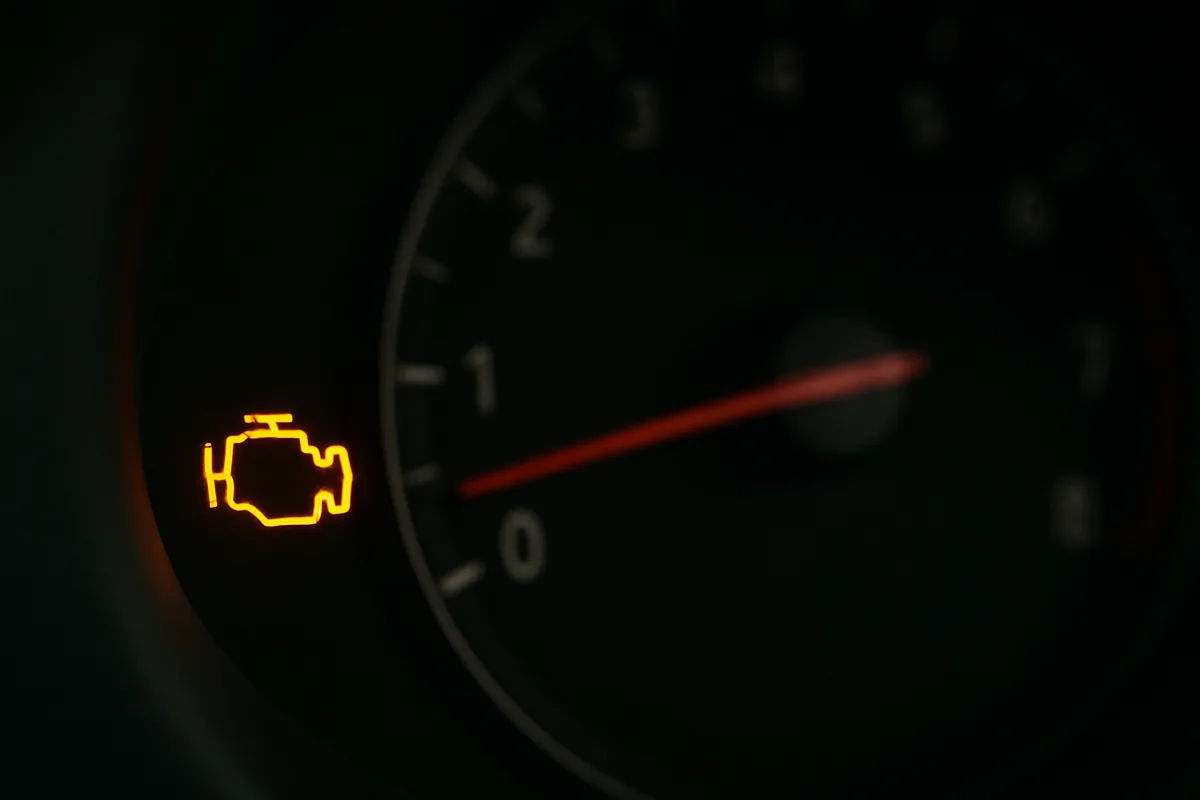
The check engine light, sometimes labeled “Service Engine Soon,” is the dashboard’s malfunction indicator lamp, and it comes on when the car’s onboard computer detects a fault it thinks could raise emissions or harm a component. Every car sold in the United States since 1996 runs an OBD-II diagnostic system that watches sensors across the engine and emissions hardware. When a reading drifts out of range, the system stores a diagnostic trouble code and lights the lamp. As New Hampshire’s Department of Environmental Services explains, that early warning is meant to catch a small fault, like a bad oxygen sensor, before it turns into a bigger repair such as a ruined catalytic converter.
The light itself does not tell you the cause. It only tells you a code is stored, which a scan tool can read. That is why the light can look identical whether the trigger is a loose gas cap or a serious misfire. The behavior of the light, steady or flashing, is your first real clue to how urgent it is.
If your light reads as a different symbol, such as a wrench or an oil can, that is a separate warning. See what the wrench light means and what the oil light means for those, and what SEL means on a car if yours is labeled that way.
Steady vs flashing: what is the difference?
A steady check engine light and a flashing one are not the same severity. A steady light means a fault was detected and logged, but nothing is actively failing right now. A flashing light means an active engine misfire is happening, raw fuel is reaching the exhaust, and the catalytic converter is at risk of heat damage within minutes. The bulb is the same. The behavior is the message.
| Light behavior | What it means | Urgency | What to do |
|---|---|---|---|
| Steady / solid | A stored fault, often emissions or a sensor. No active emergency. | Diagnose within a few days | Check the gas cap, then scan the code and schedule service |
| Flashing / blinking | An active misfire dumping raw fuel to the catalytic converter | Stop now | Ease off the gas, pull over safely, and tow rather than drive |
Caution: a flashing light paired with heavy shaking is an active misfire, and every mile can push a repair from spark plugs into a far more expensive catalytic converter. Do not try to “get it home.” For the shaking-and-flashing combination specifically, see check engine light flashing and car shaking.
Is it safe to drive with the check engine light on?
Whether it is safe to drive depends on the light and how the car feels. A steady light with the car running normally is usually safe for a short drive to a shop, and you should get it diagnosed within a few days rather than ignoring it. A flashing light is not safe to drive on, because the misfire behind it damages the catalytic converter quickly. According to AAA, a solid light should be addressed as soon as possible, while a flashing one calls for immediate attention.
Pull over as soon as it is safe, no matter which light it is, if the car is also losing power, shaking, stalling, overheating, or giving off a strange smell. Those symptoms turn a “drive it soon” situation into a “stop now” one. If the car will not pull cleanly or is bogging down, that is covered in why your car won’t accelerate when you press the gas, and a rough, shaky idle is covered in why your car shakes when idling. A check engine light alongside visible smoke is its own warning, explained in why your car is smoking but not overheating.
What are the most common causes?
The check engine light has one of the widest cause lists of any warning, but a handful of problems account for most of them. Ranked roughly from most to least common and cheapest to most expensive, the usual suspects are a loose gas cap, worn spark plugs or coils, a failing oxygen sensor, a failing catalytic converter, and a bad mass airflow sensor. A scan tool narrows it down fast.
| Likely cause | How to confirm | Typical repair | Typical cost (varies) |
|---|---|---|---|
| Loose or faulty gas cap | EVAP code (P0455 / P0456 / P0457); inspect the cap | Tighten or replace the cap | $10 to $25 for a new cap |
| Worn spark plugs or ignition coils | Misfire codes (P0300 series); rough running | Replace plugs and/or the failed coil | $100 to $400+ by engine |
| Failing oxygen (O2) sensor | O2 or fuel-trim codes; poor fuel economy | Replace the affected sensor | $150 to $500 |
| Failing catalytic converter | Efficiency codes (P0420 / P0430) | Replace the converter | $1,000 to $3,000+ |
| Bad mass airflow (MAF) sensor | MAF codes; hesitation, rough idle | Clean or replace the sensor | $200 to $400 |
Loose or faulty gas cap
A loose, cracked, or worn gas cap is the most common and cheapest trigger, because the sealed fuel tank is part of the emissions system and a leak sets a code. Confirm it by checking whether the cap clicks tight and looks undamaged. To fix it, tighten the cap until it clicks a few times, or replace it if the seal is cracked. Per Georgia’s Clean Air Force emissions program, if the code points to the evaporative system, tightening the cap and driving for a few days often lets the system clear the light on its own. Have a shop run an evaporative-system test if the light returns after a new cap, since the leak may be in a hose or valve you cannot reach.
Worn spark plugs or ignition coils
Worn spark plugs or a failing ignition coil cause misfires, which is the fault most likely to make the light flash. Confirm it with a scan tool that reports a P0300-series misfire code, often paired with rough running or a shaky idle. Replacing spark plugs is a manageable job on many engines, while a coil swap depends on how the engine is laid out. Hand the job to a professional if the coils sit under an intake manifold, if the misfire persists after new plugs, or if the light is flashing, because a flashing light means you should not be driving it in the first place. The spark-plug-and-shaking link is covered in can bad spark plugs cause a car to shake.
Failing oxygen sensor or catalytic converter
A failing oxygen sensor throws off the air-fuel mixture, hurts fuel economy, and often triggers the light long before the car feels different. A failing catalytic converter sets an efficiency code and can follow an ignored misfire, which is exactly why a flashing light should never be nursed along. Both are shop diagnoses. Replace an oxygen sensor and you may save the far pricier converter later, which is the whole point of the early warning. Leave converter diagnosis to a professional, since the same efficiency code can be caused by an upstream problem rather than the converter itself.
How do you find out which code it is?
Reading the trouble code is the fastest way to turn a vague light into a specific problem. You do not have to guess your way down the cause list.
- Plug in an OBD-II scanner. The port sits under the dashboard near the steering column on any car built since 1996. Many auto parts stores will read the code for you at no charge.
- Write the code down before you clear anything. Codes like P0300 (misfire) or P0420 (catalytic converter efficiency) point you straight at the system at fault. Note it exactly.
- Check the simple things first. Confirm the gas cap is tight and undamaged, since that is the cheapest fix and a common cause.
- Do not just erase the code to make the light go off. Clearing a code without fixing the fault only hides it, and the light returns once the system re-checks. On a real fix, the light often clears itself after several drive cycles.
Ignoring the light is the one option that reliably costs more later. A small fault left alone can grow into a big one, which is the case laid out in the hidden dangers of ignoring dashboard warning lights.
How much does it cost to fix a check engine light?
The cost to fix a check engine light ranges from almost nothing to well over a thousand dollars, depending entirely on the code behind it. A loose gas cap is free to tighten. A catalytic converter is one of the priciest common repairs on a car. The figures below are broad typical ranges, and your make, model, engine, and local labor rates move them, so get a quote for your vehicle before deciding.
Last updated: July 2026.
| Repair | Typical range (varies by vehicle) |
|---|---|
| Diagnostic scan at a shop | Often $75 to $150 (free code reads at many parts stores) |
| Gas cap | $10 to $25 |
| Spark plugs / ignition coil | $100 to $400+ |
| Oxygen (O2) sensor | $150 to $500 |
| Mass airflow (MAF) sensor | $200 to $400 |
| Catalytic converter | $1,000 to $3,000+ |
Frequently asked questions
Can I drive with the check engine light on?
You can usually drive briefly with a steady check engine light if the car feels normal, but get it diagnosed within a few days. Do not drive with a flashing light, because it signals an active misfire that damages the catalytic converter fast. Pull over for any light if the car is shaking, losing power, or overheating.
Will the check engine light reset itself?
The check engine light will often reset itself once the fault is actually fixed, usually after several drive cycles. Tightening a loose gas cap, for example, can let the light clear on its own within a few days. Clearing the code with a scanner without fixing the problem only hides it, and the light comes back.
Is a flashing check engine light an emergency?
Yes, a flashing check engine light is essentially an emergency. It means one or more cylinders are actively misfiring and dumping raw fuel into the exhaust, which can overheat and destroy the catalytic converter within minutes. Ease off the gas, pull over safely, and have the car towed rather than driving it to the shop.
Can a loose gas cap really cause the check engine light?
Yes, a loose or faulty gas cap is one of the most common causes of a check engine light. The sealed fuel tank is part of the emissions system, so a leak at the cap sets an evaporative-system code. Tighten the cap until it clicks, and if the light does not clear within a few days, have the cap and system checked.
How much does it cost to diagnose a check engine light?
A shop diagnostic for a check engine light often runs about $75 to $150, though many auto parts stores read the trouble code for free. The code narrows down the system at fault, but a full diagnosis to confirm the exact part can take more time and cost more, especially for misfires or emissions faults with several possible causes.
Does the check engine light mean I will fail an emissions test?
Yes, in states with emissions testing, a check engine light that is on will usually fail the inspection, because it signals an emissions-related fault. Turning the light off without a real repair does not help, since the system reports as not ready or the light returns. Fix the underlying code first, then retest.
What to do now
Read the light before you worry about the worst case. A steady check engine light with a normal-feeling car is usually safe to drive to a shop within a few days, and checking the gas cap costs you nothing. A flashing light is the exception that changes everything: it means an active misfire, so ease off the gas, pull over, and tow rather than drive. Whatever the color of the panic, do not simply clear the code and hope, because the cheapest outcome comes from fixing the actual fault early.
From here, decode the rest of your dashboard in our complete guide to dashboard warning lights and terms, or head to the car care and troubleshooting hub for everything else.
