

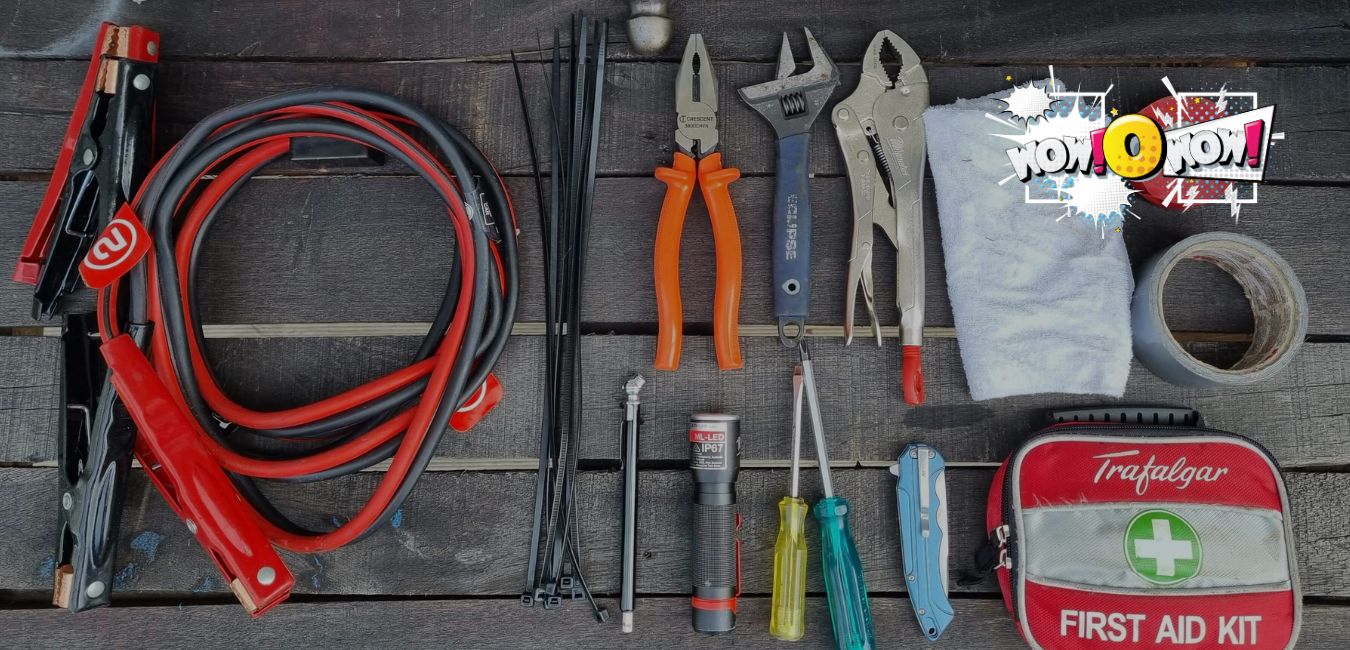
| What this is | A readiness guide to 5 generic tool types, not a shopping list |
| The 5 essentials | Jump starter, tire inflator + gauge, OBD-II scanner, emergency kit, basic repair kit |
| What they solve | Dead battery, flat or low tire, warning light, breakdown, small fixes |
| On a budget | Start with safety and visibility, then a jump starter and an inflator |
| Note | Tool categories only — pick what fits your vehicle; no brand picks |
A good travel kit is not about owning the fanciest gear; it is about having the one tool that gets you moving again when something fails far from a shop. The five below cover the failures a traveler actually hits, and each is usable by someone who is not a mechanic. Think of them as categories to fill, not products to chase.
These are generic tool types, not brand picks — choose what fits your vehicle and budget. Price ranges are broad and regional, so treat them as rough guidance. Set tire pressure to your vehicle’s door-jamb figure, not the maximum on the tire sidewall.
Table of Contents
How we chose these (and what we left off)
We chose these five for the common roadside failures a traveler actually hits: a dead battery, a flat or low tire, and a warning light, plus being seen and safe after a breakdown. Each is a tool category a non-mechanic can use, named generically so you can match it to your vehicle and budget. The table below ties each one to the exact problem it solves.
| Tool | Problem it solves | Features to look for | Rough price range |
|---|---|---|---|
| Portable jump starter | A dead battery with no second car nearby | Capacity for your engine size, a built-in light, USB charging | roughly $50–$150 |
| Tire inflator + gauge | A low or slow-leaking tire away from a station | A 12V plug, auto-shutoff, an accurate gauge | roughly $25–$80 |
| OBD-II scanner | A check-engine light with no idea why | Reads and clears codes; Bluetooth or standalone | roughly $20–$100 |
| Roadside emergency kit | Being seen and treated after a breakdown | Reflective triangle or vest, flashlight, first-aid, gloves | roughly $20–$60 |
| Basic tool + tire-repair kit | Small fixes: a plug, a fuse, a loose clamp | Multi-tool, tire plug kit, fuses, tape, tow strap | roughly $20–$60 |
1. Portable jump starter
A portable jump starter is a battery pack that restarts your car when the battery is dead and there is no second vehicle to jump from. It solves the most common roadside stranding: a no-start in a parking lot or driveway. Look for a pack rated for your engine size, a built-in work light, and USB ports to charge a phone. A rough price range is $50 to $150. Caution: connect the clamps in the correct order and never let the two clamps touch, and keep the pack charged so it is ready. When the battery dies at home, our guide to how to jump-start a car walks through it, and a no-start with a clicking sound is covered in car won’t start and just clicks.
2. Tire inflator and pressure gauge
A tire inflator with a gauge lets you top up a low or slowly leaking tire away from a gas station. It solves the low-pressure or slow-leak problem that would otherwise leave you stranded or riding on an unsafe tire. Look for a 12V plug that runs off the car, an auto-shutoff, and an accurate built-in gauge. A rough price range is $25 to $80. Set the tire to the pressure on your driver’s door-jamb placard, not the maximum printed on the tire, per NHTSA. If a tire keeps going down, see how to fix a slow leak in a car tire.
3. OBD-II scanner
An OBD-II scanner reads the trouble code behind a check-engine light so you know what the car is complaining about. It solves the mid-trip warning light that otherwise leaves you guessing whether to keep driving or stop. Look for one that both reads and clears codes, in either a standalone unit or a Bluetooth dongle that pairs with a phone. A rough price range is $20 to $100. A code narrows the problem but does not fully diagnose it, and a flashing check-engine light means a severe misfire that should be addressed quickly, per the EPA. See a flashing check engine light with shaking for what to do.
4. Roadside emergency kit
A roadside emergency kit keeps you visible and cared for after a breakdown, which matters most on a dark shoulder or in bad weather. It solves the being-seen-and-safe problem that a tool kit alone does not. NHTSA recommends carrying jumper cables, a flashlight, warning devices such as flares or emergency markers, a first-aid kit, blankets, water, and a phone charger, in its winter driving guidance. A rough price range for a prebuilt kit is $20 to $60. Caution: pull fully off the road, turn on your hazards, and set out the triangle or flares before you work near traffic. For the roadside emergency itself, see what to do if your brakes fail on the road.
5. Basic tool and tire-repair kit
A basic tool and tire-repair kit handles the small fixes that get you to a shop: a loose clamp, a blown fuse, or a nail in a tire. It solves the minor problems that do not need a tow but do need a tool you probably do not carry. Look for a multi-tool or small socket set, a tire plug kit, spare fuses, tape, and a tow strap. A rough price range is $20 to $60. Stop here: a tire plug is a temporary, get-you-home fix, not a permanent repair, so have the tire properly repaired or replaced soon, as covered in tire plug vs patch.
What to prioritize on a budget
You do not need all five at once. In priority order, start with safety and visibility, because being seen after a breakdown matters most, then add a way to restart and a way to re-inflate, and treat the scanner as a useful extra once the basics are covered.
- Safety and visibility first: a reflective triangle or vest, a flashlight, and a first-aid kit.
- A portable jump starter, so a dead battery does not strand you.
- A tire inflator and gauge for a low or slow-leaking tire.
- A basic tool and tire-plug kit for small fixes.
- An OBD-II scanner, a handy add once the basics are covered.
Frequently asked questions
What tools should I keep in my car for a road trip?
For a road trip, keep at minimum a way to restart a dead battery (a jump starter or cables), a way to re-inflate a tire (an inflator and gauge), a visibility and first-aid kit, and a basic tool and tire-plug kit. An OBD-II scanner is a useful add for reading a warning light.
Are portable jump starters worth it?
For travel, portable jump starters are worth it, because they let you restart a dead battery without a second vehicle, which is the most common roadside stranding. Pick one rated for your engine size, keep it charged, and follow the clamp-order instructions to use it safely.
Do I need an OBD-II scanner if I’m not a mechanic?
You do not strictly need an OBD-II scanner if you are not a mechanic, but it is handy. A basic scanner reads the code behind a check-engine light so you know whether to keep driving or stop, even if you cannot fix it yourself. It narrows the problem; it does not replace a diagnosis.
What to do next
Build your kit in priority order, tie each tool to the problem it solves, and read the matching how-to before you need it, not during a breakdown. Start with safety and visibility, add a jump starter and an inflator, then round it out with a basic repair kit and a scanner.
Match each tool to a real failure, keep the safety gear where you can reach it, and treat a tire plug or a jump pack as a get-you-moving fix rather than a permanent repair. Before a long trip, run through how to prepare your car for a road trip, and see our car troubleshooting guides.
