

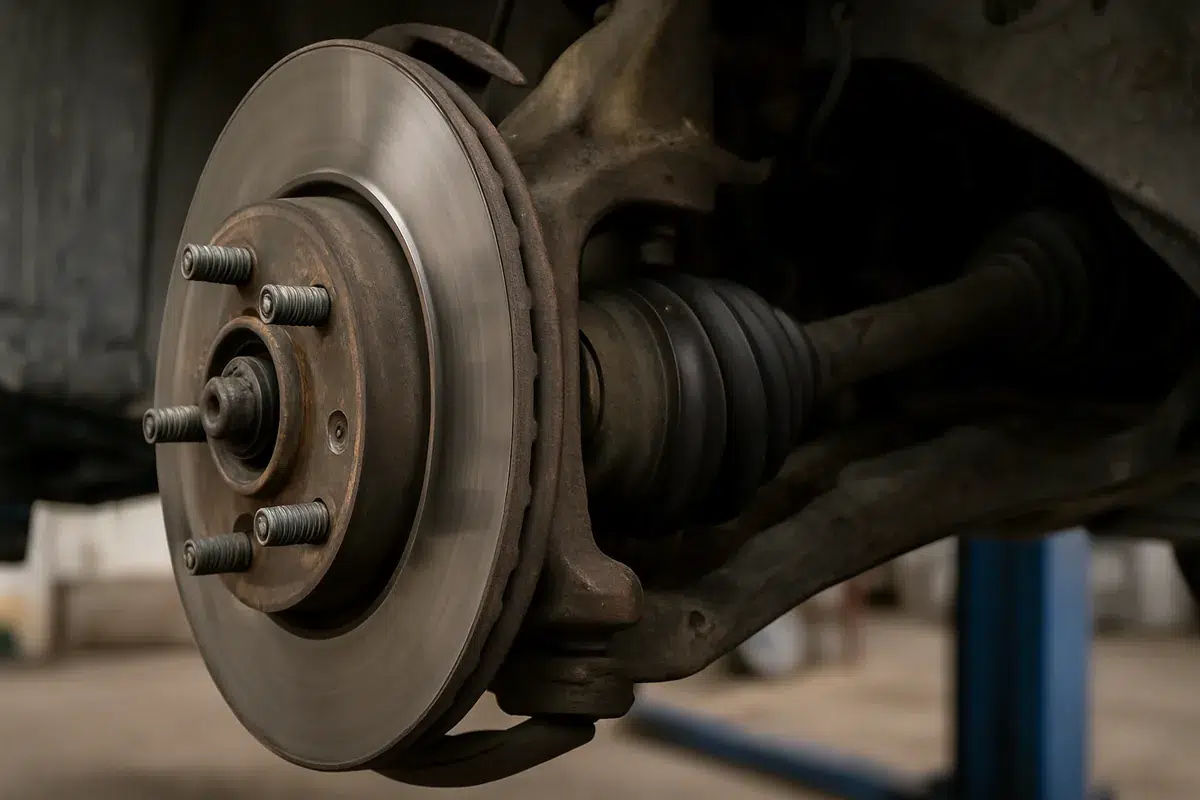
| What grinding means | Advanced wear, not an early warning |
| #1 cause | A failing wheel bearing |
| Also common | A badly worn CV joint, worn brakes, the power steering |
| Safe to drive? | Not for long. Get it inspected promptly. |
| Useful clue | Which way you turn when it gets louder |
| DIY or shop? | Shop. Bearings, axles, brakes and steering are pro repairs |
Cars announce wear in stages, and grinding is a late one. A click or a hum on turns means a part is on its way out; a harsh, metallic grinding means it has worn past that point and is scraping. That difference is what makes this noise worth acting on this week rather than next month, and it also narrows the list of parts likely to be responsible.
Repair costs vary widely by vehicle and by which part has failed, so no dollar figures appear on this page. Get a quote once a shop has identified the source, and have the noise inspected rather than diagnosed by ear alone.
Table of Contents
Why grinding, not clicking or humming?
The sound tracks how far the wear has gone. A click on sharp turns is an early or moderate fault, usually a CV joint. A hum that rises with speed is a bearing in the middle of its decline. Grinding, a harsh metallic scrape, means a component has reached metal-on-metal contact or is coming apart, which is why it belongs in a different urgency bracket.
That is the practical takeaway on this page. Our guide to a car that makes noise when turning covers the full range of turning sounds and which part each one points to. Read this page instead if what you hear is specifically grinding, because the list of likely causes is shorter and the timeline for dealing with it is much tighter.
Most common causes of grinding when turning
Five faults account for nearly all grinding on turns, and the first two are the most likely. Turning loads the wheels unevenly, which is why a part that is quiet in a straight line starts grinding on a curve. Use the table to match the pattern you hear, then take it to a shop, since none of these repairs is a driveway job.
| Cause | How to spot it | How urgent |
|---|---|---|
| Failing wheel bearing | Grinding or growling that rises with speed and changes as you turn one way | Prompt. A bearing can seize |
| Badly worn CV joint | Started as clicking on sharp turns, now grinds; often worse on full lock | Prompt. An axle can break |
| Worn brakes or trapped debris | Grinds when turning and when braking; a stone can grind constantly | Prompt brake inspection |
| Failing power steering pump | Grinding or whining that follows the steering wheel, not road speed; often low fluid | Book it in |
| Worn strut bearing or mount | Grinding or creaking as the wheel turns, sometimes felt through the wheel | Book it in |
Two questions separate most of these. Does the noise follow road speed or the steering wheel? Road speed points at a bearing, a CV joint, or the brakes, while noise that appears when you turn the wheel even at a standstill points at the steering. And does it also grind when you brake? If so, read our guide to a car grinding noise when braking first, because brakes are the more likely culprit.
A failing wheel bearing: the usual cause
A worn wheel bearing grinds or growls and changes volume as you turn, because turning shifts the car’s weight onto the loaded side and forces the failing bearing to carry more of it. Turning one way often makes it louder and the other quieter, which both confirms it is a bearing and tells the shop which side to look at.
A bearing that has reached the grinding stage is near the end. Left alone it can overheat, develop play in the wheel, and in the worst case seize or allow the hub to come apart, which is why this one is not a wait-and-see noise. Have it replaced rather than monitored. If your noise is clearly worse turning one direction, our guide to a car that makes noise turning right but not left covers how that asymmetry pinpoints the side.
Caution: a grinding bearing can be accompanied by a wheel that feels loose, a vibration through the steering wheel, or a wheel hot to the touch after a drive. Any of those means stop driving and arrange an inspection rather than finishing the week on it.
CV joints, brakes, and power steering
If the bearing checks out, three other parts produce grinding on turns and each has its own tell. A CV joint that has gone past clicking into grinding is badly worn. Brakes grind when the friction material is gone or a stone is trapped. The power steering grinds or whines in time with the steering wheel rather than with road speed, usually when the fluid is low or old.
| Cause | The tell | The fix |
|---|---|---|
| Worn CV joint | Worse on full lock and tight turns; a torn rubber boot with grease flung around it | Shop replacement of the joint or the axle |
| Worn brake pads | Grinds when braking as well as turning; braking feels less confident | Brake inspection and pad replacement |
| Trapped debris | Started suddenly, often after gravel; can grind even in a straight line | A shop removes it; usually cheap |
| Power steering pump or fluid | Noise follows the steering wheel, even parked; heavier steering | Check the fluid, then shop diagnosis |
The overlap with brakes is worth pinning down early, because a brake that grinds is also a brake that is not stopping the car as well as it should. Grinding alongside a pedal that feels soft or sinks is a different and more urgent problem, covered in our guide to a soft brake pedal. The Car Care Council recommends a brake inspection at least once a year and warns against letting pads wear to the metal-to-metal point, which is exactly the sound in question.
Is it safe to drive with a grinding noise when turning?
Driving on a grinding turning noise is not safe for long. Grinding means a part has already worn past its service limit, and the two most likely candidates both fail in ways that affect control: a wheel bearing can seize, and a badly worn CV joint can break and leave the car without drive. Arrange an inspection now rather than waiting for the noise to get worse.
Keep the driving you do gentle and short in the meantime, and stop altogether if the steering feels loose or vague, if a wheel vibrates or feels hot, or if the grinding gets suddenly louder. Because bearings, axles, brakes and steering are all safety systems, this is work for a shop rather than a first DIY project. You can ask whether the technician holds ASE certification in suspension and steering. It is also worth running your VIN through NHTSA’s recall lookup, since steering and suspension defects are a recurring recall category and a recall repair is free.
Frequently asked questions
Is a grinding noise when turning dangerous?
A grinding noise when turning can be dangerous, because grinding signals advanced wear and the usual causes are a wheel bearing or CV joint that can seize or break. Losing a bearing or an axle affects control of the car. Have it inspected promptly instead of continuing to drive on it.
What causes grinding when turning at low speed?
Grinding on low-speed turns is usually a worn wheel bearing or CV joint loading up, or worn brakes and trapped debris if the noise also appears when braking. Power steering faults grind in time with the steering wheel rather than road speed. All of them need a shop inspection.
Is it the wheel bearing or the CV joint?
A grinding or growling that rises with road speed and changes as you turn one way is usually a wheel bearing. A grinding that began as clicking on sharp turns, and is worst on full lock, is more likely a worn CV joint. Both are advanced wear, and a shop confirms which.
Can worn brakes grind only when turning?
Worn brakes can grind mainly on turns, because turning shifts weight onto one side and changes how the pad contacts the disc. Trapped debris does the same. Grinding that also appears when you brake points at the brakes rather than a bearing, and needs a brake inspection.
What to do now
Treat grinding as the late-stage noise it is. Note whether it follows road speed or the steering wheel, whether it changes as you turn one way, and whether it also grinds when you brake, because those three answers point at the bearing, the steering, or the brakes. Then book an inspection promptly rather than driving on it, since a grinding bearing or CV joint can seize or break.
For the clicks, hums, and clunks that come before grinding, see our guide to a car that makes noise when turning, or browse the complete car noises guide. More help lives on the wowowow car care home page.
