

At a Glance
| Where is your number | The driver’s door-jamb placard (or the owner’s manual) |
| Typical range | About 30–35 PSI for most passenger cars — your placard is the real target |
| The sidewall number | The tire’s maximum pressure, not your everyday target |
| When to check | Cold (parked 3+ hours), at least monthly and before long trips |
| Front vs. rear | May differ — match the placard exactly |
| Tools | A tire pressure gauge and an inflator or air pump |
“What is the correct tire pressure for my car?” has one reliable answer: the cold pressure printed on your vehicle’s door-jamb placard. This guide shows you exactly where to find that number, why it is not the number on the tire, how to check and set your pressure correctly, and how to adjust for cold weather and loads. Tires are the only thing connecting your car to the road, so getting this right matters for safety, handling, and how long your tires last.
The 30–35 PSI figure is a typical range only. Your real number is on your placard — confirm it there or in your owner’s manual before setting your pressure.
Table of Contents
Where do I find the recommended tire pressure?
Your recommended tire pressure is on the Tire and Loading Information placard, a sticker on the driver’s-side door jamb (the B-pillar you see when the door is open). If it is not there, it may be on the rear edge of the driver’s door, the fuel-filler door, the glovebox, or in the owner’s manual. The placard lists the cold PSI for the front and rear tires, and sometimes a separate figure for the spare or for heavy loads.
Two things on the placard trip people up. First, many vehicles specify different front and rear pressures, so read them as a pair rather than assuming all four match. Second, the placard number is a cold inflation pressure, which is the reading you get before the tires have been warmed by driving. NHTSA’s tire safety guidance points drivers to this placard as the authoritative source, and it is the number to trust for everyday driving.
Why isn’t the number on the tire sidewall my pressure?
The number on the tire sidewall is the tire’s maximum safe pressure, set by the tire manufacturer, not the pressure tuned for your specific vehicle. A sidewall that reads something like “Max 51 PSI” tells you the ceiling the tire can hold, not the target your car was designed around. Inflate to that number and you will over-inflate most passenger cars.
The reason the two numbers differ is that they answer different questions. The sidewall states what the tire can handle. The placard states what your vehicle needs, based on its weight, suspension tuning, and axle loads — which is why two cars wearing the identical tire size can call for different pressures.
Caution: over-inflation shrinks the tire’s contact patch, which worsens grip and wears the center of the tread, while under-inflation builds heat and raises blowout risk. Never inflate a tire above the sidewall maximum. When in doubt, the placard wins. The full care context lives in our complete car tire guide .
How do I check my tire pressure correctly?
You check tire pressure with a gauge while the tires are cold, because driving heats the air inside and raises the reading. “Cold” means the car has been parked for at least three hours, or driven less than about a mile. Check first thing in the morning for the most accurate result.
- Confirm the tires are cold — parked 3+ hours, or driven under a mile.
- Find your target PSI on the driver’s door-jamb placard (note the front and rear figures separately).
- Unscrew the valve cap on the first tire and set it somewhere you won’t lose it.
- Press the gauge squarely onto the valve stem until the hissing stops, then read the number.
- Repeat on all four tires and the spare, writing each reading down.
- Compare each reading to the placard number to see which tires need air.
The step people skip is the cold rule, and it matters because pressure rises as tires warm. If you check after a drive and let air out to hit the placard number, the tire will read low the next cold morning. If you must check warm, treat the placard figure as a cold target and recheck later. Keep a gauge in the car, since a pothole or curb strike can drop pressure suddenly. If you are topping up at a station, our guide on whether it is fine to leave the car on while putting air in the tires covers that common question.
How do I add air and set the pressure?
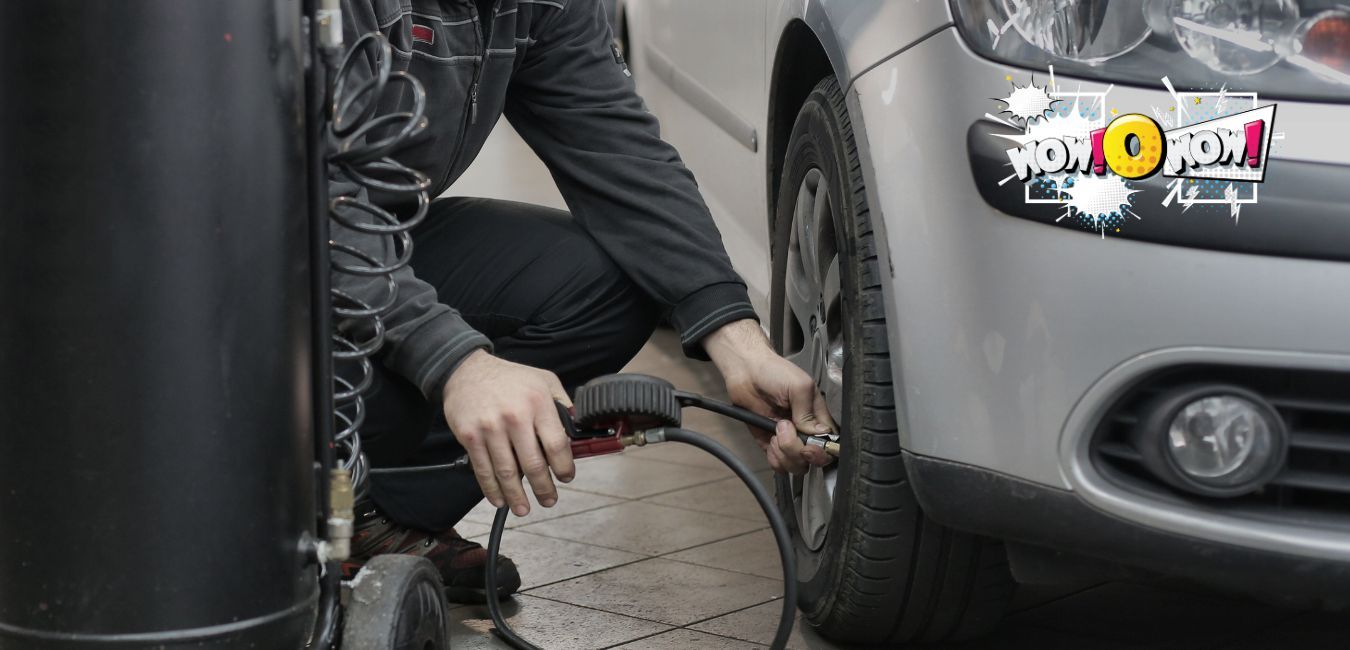
You add air by connecting an inflator or air pump to the valve stem and filling in short bursts until the tire reaches the placard PSI. The half of the job most guides skip is letting air out when you overshoot, which is just as important as adding it.
- Set your target — the cold placard PSI for that tire (front or rear).
- Press the inflator or pump hose firmly onto the valve stem.
- Add air in short bursts, checking with your gauge between bursts.
- If you overshoot, press the small pin inside the valve (or use the bleed button on the gauge) to release air, then recheck.
- Recheck each tire, then screw the valve caps back on.
Caution: do not bleed air out of a hot tire to match the cold number, because the tire will be underinflated once it cools. Any home compressor, portable inflator, or gas-station pump works for this. If you are choosing a tool, we cover whether you can use an air compressor to inflate car tires and even whether a bike pump works on a car tire. Have a tire professional look at it if the placard is missing or does not match the tires currently fitted, or if one tire keeps dropping no matter how often you top it up. You can find one through ASE, which certifies automotive technicians.
Should I adjust pressure for cold weather, loads, or towing?
Yes, temperature and load both change what you should do, though your placard number stays the baseline. Tire pressure falls in cold weather by roughly 1 PSI for every 10°F drop, which is why the pressure-warning light so often appears on the first cold morning of the season. Heavy loads or towing may call for the higher “loaded” figure some placards list.
| Situation | What to do |
|---|---|
| Cold snap / winter | Pressure drops ~1 PSI per 10°F. Top up to the placard number when the tires are cold. A warning light on a freezing morning is usually just this. |
| Summer heat / after driving | Tires read several PSI higher when hot. Don’t bleed to the cold number — recheck cold instead. |
| Heavy load or towing | Use the higher “loaded” placard figure if one is listed, and only while loaded. |
| Spare tire | Compact/donut spares often need much higher pressure. Use the placard’s spare figure. |
The temperature effect is normal physics, not a leak, and the U.S. Tire Manufacturers Association notes the same roughly 1–2 PSI per 10°F relationship. If your light keeps returning after you have set the pressure correctly, that points to a slow leak rather than the weather — see whether your tires are losing air to the cold or whether something is making your tires keep losing air.
What happens if my pressure is too high or too low?
Both under- and over-inflation cause problems, and the tread wear pattern tells you which one you have. Underinflation is the more dangerous of the two, because a soft tire flexes more, builds heat, and can fail — NHTSA identifies underinflation as a leading cause of tire blowouts.
| Too low (underinflated) | Too high (overinflated) | |
|---|---|---|
| How it feels | Sluggish, vague steering; extra rolling drag | Harsh, skittish ride over bumps |
| Tread wear | Both outer edges wear faster | Center of the tread wears faster |
| Main risk | Heat build-up and blowout | Less grip; easier to damage on a pothole |
| Fuel economy | Worse — soft tires drag | Marginal at best; not worth the safety cost |
Safe to drive? A pressure-warning light means check your tires soon, not stop immediately — one or more is low, so add air to the placard number when you can. But a tire that is deflating fast, thumping, or visibly flat is different: pull over safely rather than drive on it. Driving on a flat can destroy the tire and the wheel and can pull the car off line. See whether you can drive a car with a flat tire and how to fix a slow leak in a car tire for the next steps.
Frequently asked questions
Is 40 PSI too high for my tires?
Usually, yes, for a passenger car. Most passenger vehicles are set around 30–35 PSI on the door placard, so 40 PSI is often near the tire’s maximum rather than your target and can overinflate the tire. Some SUVs, light trucks, and loaded/towing setups do call for figures near 40, so check your placard — that number is the deciding factor, not a round figure at the pump.
Should all four tires have the same pressure?
Not always. Match the placard: many vehicles specify different front and rear pressures, sometimes by several PSI, because of how the car’s weight sits. So “all four the same” is only correct if your placard lists the same number front and rear. Set each axle to its listed figure rather than picking one number for the whole car.
Can I drive with the TPMS light on?
Check your tires first. The tire-pressure warning light means at least one tire is low — federal rules require it to warn by about 25% below the recommended pressure. If it is a slow drop, drive gently to a pump and add air to the placard number. If a tire is deflating quickly or feels or looks flat, stop safely instead of driving on it.
Does tire pressure change with temperature?
Yes. Tire pressure changes about 1 PSI for every 10°F change in temperature, so it drops as the weather cools and rises as it warms. That is why the warning light so often appears on the first cold morning of fall or winter. It is normal physics, not a leak — just top the tires back up to the placard pressure when they are cold.
What to do now
The whole routine fits in one line: find your placard number, check the tires cold, and set all four (plus the spare) to the listed front and rear figures. Do it once a month and before long trips, and adjust up if you are towing or hauling a heavy load. Keep in mind that correct pressure is a safety issue first — underinflation is a leading cause of blowouts, so a monthly cold check is worth the few minutes it takes. For everything else on tread, rotation, and leaks, see our complete car tire guide, or the broader automotive care hub.
