

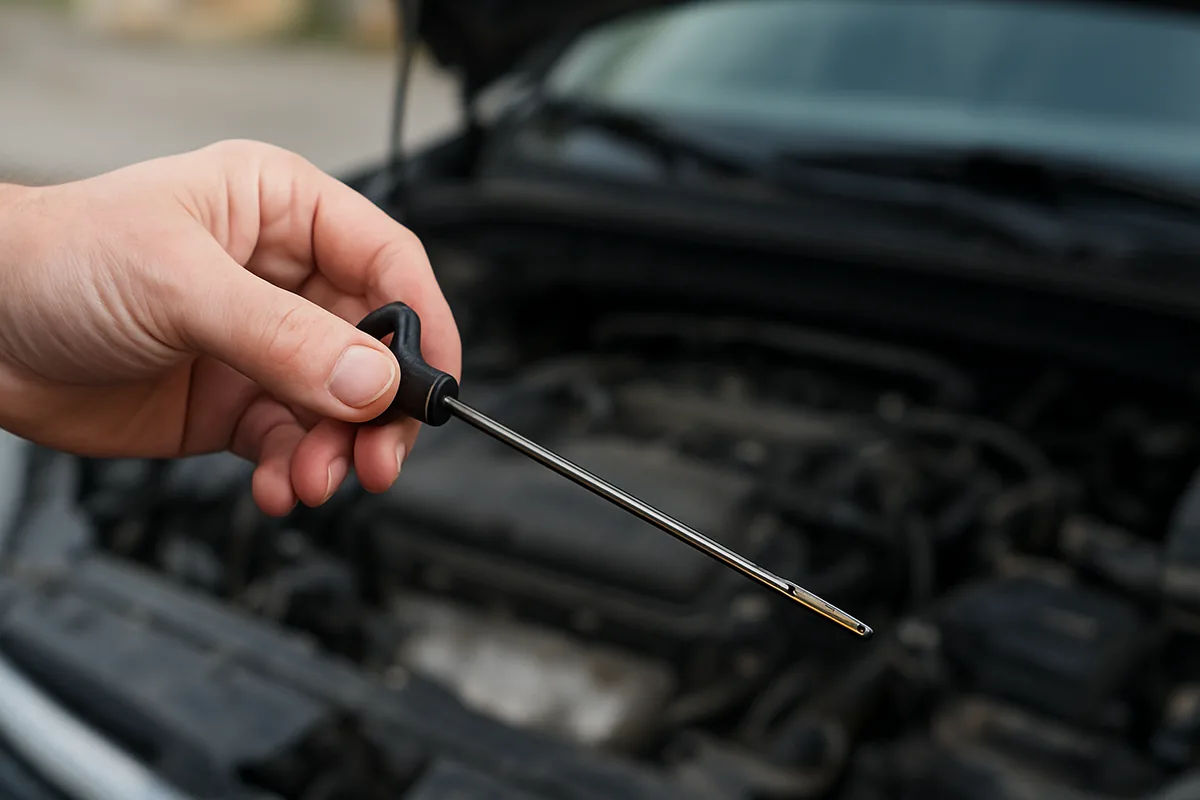
| What you’ll do | Pull, wipe, reinsert and read the dipstick |
| Difficulty | Easy, no tools, no experience needed |
| Time | About 1 to 2 minutes |
| What you need | A rag or paper towel, and your owner’s manual |
| Where the level should sit | Between the min and max marks, ideally near the top |
| The one hazard | A warm engine bay has hot parts. Let it cool first |
Most cars give you no warning that the oil is getting low until a light comes on, and by then the level has usually been falling for a while. A dipstick check catches it early, and it is the single easiest piece of maintenance an owner can do without opening a toolbox.
This page covers the reading method step by step, whether to check hot or cold, what the level and the oil’s color are actually telling you, what to do if your car has no dipstick at all, and how often the check is worth doing. For intervals, leaks, oil types and everything else under the cap, see the complete oil and engine oil guide.
Dipstick markings differ by vehicle. Some use MIN and MAX, some use L and H, some use two pinholes and some use a crosshatched band, so the marks on your own dipstick and the guidance in your owner’s manual override any general description here.
Table of Contents
How to check your engine oil level in 6 steps
To check your engine oil level, park the car level, turn the engine off, then pull the dipstick, wipe it, reinsert it fully and read the film on the second pull. The wipe-and-reinsert part is the step beginners skip, and skipping it is why a first reading is almost always wrong.
- Park on level ground and shut the engine off. A car sitting on a slope pools the oil to one end of the pan and gives a false reading. Wait a few minutes after switching off so the oil in the top of the engine drains back down.
- Open the hood and find the dipstick. Look for a small loop or T-shaped handle sticking out of the engine, often colored yellow or orange to make it obvious. Some cars have a second dipstick for transmission fluid, so check your owner’s manual if the handle is not clearly marked.
- Pull the dipstick out and wipe it clean. Use a rag or paper towel and wipe the whole blade dry. The oil clinging to it from sitting in the tube is not a reading, it is just splash.
- Push the dipstick all the way back in. Seat it fully, until the handle sits down against the tube the way it did before you pulled it. A dipstick left half in reads low.
- Pull it out again and read the oil film. Hold it horizontally and look at both sides. The top of the oil streak is your level, and it should fall between the two marks or inside the crosshatched band.
- Check the color and condition, then put it back. Note whether the oil is amber, dark or milky before you wipe the dipstick and reseat it fully. Close the hood and you are done.
Caution: if you have just been driving, the engine bay is hot enough to burn you. Let the car sit until you can rest a hand near the dipstick tube comfortably, and keep sleeves and hair clear of the belt and fan area even with the engine off.
Should you check the oil hot or cold?
Check the oil with the engine off, and be consistent about the timing. Consumer Reports advises giving the engine time to cool on most cars so you do not burn yourself, while noting that some vehicles specifically call for checking after the engine has warmed up, which is why the owner’s manual settles it.
Two things throw a reading off more than temperature does. The first is a car parked on any kind of slope, including a mildly crowned driveway. The second is checking within seconds of switching off, before the oil that was circulating through the top of the engine has run back into the pan. Both make the level read low, and both are why two readings taken minutes apart can disagree by a visible amount.
Pick one routine and stick to it. Checking cold in the morning on flat ground is the easiest habit to keep, and comparing like with like month to month is what lets you spot a level that is genuinely falling. If you are checking because you already suspect the level is low and the engine is still warm, the timing and the burn risk are covered in whether you can put oil in a hot car engine.
What the oil level on the dipstick tells you
Oil at or just below the maximum mark is exactly where it should be. Anywhere inside the marked range is fine. At or below the minimum mark, the engine needs oil before you drive any further, and a level that has dropped noticeably since your last check means the engine is burning oil, leaking it, or both.
Add oil gradually rather than emptying a bottle in. Consumer Reports suggests adding roughly half a quart, waiting a minute, and rechecking, because most cars rarely need more than a quart to come back up to full. The mechanics of topping up, including whether the engine should be running, are covered in whether the car should be running when adding oil.
Overfilling is a real problem, not a harmless excess. Oil above the maximum mark can be whipped into foam by the crankshaft, and foam does not carry pressure the way liquid oil does. If you have gone past the top mark, what happens next and how to correct it are set out in what happens if you put too much oil in your car.
A level that keeps dropping is worth treating as information rather than an inconvenience. Topping up fixes the symptom while the cause carries on, and the difference between a slow leak and genuine consumption is something a dipstick check over a few weeks will show you before a mechanic ever sees the car.
What the oil’s color and condition tell you
Oil color turns a level check into a quick engine health check. Fresh oil is amber and translucent, and it darkens steadily in normal use as it picks up combustion soot and does its job. Darkening alone is not a fault. What matters is texture, and one appearance in particular is a stop sign.
| What the oil looks like | What it usually means | What to do |
|---|---|---|
| Amber to light brown, translucent | Fresh or recently changed oil | Nothing. Recheck next month |
| Dark brown to black, still smooth and slippery | Normal aging | Check where you are in the service interval |
| Very black, gritty, or thick and sludgy | Overdue for a change | Book the oil change now |
| Milky, foamy, or tan like coffee with cream | Coolant getting into the oil | Stop driving. Have it diagnosed, and towed if a coolant leak is likely |
| Glittery, with fine metal flecks | Possible internal engine wear | Mechanic, before driving further |
Milky oil is the one entry on that table that changes your plans. Both AAA and Consumer Reports treat a light, milky appearance on the dipstick as a sign that coolant may be leaking into the engine, and Consumer Reports goes further, advising that a car suspected of a coolant leak be towed rather than driven. Coolant and oil mixing points at a failed head gasket or a cracked component, and continuing to drive turns a repair into a replacement engine. This is a job for a professional from the moment you see it, not a wait-and-see.
Metal flecks belong in the same category. Fine glitter in the oil suggests something inside the engine is wearing metal off itself, and no amount of fresh oil addresses that. Very dark, gritty oil is far less dramatic and simply means the service is due, which is the question worked through in how long a car can go without an oil change.
What if my car has no dipstick?
Many newer vehicles have replaced the dipstick with an electronic oil level sensor, and the level is read from the dashboard menu instead. Consumer Reports notes that some recent cars have an electronic oil monitor with no traditional dipstick for manual inspection, so if you cannot find a dipstick anywhere in the engine bay, that is very likely why.
Follow the vehicle’s own procedure, because the sequence varies. On most systems it means switching the ignition on with the engine off, parking level, and navigating to a vehicle information or service menu, sometimes after a short wait while the sensor settles. Your owner’s manual has the exact menu path, and there is no generic version of it worth guessing at.
Treat an electronic reading with the same eye you would give a dipstick. The display tells you the level but not the color or texture, so a car with no dipstick gives you no early look at milky or gritty oil. That makes sticking to the manufacturer’s service schedule more important, not less, and it makes the oil warning light worth understanding properly.
How often should you check your engine oil?
Check your engine oil about once a month, and before any long drive. AAA recommends building the habit of checking at least monthly, ahead of any warning light appearing, while Consumer Reports suggests the quicker cadence of every other fill-up. Either is fine. The one that actually happens is the right one.
Long trips deserve their own check. NHTSA advises drivers of conventional and hybrid vehicles to check the oil level periodically and to get the oil change done before travelling if the service is nearly due, alongside the other fluid levels. Two minutes in the driveway is cheaper than a breakdown three states from home.
Check immediately, whatever your schedule says, if the oil pressure or oil level light comes on, if you spot fresh drips where the car parks, or if the engine sounds louder or rougher than usual. What each of the oil symbols on the dash actually means is covered in what the oil light means, and the reason a low level is treated so seriously is explained in whether low oil can cause a car to shut off.
When you do top up, use the viscosity grade your manual specifies rather than whatever is on the shelf. The US Department of Energy notes that using the manufacturer’s recommended grade of motor oil can improve gas mileage by 1 to 2 percent compared with the wrong grade, and the grade is chosen for how the engine is built, not just for economy.
Frequently asked questions
Do you check engine oil with the car on or off?
Check engine oil with the engine off. Shut the car down and give it a few minutes so the oil drains back into the pan, because a reading taken while the engine runs or immediately after shutting it off shows a false low level. Some manufacturers specify checking warm, so confirm in your owner’s manual.
Where should the oil be on the dipstick?
Engine oil should sit between the minimum and maximum marks on the dipstick, ideally closer to the maximum. Below the minimum means the engine needs oil before you drive further. Above the maximum means it is overfilled, and the excess should be drained rather than left in.
What does dark or dirty oil on the dipstick mean?
Dark oil on the dipstick is normal, because oil darkens as it collects combustion soot during ordinary use. Very black, gritty or sludgy oil means the change is overdue. Milky or foamy oil is a different problem entirely and can mean coolant is mixing in, which needs a mechanic.
How much oil do I add if it’s low?
Add oil in small amounts, roughly half a quart at a time, then wait a minute and recheck the dipstick before adding more. Most cars need no more than a quart to come back up to the full mark. Use the viscosity grade listed in your owner’s manual.
What to do now
Park level, switch the engine off, wait a few minutes, then pull the dipstick, wipe it, push it fully back in, pull it again and read the film. Keep the level between the minimum and maximum marks, and top up in small amounts rather than all at once so you do not overfill. Glance at the color while you are there, and put a monthly check in your phone so the habit survives the first busy week. Stop driving and get the car looked at if the oil is milky, foamy or full of metal flecks.
For intervals, leaks, oil grades and what happens when things go wrong, see the complete oil and engine oil guide, or browse the wider automotive care and repair section.
