

At a Glance
| The old 3,000-mile rule | Outdated for modern engines and oils |
| Your real interval | The owner’s manual or the oil-life monitor |
| Conventional oil | Roughly 5,000–7,500 miles (verify for your car) |
| Full synthetic | Roughly 7,500–10,000+ miles (verify) |
| The warning to fear | The red oil-pressure light — stop the engine |
| Typical cost | About $35–$125 depending on oil type (verify) |
Engine oil is the cheapest insurance your car has, and getting a few basics right prevents the expensive failures. This guide is the complete reference: how often to actually change your oil, which oil your engine needs, how to read the numbers on the bottle, how to check and change it safely, and how to diagnose the common oil problems, from overfilling to leaks to a lit warning light. Each section links to a detailed walkthrough, so use this page as the map.
Every interval, spec, and cost figure here is a sourced range or defers to your owner’s manual. There is no universal oil-change mileage. Confirm the exact numbers for your vehicle before acting on them.
Table of Contents
What does engine oil actually do?
Engine oil does four jobs at once, and understanding them explains every problem later in this guide. It lubricates, cools, cleans, and seals, and when it wears out it stops doing all four well. That is why fresh oil matters far more than its low cost suggests.
- Lubricates. Oil forms a thin film between metal parts that move against each other, such as the crankshaft bearings, camshaft, and piston rings, preventing the metal-to-metal contact that would quickly destroy them.
- Cools. Oil carries heat away from the hottest parts of the engine that coolant never reaches, like the underside of the pistons.
- Cleans. Detergent additives suspend soot and combustion byproducts so they get carried to the filter instead of building up as sludge.
- Seals. Oil fills the microscopic gaps between the piston rings and cylinder walls, helping the engine hold compression.
Oil wears out because heat, contaminants, and moisture gradually break down its additives and thicken it, which is why it needs replacing on a schedule rather than lasting forever. Short trips are especially hard on oil, because the engine never gets hot enough to burn off the moisture and fuel that sneak into the crankcase, so oil in a city commuter degrades faster than the mileage alone suggests. This is also why running low or using the wrong grade is so damaging: it undercuts all four jobs at once. If you let oil go long enough without changing it, the consequences are serious, covered further down.
How often should I change my oil?
You should change your oil on the schedule in your owner’s manual or when the car’s oil-life monitor tells you to, not on a fixed 3,000-mile rule. The 3,000-mile interval made sense in the 1970s, when engines ran dirtier and oil broke down faster, but modern engines and oils last far longer. For most cars today the realistic interval falls between 5,000 and 10,000 miles depending on the oil type. The reason the old rule persists is that it benefits the businesses that sell oil changes, not drivers, and the company that actually designed and warrants your engine, the manufacturer, publishes a longer interval in the manual.
The table below gives typical ranges. Treat them as a gut check only, because the manufacturer’s schedule and the oil-life monitor override any generic number.
| Oil type / situation | Typical interval (verify against your manual) |
|---|---|
| Conventional oil | ~5,000–7,500 miles |
| Synthetic blend | ~5,000–7,500 miles |
| Full synthetic | ~7,500–10,000 miles (some go 10,000–15,000 per the monitor) |
| Oil-life monitor equipped | Change when it says, regardless of a round mileage figure |
| Severe service (short trips, towing, heat, cold, dust) | Shorter — follow the manual’s severe schedule |
Two points catch people out. First, the severe-service schedule is why two owners of the same car get different intervals: lots of short trips, stop-and-go traffic, towing, or extreme temperatures all shorten the interval, and that describes most real driving. Second, even a low-mileage car should have its oil changed at least once a year, because oil degrades with time and moisture, not just mileage. It is also worth trusting the oil-life monitor over the odometer if your car has one, because it factors in how hard those miles were, not just how many. A car driven gently on the highway will genuinely stretch further than one that does nothing but short cold-start trips, and the monitor reflects that. For the edge cases, see how long a car can go without an oil change, how often to change synthetic oil, and how long oil lasts in a car that isn’t driven. Modern oils are a big reason intervals stretched; the U.S. Department of Energy’s fueleconomy.gov covers how the right oil also protects efficiency.
Synthetic vs conventional oil: which do I need?
You need whichever oil your owner’s manual specifies, and for a growing majority of modern cars that is full synthetic. Synthetic oil flows better when cold, resists breakdown at high heat, and lasts longer between changes, which is why newer engines, especially turbocharged and direct-injection ones, require it. Conventional oil is cheaper and fine for older or simpler engines that call for it. The difference comes from how the oil is made: synthetic uses engineered molecules of a more uniform size, so it behaves more predictably across temperature extremes than refined crude, which is a mix of molecule sizes. That uniformity is what gives synthetic its better cold flow, heat stability, and resistance to sludge.
| Conventional | Synthetic blend | Full synthetic | |
|---|---|---|---|
| Cost per change | $ (lowest) | $$ | $$$ (highest) |
| Typical interval | 5,000–7,500 mi | 5,000–7,500 mi | 7,500–10,000+ mi |
| Cold-start flow | OK | Better | Best |
| High-heat stability | OK | Better | Best |
| Best for | Older/simple engines that specify it | A middle-ground upgrade | Modern, turbo, GDI, or where the manual requires it |
The right way to think about the cost is per mile, not per bottle. Full synthetic costs more up front but goes noticeably longer between changes, so the gap in yearly cost is smaller than the shelf price suggests. The one rule that matters: do not downgrade below a synthetic your manual requires, because it can affect protection, emissions parts, and your warranty. There is also high-mileage oil, formulated with seal conditioners and extra detergents for engines over about 75,000 miles. Those conditioners can gently swell aging seals and reduce minor seepage, so if an older engine is starting to leave small spots but isn’t burning oil badly, high-mileage oil is a reasonable, low-cost thing to try before chasing a gasket. It is not a fix for a real leak, though, just a way to slow minor weeping. For a fuller breakdown, see our synthetic vs conventional oil guide, and if you are unsure whether you even need a full change, oil change vs adding oil covers that.
What do the numbers and symbols on the oil mean?
The numbers and symbols on an oil bottle tell you its thickness and which standards it meets, and matching them to your manual is what keeps your engine protected and your warranty intact. The most prominent marking, like SAE 5W-30, is the viscosity grade. The “5W” is how easily the oil flows when cold (the W is for winter), and the “30” is how thick it stays at full operating temperature.
| Marking | What it tells you |
|---|---|
| SAE 5W-30 | Viscosity: “5W” = cold-start flow, “30” = thickness when hot |
| API “donut” (e.g., SP) | The service/quality standard the oil meets — SP is the current gasoline category |
| ILSAC “starburst” | Certified to the current GF-6A standard (common grades like 0W-20, 5W-30) |
| ILSAC “shield” | The newer GF-6B mark, for 0W-16 oils only — not backward compatible |
| OEM approval (e.g., dexos) | A specific carmaker’s own requirement, such as GM’s dexos |
The rule when buying is simple: match the viscosity and any spec your owner’s manual or oil cap lists, and look for the API starburst or donut that confirms certification. Using a thinner or thicker grade than specified reduces protection, and ignoring an OEM spec like dexos can matter for warranty and emissions. Viscosity matters most at the two extremes: a cold engine needs oil thin enough to flow instantly to the top of the engine on start-up, which is what the “5W” side governs, while a hot engine needs oil thick enough not to thin out and lose its protective film, which is the “30” side. Fit oil that is too thick for the cold rating and it is slow to protect on a freezing morning; too thin for the hot rating and it can fail to hold a film under load. Diesel engines use API “C” categories and motorcycles need their own oils, so the “match the manual” rule is not optional. The American Petroleum Institute’s oil category guidance is the authority behind these marks.
How do I check my engine oil level?
You check your oil level with the dipstick while the car is parked on level ground and the engine is off. Checking on a slope or right after a hard drive gives a false reading, so let the oil settle for a few minutes first.
Caution: a hot engine and hot oil can burn you, so let it cool before you open anything or handle the dipstick tube.
- Park on level ground and turn the engine off. Let it sit a few minutes so the oil drains back to the pan.
- Pull the dipstick out, wipe it clean with a rag, and reinsert it fully.
- Pull it out again and look at where the oil film sits between the low and full marks.
- Check the color and feel too: healthy oil is amber to light brown; very dark or gritty oil is overdue, and a milky, coffee-colored look can mean coolant is getting in.
- If it is low, add the specified oil in small amounts, rechecking each time, until it reaches but does not pass the full mark.
Many newer cars have no dipstick at all and instead show the oil level through an electronic sensor in the dashboard menu, so check your manual for how yours reports it. It is worth checking your oil about once a month and before any long trip, because catching a slow drop early is what prevents running dangerously low between changes. When you read the dipstick, the color and texture tell you almost as much as the level: clean oil is translucent amber to light brown, while oil that is jet black and gritty between your fingers is overdue, and a milky, tan, foamy look on the stick can signal coolant leaking into the oil, which is a bigger problem worth a mechanic’s look. Whether you can top up on a warm engine, and whether the engine should be running, are common questions covered in whether you can put oil in a hot engine and whether the car should be running when you add oil. The full walkthrough lives in how to check your engine oil level.
How do I change my oil myself?
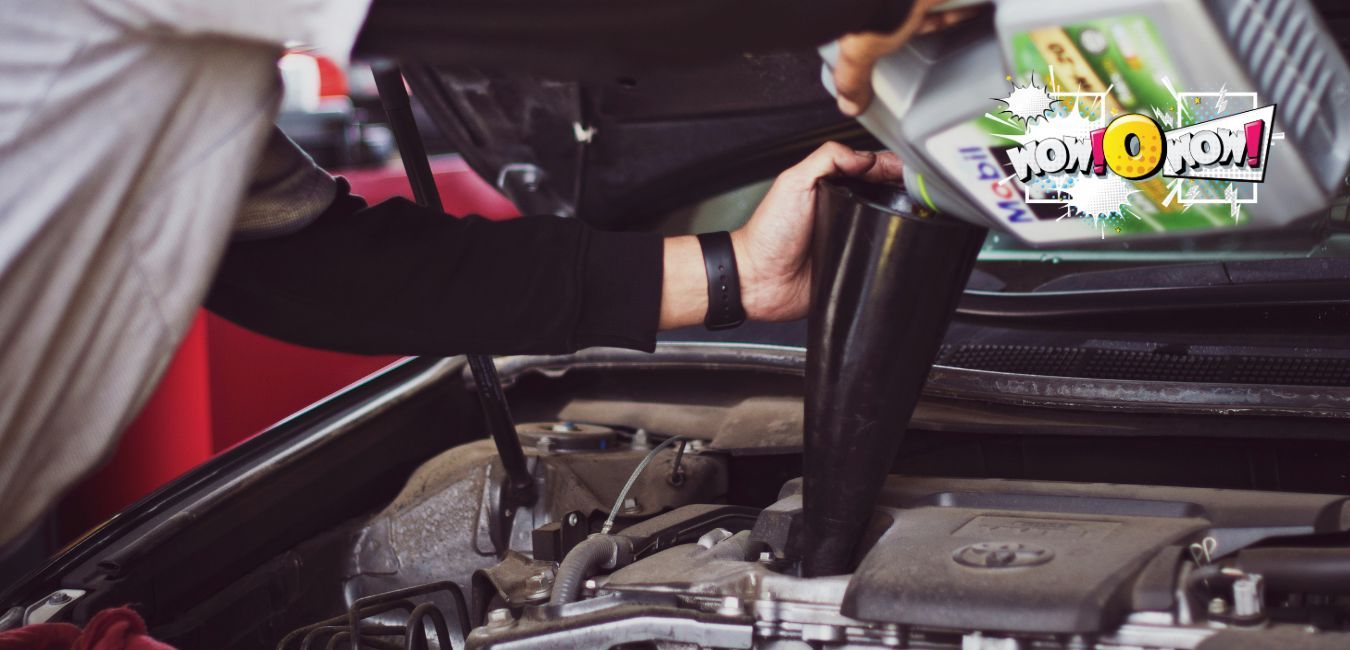
You change your oil by draining the old oil, replacing the filter, and refilling with the correct grade and amount, and it is a manageable job on many cars if you can safely get underneath. The whole job usually takes 30 to 45 minutes once you have the gear, and the biggest one-time hurdle for a beginner is simply getting the car high enough to work under safely. The part that ruins it for beginners is skipping the new crush washer or overtightening the drain plug, so work carefully.
Caution: drained oil is hot enough to scald, and a car must be supported properly before you get under it. Never rely on a jack alone.
- Warm the engine for a minute so the oil flows out cleanly, then shut it off and let it cool enough to work safely.
- Raise the car on ramps or on jack stands, never a jack alone, and confirm it is stable.
- Put a drain pan underneath, remove the drain plug, and let the old oil drain completely.
- Remove the old oil filter, wipe the seat clean, lightly oil the new filter’s gasket, and thread the new filter on.
- Reinstall the drain plug with a new crush washer, snug to the correct torque, not overtightened.
- Add the exact amount and grade of new oil the manual specifies, then check the level on the dipstick.
- Run the engine briefly, check underneath for leaks, recheck the level, and take the used oil to a recycling center.
Used oil is recyclable and should never go in the trash or a drain; most auto parts stores and many service centers accept it free, and the EPA covers proper disposal. For the gear and a printable list, see the tools needed for an oil change and our oil-change checklist. Two mistakes cause most DIY leaks: forgetting the new crush washer, which lets the drain plug seep, and double-gasketing, where the old filter’s rubber seal sticks to the engine and the new filter seals against it instead of the block. Check that the old gasket came off with the old filter before fitting the new one. Leave the job to a shop, and use a certified technician you can find through ASE, if you can’t lift the car safely, if the drain plug or filter is stuck or stripped, or if your car needs a special filter housing or reset procedure you’re not set up for.
Does the oil filter need changing every time?
Yes, you should replace the oil filter at every oil change, and reputable shops always do. The filter’s whole job is to trap the metal particles, soot, and grit that the oil picks up as it circulates, and a filter that has been doing that for a full interval is loaded with the very contaminants you are trying to remove. Put fresh oil in over an old filter and it gets dirty far faster, and a clogged filter can even restrict oil flow.
Filters are inexpensive, so there is no real saving in reusing one. Most engines use a spin-on canister filter that threads off and on, while many newer cars use a replaceable paper cartridge that sits inside a housing, which is a little more involved but the same idea. Whichever type your car has, the new filter goes on with a light smear of fresh oil on its gasket so it seals cleanly and comes off easily next time. The bigger risk is a filter that is never changed at all: a neglected filter eventually clogs and forces oil through a bypass valve unfiltered, letting grit circulate through the engine. That is one more reason the filter is not the corner to cut. If a shop ever quotes an “oil change” that pointedly leaves the filter out to hit a low price, treat that as a red flag rather than a bargain, because a fresh-oil-old-filter service is a false economy that shortens the oil’s useful life.
What happens if I overfill, underfill, or use the wrong oil?
Overfilling, running low, and using the wrong oil each cause a distinct problem, and none of them is harmless. Overfilling lets the spinning crankshaft whip the oil into foam, which the pump can’t circulate properly, so parts don’t get lubricated and seals can be stressed. A small overfill of a quarter-inch on the dipstick is usually nothing to panic about, but a half-quart or more over the full mark is worth draining, especially if you notice foamy oil on the dipstick, a rougher idle, or blue-tinged exhaust smoke. Running low starves the engine of oil and is the more dangerous of the two. The table sorts them out.
| Problem | What it causes | What to do |
|---|---|---|
| Overfilled | Foaming and aeration, poor lubrication, possible seal stress | Drain the excess, or have a shop do it if you can’t cleanly |
| Too low / run low | Oil starvation, overheating, bearing and engine damage | Add oil to the correct level, then find why it dropped |
| Wrong viscosity | Reduced flow or protection, worst in temperature extremes | Correct it at the next change; use the specified grade |
| Wrong spec (e.g., non-dexos where required) | Can affect emissions parts, warranty, and long-term wear | Switch to the manual’s spec going forward |
Have a shop drain an overfill if you can’t do it cleanly, and leave things to a mechanic the moment the oil-pressure light comes on and stays on, because driving with lost oil pressure can destroy an engine in minutes. A small viscosity mismatch caught quickly is usually not a disaster, but it should be corrected. The wrong-spec case is subtler than the others: a modern car that requires a dexos or similar approval can run for a while on a non-approved oil without an obvious symptom, but over time it can affect emissions components and, if a warranty claim arises, give the manufacturer a reason to push back. That is why matching the spec, not just the viscosity, is worth the small effort. For the specifics, see what happens if you put too much oil in your car and what happens if you put the wrong oil in.
Why is my car leaking or burning oil?
A car that keeps losing oil is either leaking it or burning it, and where the oil goes tells you which. A puddle under the car points to a leak from a gasket or seal; blue smoke from the exhaust points to oil burning inside the engine; and oil that vanishes with neither a puddle nor smoke is usually a slow burn or a small leak that cooks off on hot parts.
| Sign | Likely cause |
|---|---|
| Puddle under the car | Leaking gasket or seal — valve cover, oil pan, drain plug, filter, or rear main seal |
| Blue smoke from the exhaust | Burning oil — worn piston rings or valve seals, or a bad PCV valve |
| Oil low with no puddle or smoke | A slow burn, or a leak that evaporates on hot components |
| Oil appears right after a change | Loose drain plug or filter, a missing crush washer, or a double gasket |
Caution: oil dripping onto a hot exhaust or engine can start a fire and is the usual source of a burning-oil smell, so a leak that reaches hot parts is not something to leave. It helps to know where the common leaks come from. A valve-cover gasket leaks at the top of the engine and often drips down onto hot parts, which is why it smells; an oil-pan gasket or drain plug leaks at the very bottom and leaves a puddle; and a rear main seal leaks where the engine meets the transmission and is the most labor-intensive to fix. Burning oil, by contrast, happens inside the engine when worn piston rings or valve seals let oil into the combustion chamber, or when a stuck PCV valve raises crankcase pressure and pushes oil past the seals. To narrow it down, see whether your car is losing oil with no leak or smoke, how to stop a car from burning oil, whether it is normal for an old car to leak oil, and why a car might leak oil right after an oil change. The smell itself is covered in how to get rid of a burning-oil smell, and leaks after a collision in post-accident oil leaks. Gasket and seal repair costs vary widely by engine and by how buried the seal is, so get a quote for yours rather than trusting a flat figure.
Can low oil damage or stall my engine?
Yes, low oil can damage and even stall an engine, because oil is what keeps metal parts from grinding together. Run low enough and the engine overheats, the bearings wear, and in a severe case it can seize entirely. This is why the oil warning matters so much, and why it is worth knowing exactly which light you are looking at.
Caution — the light that means stop: the red oil-pressure light, usually shaped like an oil can, is not the oil-change reminder. It means the engine has lost oil pressure right now. If it comes on, pull over as soon as it is safe and shut the engine off, because continuing to drive can destroy the engine in minutes. The oil-change reminder or “oil life” message, by contrast, is just a maintenance nudge and does not require you to stop. The difference is worth understanding: oil level is how much oil is in the pan, while oil pressure is whether the pump is pushing that oil through the engine under enough force. You can have a full pan and still lose pressure if the pump or a passage fails, and you can lose pressure simply because the level dropped too low. Either way, the red light means the moving parts may be running dry, which is what seizes an engine. If a weak or empty oil supply is making your car cut out, see whether low oil can cause a car to shut off. When in doubt about a red oil light, treat it as the serious one and stop.
What are the signs I need an oil change?
The clearest sign you need an oil change is your car telling you, through the oil-life monitor or a change-reminder light, but there are physical signs too. Because oil degrades with both mileage and time, watch for these together rather than waiting for a single one:
- The oil-life monitor or change-reminder light. On cars that have one, this is the most reliable signal.
- Dark, dirty, or gritty oil on the dipstick, or a level that keeps dropping.
- You’ve reached the manual’s mileage or the one-year mark, whichever comes first.
- The engine sounds louder or rougher, since fresh oil quiets the valvetrain.
- A burning-oil smell or exhaust smoke, which also warrants checking for a leak or burning.
None of these should be ignored, but none is an emergency the way a red oil-pressure light is. If your oil looks fine but a reminder is on, the reminder is usually right, since it tracks how the car has actually been driven. It is a common mistake to reset the reminder and keep driving because the oil “looks okay,” but the monitor is judging the oil’s actual condition from how the car has been used, which your eyes cannot. What the percentage on that reminder actually measures is a common question, answered below and in what the oil life percentage means.
What happens if you never change your oil?
Never changing your oil eventually destroys the engine, and it is one of the most expensive avoidable failures a car can have. As oil ages it thickens, loses its additives, and turns to sludge, so it can no longer lubricate, cool, or clean properly. Once that happens, wear accelerates across every moving part at once.
The failure progresses in stages. First, dirty oil makes the engine run hotter and noisier as friction climbs. Then sludge clogs the narrow oil passages, starving parts of oil even when the level looks fine. Left long enough, bearings wear out, components overheat, and the engine can seize entirely, which usually means a rebuild or replacement costing thousands. A missed oil change now and then does not do this; it is sustained neglect over tens of thousands of miles that kills an engine. The oil filter matters here too, because a clogged filter lets contaminants recirculate. What makes this failure so frustrating is how avoidable it is: an oil change costs a fraction of what an engine does, yet a skipped one is invisible until the damage is already done, since sludge builds silently while the car still runs fine day to day. For the full picture, see what happens if you don’t change your oil and what happens if you don’t change the oil filter. The takeaway is simple: an oil change is cheap, and the engine it protects is not.
How long does an oil change take, and what does it cost?
An oil change takes about 30 to 45 minutes and costs roughly $35 to $125, with the price driven mostly by the oil type and your vehicle. Conventional is cheapest, full synthetic costs more, and large-sump, European, or performance engines cost more again. The single biggest swing is the oil itself: a full-synthetic car with a large capacity uses more of a pricier oil, which is why two oil changes at the same shop can differ by fifty dollars or more. Every figure below varies by region and vehicle, so confirm a local quote.
| Option | Typical range (verify locally) |
|---|---|
| Conventional oil change (shop) | ~$35–$75 |
| Synthetic-blend change (shop) | ~$50–$90 |
| Full-synthetic change (shop) | ~$65–$125+ |
| DIY (oil + filter) | ~$25–$50 |
| Easy-to-miss extras | New crush washer, correct filter, used-oil disposal |
DIY saves the labor but adds the hassle of lifting the car and recycling the oil, and the true saving is smaller once you count a new filter and crush washer. Where you go changes the price too: a dealer typically charges more than an independent shop or a quick-lube, though a dealer is worth it while a car is under warranty or needs a specific oil-life reset. Watch that a cheap advertised price is for conventional oil and the correct one for your car may be synthetic, which is the real number to compare. Some vehicles are simply expensive to service because of large synthetic capacities or awkward filter placement, which is why a Porsche oil change costs so much. For how the time breaks down, see how long it takes to change oil. If your car needs a specialty filter or a monitor reset you’re not equipped for, a shop is the sensible call.
Frequently asked questions
Is the 3,000-mile oil change still a thing?
No, not for modern cars. The 3,000-mile rule dates to older engines and simpler oils; today’s engines running synthetic often go 7,500 to 10,000 miles or more. Follow your owner’s manual or the oil-life monitor instead of a windshield sticker, which usually has you changing oil far more often than necessary.
Can I mix synthetic and conventional oil?
Yes, mixing them will not harm your engine. They are compatible, so topping up with whatever is on hand in a pinch is fine. The catch is that adding conventional to synthetic dilutes the synthetic’s longer-lasting, higher-heat benefits, so at your next full change go back to the grade and type your manual specifies.
What does the oil life percentage actually measure?
It measures an estimate, not a direct test of the oil. Most oil-life monitors run an algorithm based on how you drive: mileage, engine temperature, speeds, and cold starts. A few use an actual oil sensor. Either way it is predicting how used up the oil is from driving conditions, which is usually more accurate than a fixed mileage number.
Is it bad to go a little over the oil change interval?
A small overrun is usually fine. Going a few hundred miles past the interval now and then will not wreck a healthy engine. The damage comes from sustained neglect, thousands of miles late or skipping changes for years, which lets oil turn to sludge and accelerates wear. Treat the interval as a real deadline, not a hard cliff, but don’t lean on that.
Do I have to use synthetic if my car came with it?
Yes. If your manufacturer specifies full synthetic, use full synthetic, and don’t downgrade to conventional to save money. Synthetic is required for a reason on modern turbo and direct-injection engines, and using a lesser oil can reduce protection, affect emissions equipment, and jeopardize your warranty.
How do I know how much oil my car takes?
Your engine’s oil capacity is listed in the owner’s manual, usually somewhere between 4 and 6 quarts for a typical car, though larger engines hold more. Don’t just pour in a set number, though: add most of it, then use the dipstick to reach the full mark without passing it, since the exact amount changes slightly depending on how much drained out and whether you replaced the filter.
What to do now
Start with whatever brought you here. If you’re due, change the oil on your manual’s schedule or when the monitor says, using the grade and spec your manual lists, not a generic 3,000-mile habit. If you have a leak, work out whether the oil is puddling, smoking, or vanishing, and route from there. If you overfilled, drain the excess back to the full mark. If a warning light is on, be sure which one it is: an oil-life reminder is a maintenance nudge, but a red oil-pressure light is not. And the one rule that outranks the rest: a red oil-pressure light means stop the engine and pull over safely, because that is the difference between a cheap fix and a ruined engine. Keep the basics simple, check your oil monthly, change it on schedule with the right grade, and replace the filter each time, and the engine will almost always outlast the worry. For everything on keeping your car healthy, see the complete automotive care hub.
